Kumuyi Daniel O, Akinnawo Ebenezer O, Akpunne Bede C, Akintola Aderonke A, Onisile Deborah F, Aniemeka Onyeka O
Department of Behavioural Studies, Faculty of Social Sciences, Redeemer's University, Ede, Osun State, Nigeria.
Department of Nursing Science, Faculty of Basic Medical Sciences, Redeemer's University, Ede Osun State, Nigeria.
S Afr J Psychiatr. 2022 Jul 22;28:1737. doi: 10.4102/sajpsychiatry.v28i0.1737. eCollection 2022.
Conduct Disorder (CD) is a repetitive disruptive behaviour that violates the rights of others, manifests in rules violation, aggression, hostility, and deceitfulness and has assumed prominence in its association with juvenile offending and criminality in adulthood. Despite this knowledge, little research attention is given to ascertaining effective psychobehavioural interventions to manage this problem, especially amongst Nigerian adolescents.
This study examined the efficacy of two psychobehavioural strategies to manage CD amongst in-school adolescents in Ibadan, Nigeria.
Ibadan, Southwestern Nigeria.
A randomised controlled trial (RCT) of adolescents with CD was performed. Sixteen participants (aged 12-17 years) who reported high CD from an assessment of 1006 in-school adolescents of selected secondary schools in Ibadan were randomly grouped to receive either cognitive behavioural therapy (CBT), social skills training (SST) or combined CBT and SST. The Frequency of Delinquent Behaviour Scaling Instrument (FDBSI) was used for assessments.
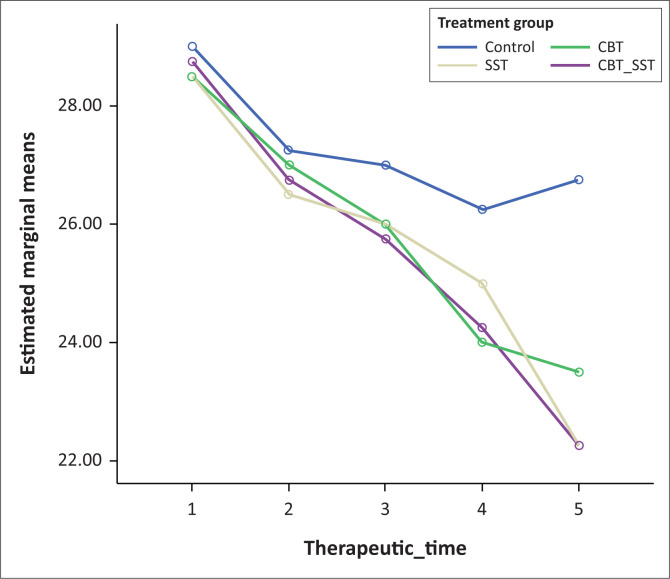
Significant reduction in CD was observed among participants exposed to CBT ([6] = 8.510), < 0.05) at 8 weeks, SST ([6] = 12.728), < 0.05) at 8 weeks, and combined CBT and SST ([8] = 12.728, < 0.05) at the 6 week mark of interventions respectively.
From the study, CBT and SST are effective in managing CD. However, the combined psychobehavioural intervention of CBT and SST was more effective in managing CD, based on a faster therapeutic effect than the independent psychobehavioural intervention of CBT and SST.
品行障碍(CD)是一种重复性的破坏性行为,侵犯他人权利,表现为违反规则、攻击性、敌意和欺骗性,并且在与青少年犯罪及成年期犯罪的关联中显得尤为突出。尽管有这些认知,但对于确定管理这一问题的有效心理行为干预措施,尤其是在尼日利亚青少年中,研究关注较少。
本研究考察了两种心理行为策略对尼日利亚伊巴丹在校青少年品行障碍的管理效果。
尼日利亚西南部的伊巴丹。
对患有品行障碍的青少年进行了一项随机对照试验(RCT)。从伊巴丹选定中学的1006名在校青少年的评估中筛选出16名报告有高度品行障碍的参与者(年龄在12 - 17岁),随机分组接受认知行为疗法(CBT)、社交技能训练(SST)或CBT与SST联合治疗。使用犯罪行为频率量表(FDBSI)进行评估。
在干预8周时,接受CBT的参与者([6] = 8.510,<0.05)、接受SST的参与者([6] = 12.728,<0.05)以及在干预6周时接受CBT与SST联合治疗的参与者([8] = 12.728,<0.05)的品行障碍均有显著减轻。
从该研究来看,CBT和SST对管理品行障碍有效。然而,基于比CBT和SST的独立心理行为干预更快的治疗效果,CBT与SST的联合心理行为干预在管理品行障碍方面更有效。