Cui Jiaxin, Lv Liting, Du Huibo, Cui Zhanling, Zhou Xinlin
College of Education, Hebei Normal University, Shijiazhuang, China.
State Key Laboratory of Cognitive Neuroscience and Learning, Faculty of Psychology, Beijing Normal University, Beijing, China.
Front Psychol. 2022 Jul 22;13:929719. doi: 10.3389/fpsyg.2022.929719. eCollection 2022.
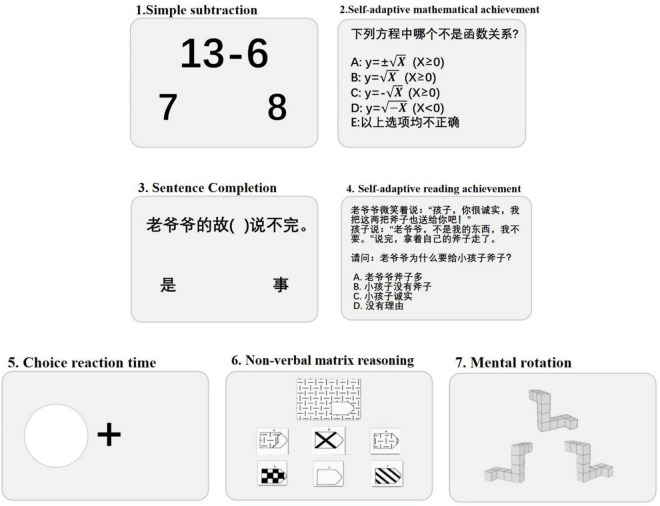
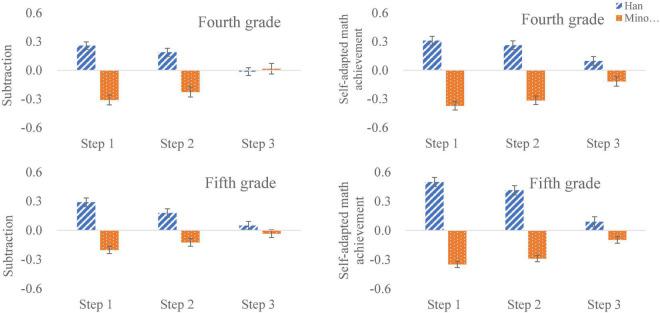
The mathematics achievement of minority students has always been a focal point of educators in China. This study investigated the differences in mathematics achievement between Han and minority pupils to determine if there is any cognitive mechanism that can account for the discrepancy. We recruited 236 Han students and 272 minority students (including Uygur and Kazak) from the same primary schools. They were tested on mathematics achievement, language abilities, and general cognitive abilities. The results showed that Han pupils had better mathematics achievement scores and better Chinese language ability than minority students. After controlling for age, gender, and general cognitive abilities, there were still significant differences in mathematics achievement between Han and minority students. However, these differences disappeared after controlling for language ability. These results suggest that the relatively poor levels of mathematics achievement observed in minority students is related to poor Chinese language skills.
少数民族学生的数学成绩一直是中国教育工作者关注的焦点。本研究调查了汉族和少数民族小学生在数学成绩上的差异,以确定是否存在任何认知机制可以解释这种差异。我们从同一所小学招募了236名汉族学生和272名少数民族学生(包括维吾尔族和哈萨克族)。对他们进行了数学成绩、语言能力和一般认知能力测试。结果表明,汉族小学生的数学成绩得分和汉语能力均优于少数民族学生。在控制了年龄、性别和一般认知能力后,汉族和少数民族学生在数学成绩上仍存在显著差异。然而,在控制了语言能力后,这些差异消失了。这些结果表明,少数民族学生数学成绩相对较差与汉语技能较差有关。