Brucks Désirée, Härterich Anna, König von Borstel Uta
Animal Husbandry, Behaviour and Welfare Group, Institute of Animal Breeding and Genetics, University of Giessen, Giessen, Germany.
Front Psychol. 2022 Jul 22;13:954472. doi: 10.3389/fpsyg.2022.954472. eCollection 2022.
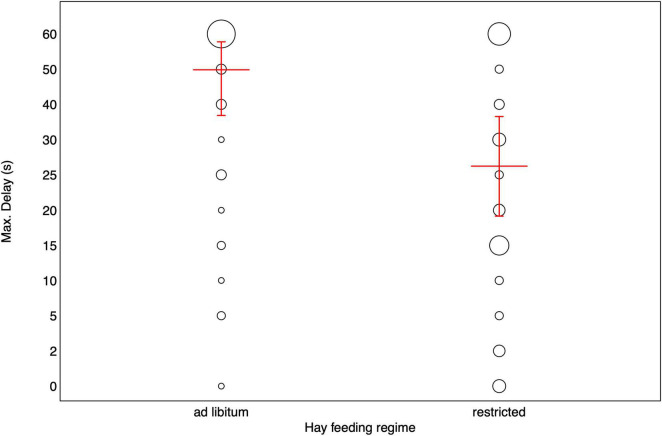
Self-control, defined as the ability to forgo immediate satisfaction in favor of better pay-offs in the future, has been extensively studied, revealing enormous variation between and within species. Horses are interesting in this regard because as a grazing species they are expected to show low self-control whereas its social complexity might be linked to high self-control abilities. Additionally, self-control may be a key factor in training and/or coping with potentially stressful husbandry conditions. We assessed horses' self-control abilities in a simplified delay of gratification test that can be easily implemented in a farm setting. In Experiment 1, we gave horses ( = 52) the choice between an immediately available low-quality reward and a delayed high-quality reward that could only be obtained if the horse refrained from consuming the immediate reward. Different experimenters ( = 30) that underwent prior training in the procedures, tested horses in two test phases either with their eyes visible or invisible (sunglasses). Twenty horses waited up to the maximum delay stage of 60 s while all horses performed worse in the second test phase. In Experiment 2, we improved the test procedure (i.e., one experimenter, refined criterion for success), and tested 30 additional horses in a quality and quantity condition (one reward vs. delayed bigger reward). Two horses successfully waited for 60 s (quality: = 1, quantity: = 1). Horses tolerated higher delays, if they were first tested in the quantity condition. Furthermore, horses that were fed hay , instead of in a restricted manner, reached higher delays. Coping behaviors (e.g., looking away, head movements, pawing, and increasing distance to reward) facilitated waiting success and horses were able to anticipate the upcoming delay duration as indicated by non-random distributions of giving-up times. We found no correlations between owner-assessed traits (e.g., trainability and patience) and individual performance in the test. These results suggest that horses are able to exert self-control in a delay of gratification paradigm similar to other domesticated species. Our simplified paradigm could be used to gather large scale data, e.g., to investigate the role of self-control in trainability or success in equestrian sports.
自我控制被定义为能够为了未来更好的回报而放弃即时满足感,这一概念已得到广泛研究,结果显示物种之间以及物种内部都存在巨大差异。马在这方面很有趣,因为作为食草动物,它们预计表现出较低的自我控制能力,而其社会复杂性可能与较高的自我控制能力相关。此外,自我控制可能是训练和/或应对潜在压力饲养条件的关键因素。我们在一个简化的延迟满足测试中评估了马的自我控制能力,该测试可以在农场环境中轻松实施。在实验1中,我们让马(n = 52)在即时可得的低质量奖励和延迟的高质量奖励之间做出选择,只有当马克制住不食用即时奖励时才能获得延迟的高质量奖励。30位不同的实验者(n = 30)事先接受了程序培训,在两个测试阶段对马进行测试,测试时马的眼睛可视或不可视(佩戴太阳镜)。20匹马等待到了60秒的最大延迟阶段,而所有马在第二个测试阶段的表现都更差。在实验2中,我们改进了测试程序(即由一名实验者,完善成功标准),并在质量和数量条件下(一个奖励与延迟的更大奖励)对另外30匹马进行了测试。两匹马成功等待了60秒(质量条件下:n = 1,数量条件下:n = 1)。如果马首先在数量条件下进行测试,它们能够忍受更长的延迟。此外,自由采食干草而非限量喂食的马能够达到更长的延迟。应对行为(例如,看向别处、头部移动、刨地以及增加与奖励的距离)有助于等待成功,并且马能够预测即将到来的延迟持续时间,这从放弃时间的非随机分布可以看出。我们发现主人评估的特质(例如,可训练性和耐心)与测试中的个体表现之间没有相关性。这些结果表明,马能够在类似于其他家养物种的延迟满足范式中发挥自我控制能力。我们的简化范式可用于收集大规模数据,例如,研究自我控制在可训练性或马术运动成功中的作用。