Sindhu D M, Huddar Akshata, Saini Jitender, Vengalil Seena, Nashi Saraswati, Bardhan Mainak, Unnikrishnan Gopikrishnan, Rajula Rahul Reddy, Kandavel Thennarasu, Bathala Lokesh, Visser Leo H, Nalini Atchayaram
Department of Neurology, National Institute of Mental Health and Neurosciences, Bengaluru, Karnataka, India.
Department of Neuro Imaging and Interventional Radiology, National Institute of Mental Health and Neurosciences, Bengaluru, Karnataka, India.
Ann Indian Acad Neurol. 2022 May-Jun;25(3):449-456. doi: 10.4103/aian.aian_727_21. Epub 2022 Apr 1.
Cross-sectional area (CSA) is the most important parameter to study peripheral nerves by high-resolution ultrasonography. The aim was to acquire normative data of CSA of the main upper and lower limb nerves in the Indian population.
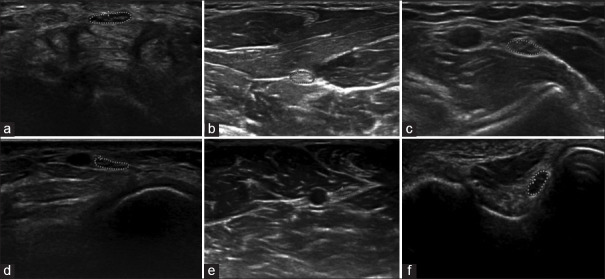
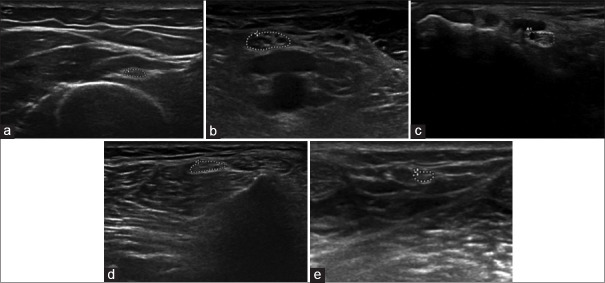
CSA of nerves was determined in 100 healthy volunteers at 11 predetermined sites: median and ulnar at the wrist, mid-forearm, elbow; radial (spiral groove); tibial (popliteal fossa, medial malleolus); common peroneal (CPN, fibular head) and sural (lateral malleolus).
The mean age of participants was 40.7 ± 13.0 years (range: 18-79). Fifty were < 40 years of age. The mean height, weight and BMI were 161.5 ± 8.3 centimeters (range: 145-179), 58.6 ± 10.1 kilograms (range: 32-90) and 22.4 ± 3.2 kilogram/square meter (range: 14.03-30.44), respectively. The median and ulnar nerve measurements were non-uniform throughout its course, and the CSA was largest at the elbow and ulnar groove, respectively. With advancing age, there was a significant difference for median and ulnar nerves at the wrist (median = 0.002, ulnar = 0.009) and tibial nerve (popliteal fossa, = 0.045, medial malleolus, = 0.005), CPN ( = 0.047). Men had greater CSA of upper limb nerves and tibial nerves at popliteal fossa ( < 0.05) as compared to women. A positive correlation was noted with weight.
It is apt for every defined population to have its own set of normative data of CSA as it varies with ethnicity, age, and the built of individuals. We provide a valuable set of CSA data for nerves in the Indian population, which can be used for comparison while investigating peripheral nerve disorders.
横截面积(CSA)是通过高分辨率超声研究周围神经的最重要参数。目的是获取印度人群主要上肢和下肢神经CSA的标准数据。
在100名健康志愿者的11个预定部位测定神经CSA:腕部、前臂中部、肘部的正中神经和尺神经;桡神经(螺旋沟);胫神经(腘窝、内踝);腓总神经(CPN,腓骨头)和腓肠神经(外踝)。
参与者的平均年龄为40.7±13.0岁(范围:18 - 79岁)。50人年龄小于40岁。平均身高、体重和BMI分别为161.5±8.3厘米(范围:145 - 179)、58.6±10.1千克(范围:32 - 90)和22.4±3.2千克/平方米(范围:14.03 - 30.44)。正中神经和尺神经在其全程的测量值不均匀,CSA分别在肘部和尺神经沟处最大。随着年龄增长,腕部的正中神经和尺神经(正中神经 = 0.002,尺神经 = 0.009)、胫神经(腘窝, = 0.045,内踝, = 0.005)、腓总神经( = 0.047)存在显著差异。与女性相比,男性上肢神经和腘窝处胫神经的CSA更大(<0.05)。与体重呈正相关。
由于CSA因种族、年龄和个体体格而异,每个特定人群都应有自己的CSA标准数据集。我们为印度人群的神经提供了一组有价值的CSA数据,可用于在研究周围神经疾病时进行比较。