Liu Boyu, Fu Dianxun, Fan Yong, Wang Zhe, Lang Xu
Department of Radiology, Tianjin Medical University General Hospital, Anshan Road 154#, Heping District, Tianjin, 300052, China.
J Interv Med. 2022 Mar 20;5(2):89-94. doi: 10.1016/j.jimed.2022.03.010. eCollection 2022 May.
Irreversible electroporation (IRE) is a nonthermal ablation technique for the treatment of malignant liver tumors. IRE has demonstrated efficacy and safety in the treatment of malignant liver tumors and its unique advantages in the treatment of nearby vascular lesions. This study aimed to compare the efficacy, safety, and intermediate-term outcomes of IRE and radiofrequency (RF) therapy in malignant liver tumors.
Twenty-four patients with primary or secondary liver malignancies were included in this prospective, double-arm clinical trial. Patients were randomly divided into the IRE and RF groups. The primary outcome was the efficacy (local ablation control evaluation at 90 days). The secondary outcomes were safety (procedure-related complications at ≤ 90 days) and intermediate-term survival (at 24 months).
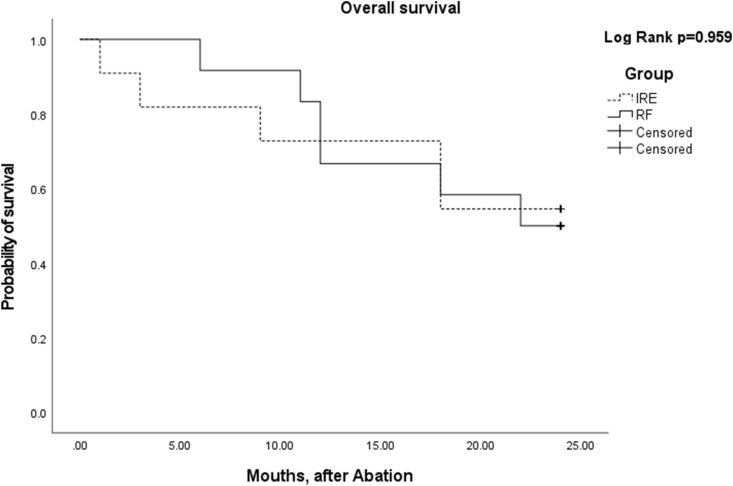
The ablation assessment at 90 days after surgery with mRECIST for IRE versus RF were 70%, 20%, 0%, and 10% versus 92.9%, 7.1%, 0%, and 0% (CR, PR, SD, and PD, respectively). The complication rates of IRE versus RF with Clavien-Dindo classification were 16.7%, 25%, 0%, 8.3%, and 8.3% versus 8.3%, 50%, 0%, 0%, and 0% (Grade I, II, III, IV, and V, respectively). The average overall survival (OS) was 17.55 months in the IRE group (95% CI 15.13-22.37) and 18.75 months in the RF group (95% CI 12.48-22.61). There was no statistical difference between the IRE and RF groups in terms of efficacy (p = 0.48), safety(p = 0.887), or 24-month OS (p = 0.959).
IRE ablation revealed similar efficacy and safety in a short-term follow-up, and similar OS in mid-term survival as RF ablation in treating malignant hepatic tumors.
不可逆电穿孔(IRE)是一种用于治疗恶性肝肿瘤的非热消融技术。IRE已在恶性肝肿瘤治疗中展现出疗效和安全性,且在治疗附近血管病变方面具有独特优势。本研究旨在比较IRE与射频(RF)治疗恶性肝肿瘤的疗效、安全性及中期结果。
本前瞻性双臂临床试验纳入了24例原发性或继发性肝恶性肿瘤患者。患者被随机分为IRE组和RF组。主要结局为疗效(90天时局部消融控制评估)。次要结局为安全性(≤90天时与手术相关的并发症)和中期生存率(24个月时)。
IRE组与RF组术后90天采用mRECIST进行消融评估,结果分别为70%、20%、0%、10% 与92.9%、7.1%、0%、0%(分别为完全缓解、部分缓解、疾病稳定和疾病进展)。IRE组与RF组采用Clavien-Dindo分类法的并发症发生率分别为16.7%、25%、0%、8.3%、8.3% 与8.3%、50%、0%、0%、0%(分别为I级、II级、III级、IV级和V级)。IRE组的平均总生存期(OS)为17.55个月(95%可信区间15.13 - 22.37),RF组为18.75个月(95%可信区间12.48 - 22.61)。IRE组与RF组在疗效(p = 0.48)、安全性(p = 0.887)或24个月总生存期(p = 0.959)方面无统计学差异。
在短期随访中,IRE消融在治疗恶性肝肿瘤方面显示出与RF消融相似的疗效和安全性,中期生存的总生存期也相似。