Chen Yanhong, Wang Lijun, Luo Ran, Wang Shuang, Wang Heng, Gao Fei, Wang Dengbin
Department of Radiology, Xinhua Hospital Affiliated to Shanghai Jiao Tong University School of Medicine, Shanghai, China.
Department of Medicine, Beijing Medicinovo Technology Co., Ltd., Beijing, China.
Front Oncol. 2022 Jul 22;12:943415. doi: 10.3389/fonc.2022.943415. eCollection 2022.
The study aims to investigate the value of a convolutional neural network (CNN) based on dynamic contrast-enhanced magnetic resonance imaging (DCE-MRI) in predicting malignancy of breast lesions.
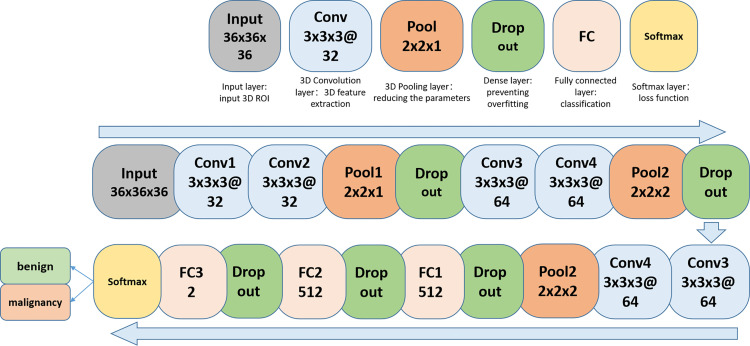
We developed a CNN model based on DCE-MRI to characterize breast lesions. Between November 2018 and October 2019, 6,165 slices of 364 lesions (234 malignant, 130 benign) in 364 patients were pooled in the training/validation set. Lesions were semi-automatically segmented by two breast radiologists using ITK-SNAP software. The standard of reference was histologic consequences. Algorithm performance was evaluated in an independent testing set of 1,560 slices of 127 lesions in 127 patients using weighted sums of the area under the curve (AUC) scores.
The area under the receiver operating characteristic (ROC) curve was 0.955 for breast cancer prediction while the accuracy, sensitivity, and specificity were 90.3, 96.2, and 79.0%, respectively, in the slice-based method. In the case-based method, the efficiency of the model changed by adjusting the standard for the number of positive slices. When a lesion with three or more positive slices was determined as malignant, the sensitivity was above 90%, with a specificity of nearly 60% and an accuracy higher than 80%.
The CNN model based on DCE-MRI demonstrated high accuracy for predicting malignancy among the breast lesions. This method should be validated in a larger and independent cohort.
本研究旨在探讨基于动态对比增强磁共振成像(DCE-MRI)的卷积神经网络(CNN)在预测乳腺病变恶性程度方面的价值。
我们开发了一种基于DCE-MRI的CNN模型来表征乳腺病变。在2018年11月至2019年10月期间,将364例患者的364个病变(234个恶性,130个良性)的6165层图像纳入训练/验证集。两名乳腺放射科医生使用ITK-SNAP软件对病变进行半自动分割。参考标准为组织学结果。使用曲线下面积(AUC)分数的加权总和,在127例患者的127个病变的1560层图像的独立测试集中评估算法性能。
在基于切片的方法中,乳腺癌预测的受试者操作特征(ROC)曲线下面积为0.955,而准确率、敏感性和特异性分别为90.3%、96.2%和79.0%。在基于病例的方法中,通过调整阳性切片数量的标准来改变模型的效率。当将具有三个或更多阳性切片的病变判定为恶性时,敏感性高于90%,特异性接近60%,准确率高于80%。
基于DCE-MRI的CNN模型在预测乳腺病变恶性程度方面显示出较高的准确性。该方法应在更大的独立队列中进行验证。