Bi Yonghua, Du Tianfeng, Pan Wenting, Tang Fan, Wang Yang, Jiao Dechao, Han Xinwei, Ren Jianzhuang
Department of Interventional Radiology, The First Affiliated Hospital of Zhengzhou University, Zhengzhou, China.
Department of Stomatology, The First Affiliated Hospital of Zhengzhou University, Zhengzhou, China.
Front Oncol. 2022 Jul 22;12:831583. doi: 10.3389/fonc.2022.831583. eCollection 2022.
We reported the long-term outcomes of transcatheter chemoembolization (TACE) for patients with late-stage or recurrent oral carcinoma.
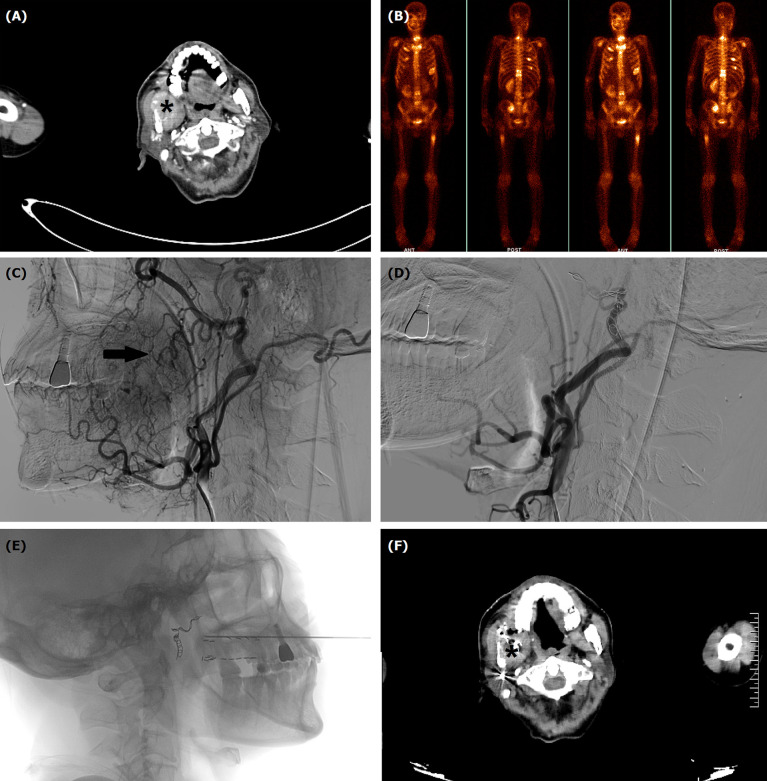
This retrospective study enrolled 18 patients with late-stage or recurrent oral carcinoma between December 2015 and April 2021. The tumor-feeding artery was catheterized, and cisplatin/oxaliplatin and 5-FU/raltitrexed were infused with embolization using polyvinyl alcohol or gelatin sponge. Computed tomography was performed at about 1, 3, and 6 months after the procedure, and every 6 months after that. During the procedure and follow-up, procedure outcomes, complications, treatment efficacy, and overall survival were analyzed.
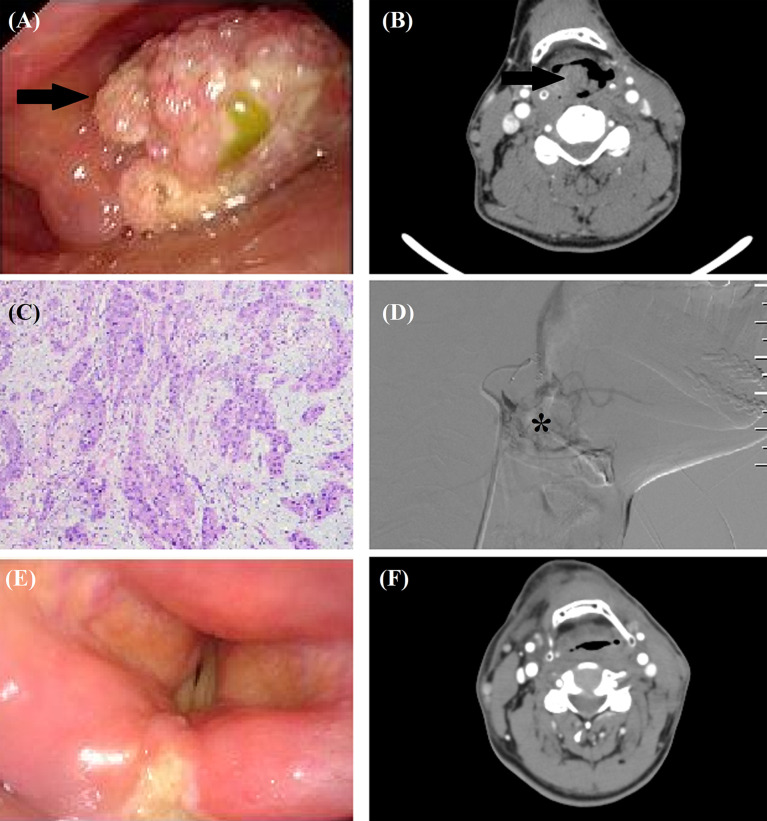
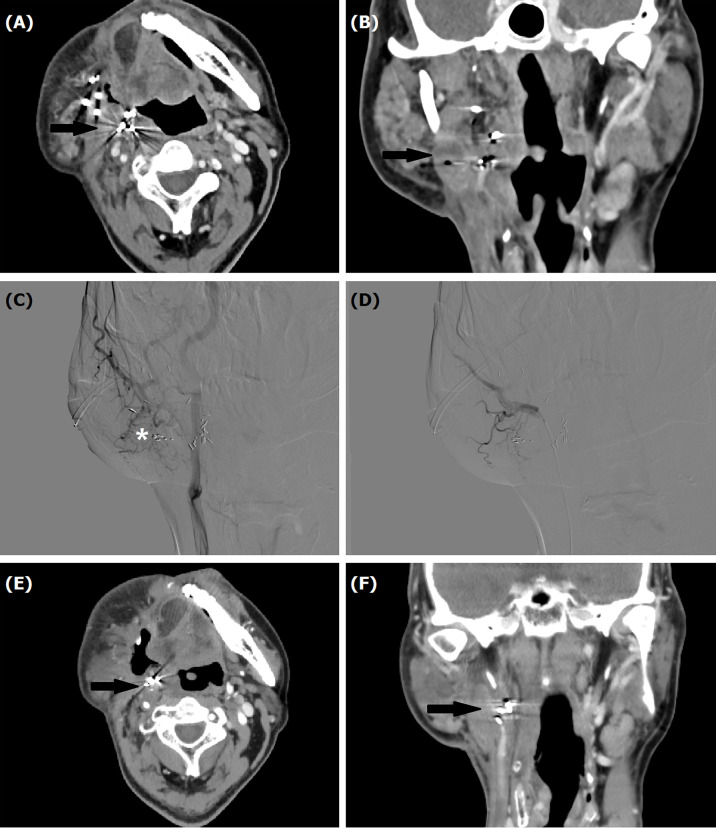
A total of 31 sessions of TACE were performed, with a technical success rate of 100%. Of 12 patients combined with oral hemorrhage, two patients showed rebleeding 35 and 37 days later, with a clinical efficiency of hemostasis of 88.9%. Mild complications were observed in 11 patients (61.1%). Severe complications or procedure-related deaths were not observed during or after the procedure. The objective response rate and disease control rate were 20.0% and 86.7%, 38.5% and 61.5%, and 25.0% and 50.0% at 1, 3, and 6 months later, respectively. Seventeen patients (94.4%) were followed up, with a median duration of 37.8 months (IQR 22.3-56.8). Nine patients died of tumor progression, one died of massive rebleeding, and one died of severe lung infection. The median overall survival was 23.8 months.
TACE is a safe and effective procedure with minimal invasiveness for treating late-stage or recurrent oral carcinoma. TACE can be recommended as a palliative treatment, particularly for patients with oral hemorrhage.
我们报告了经导管动脉化疗栓塞术(TACE)治疗晚期或复发性口腔癌患者的长期疗效。
这项回顾性研究纳入了2015年12月至2021年4月期间的18例晚期或复发性口腔癌患者。将导管插入肿瘤供血动脉,使用聚乙烯醇或明胶海绵进行栓塞的同时注入顺铂/奥沙利铂和5-氟尿嘧啶/雷替曲塞。在术后约1、3和6个月进行计算机断层扫描,之后每6个月进行一次。在手术过程和随访期间,分析手术结果、并发症、治疗效果和总生存期。
共进行了31次TACE手术,技术成功率为100%。12例合并口腔出血的患者中,2例分别在35天和37天后再次出血,止血临床有效率为88.9%。11例患者(61.1%)出现轻度并发症。手术期间或术后未观察到严重并发症或与手术相关的死亡。1、3和6个月后的客观缓解率和疾病控制率分别为20.0%和86.7%、38.5%和61.5%、25.0%和50.0%。17例患者(94.4%)接受了随访,中位随访时间为37.8个月(四分位间距22.3 - 56.8)。9例患者死于肿瘤进展,1例死于大量出血,1例死于严重肺部感染。中位总生存期为23.8个月。
TACE是一种安全有效的微创治疗晚期或复发性口腔癌的方法。TACE可作为一种姑息治疗方法推荐,特别是对于有口腔出血的患者。