Teze David, Bidart Gonzalo Nahuel, Welner Ditte Hededam
The Novo Nordisk Foundation Center for Biosustainability, Technical University of Denmark, Kongens Lyngby, Denmark.
Front Mol Biosci. 2022 Jul 22;9:909659. doi: 10.3389/fmolb.2022.909659. eCollection 2022.
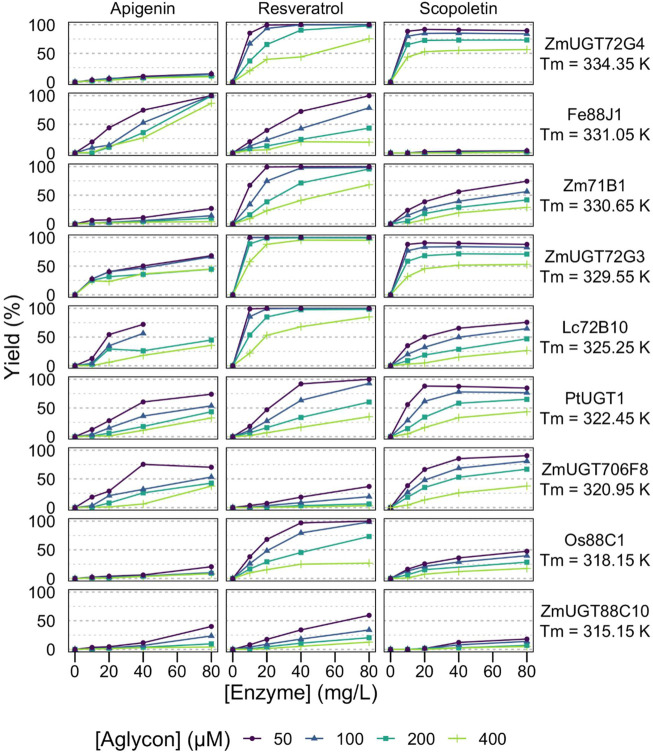
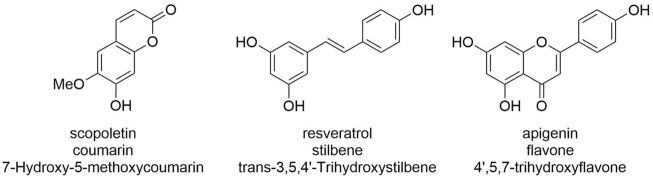
Glycosylation reactions are essential but challenging from a conventional chemistry standpoint. Conversely, they are biotechnologically feasible as glycosyltransferases can transfer sugar to an acceptor with perfect regio- and stereo-selectivity, quantitative yields, in a single reaction and under mild conditions. Low stability is often alleged to be a limitation to the biotechnological application of glycosyltransferases. Here we show that these enzymes are not necessarily intrinsically unstable, but that they present both dilution-induced inactivation and low chemostability towards their own acceptor substrates, and that these two phenomena are synergistic. We assessed 18 distinct GT1 enzymes against three unrelated acceptors (apigenin, resveratrol, and scopoletin-respectively a flavone, a stilbene, and a coumarin), resulting in a total of 54 enzymes: substrate pairs. For each pair, we varied catalyst and acceptor concentrations to obtain 16 different reaction conditions. Fifteen of the assayed enzymes (83%) displayed both low chemostability against at least one of the assayed acceptors at submillimolar concentrations, and dilution-induced inactivation. Furthermore, sensitivity to reaction conditions seems to be related to the thermal stability of the enzymes, the three unaffected enzymes having melting temperatures above 55°C, whereas the full enzyme panel ranged from 37.4 to 61.7°C. These results are important for GT1 understanding and engineering, as well as for discovery efforts and biotechnological use.
从传统化学角度来看,糖基化反应至关重要但颇具挑战性。相反,由于糖基转移酶能够在单一反应中、在温和条件下以完美的区域和立体选择性、定量产率将糖转移至受体,所以从生物技术角度而言是可行的。人们常称稳定性低是糖基转移酶生物技术应用的一个限制因素。在此我们表明,这些酶不一定本质上不稳定,而是它们既存在稀释诱导的失活现象,又对自身的受体底物具有低化学稳定性,并且这两种现象具有协同作用。我们针对三种不相关的受体(芹菜素、白藜芦醇和东莨菪素,分别为黄酮、芪类和香豆素)评估了18种不同的GT1酶,共得到54种酶 - 底物对。对于每一对,我们改变催化剂和受体浓度以获得16种不同的反应条件。所检测的15种酶(83%)在亚毫摩尔浓度下对至少一种所检测的受体表现出低化学稳定性以及稀释诱导的失活现象。此外,对反应条件的敏感性似乎与酶的热稳定性有关,三种未受影响的酶的解链温度高于55°C,而整个酶组的解链温度范围为37.4至61.7°C。这些结果对于GT1的理解和工程改造以及发现工作和生物技术应用都很重要。