Briel Sonia, Olivier Benita, Mudzi Witness
Department of Physiotherapy, Faculty of Health Sciences, University of the Witwatersrand, Johannesburg, South Africa.
S Afr J Physiother. 2022 Jul 25;78(1):1619. doi: 10.4102/sajp.v78i1.1619. eCollection 2022.
Scapular stability is primarily maintained through the action of the scapular stabilisers and not through bony stability. The values of the force couple ratios of the scapular stabilisers remain largely unknown.
To determine typical scapular force couple strength ratios in the pain-free shoulders of healthy female and male participants.
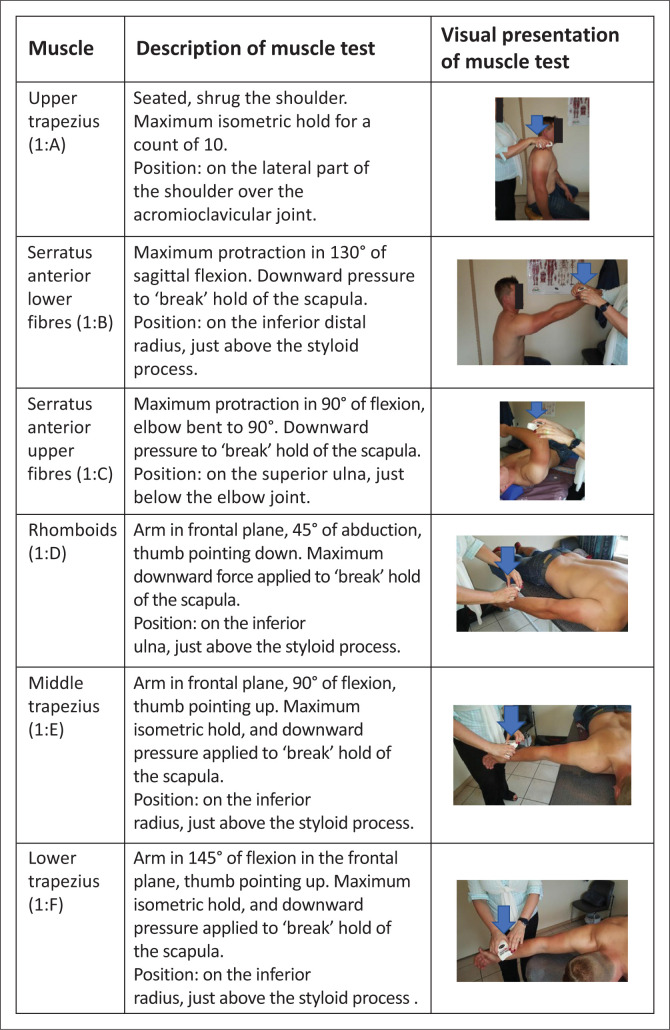
This was a quantitative cross-sectional study. The muscle strength of the serratus anterior upper and lower fibres, the upper, middle and lower trapezius and the rhomboids (in both shoulders) were determined in kilogram force (kgf) using a handheld dynamometer. The ratios of the force couples of the scapulae of both shoulders of the participants were calculated. Participants (both female and male) with healthy shoulders were recruited from the general public (a local university, schools, church groups and sport clubs). We mainly utilised descriptive analysis. Statistical significance was set at 5%.
Force couple ratios were as follows (means, with SD). Dominant arm in women: upper trapezius:lower trapezius 3.63 (0.97); serratus anterior lower fibres:lower trapezius = 1.97 (0.27); middle trapezius:serratus anterior upper fibres = 0.40 (0.10); serratus anterior lower fibres:rhomboids = 1.41 (0.21); lower trapezius:rhomboids = 0.74 (0.17). Dominant arm in men: upper trapezius:lower trapezius = 2.70 (0.72); serratus anterior lower fibres:lower trapezius = 2.15 (0.45); middle trapezius:serratus anterior upper fibres = 0.47 (0.12); serratus anterior lower fibres:rhomboids = 1.40 (0.31) and lower trapezius:rhomboids = 0.17 (0.6).
Specific force couple strength ratios were determined, between and within the nondominant and the dominant arms of the shoulders of healthy women and men.
Scapular stability is mainly maintained through the optimal force couple balance of the scapular stabilisers.
肩胛稳定性主要通过肩胛稳定肌的作用来维持,而非通过骨骼稳定性。肩胛稳定肌的力偶比值在很大程度上仍不为人知。
确定健康女性和男性无痛肩部的典型肩胛力偶强度比值。
这是一项定量横断面研究。使用手持测力计以千克力(kgf)为单位测定前锯肌上、下纤维、上、中、下斜方肌以及菱形肌(双侧肩部)的肌力。计算参与者双侧肩部肩胛的力偶比值。从普通人群(当地大学、学校、教会团体和体育俱乐部)中招募肩部健康的参与者(包括女性和男性)。我们主要采用描述性分析。设定统计学显著性水平为5%。
力偶比值如下(均值,标准差)。女性优势侧:斜方肌上束:斜方肌下束为3.63(0.97);前锯肌下纤维:斜方肌下束 = 1.97(0.27);斜方肌中束:前锯肌上纤维 = 0.40(0.10);前锯肌下纤维:菱形肌 = 1.41(0.21);斜方肌下束:菱形肌 = 0.74(0.17)。男性优势侧:斜方肌上束:斜方肌下束 = 2.70(0.72);前锯肌下纤维:斜方肌下束 = 2.15(0.45);斜方肌中束:前锯肌上纤维 = 0.47(0.12);前锯肌下纤维:菱形肌 = 1.40(0.31),斜方肌下束:菱形肌 = 0.17(0.6)。
确定了健康女性和男性肩部非优势侧和优势侧之间及内部的特定力偶强度比值。
肩胛稳定性主要通过肩胛稳定肌的最佳力偶平衡来维持。