Bartolomei Sandro, Grillone Giuseppe, Di Michele Rocco, Cortesi Matteo
Department of Biomedical and Neuromotor Sciences, University of Bologna, 40136 Bologna, Italy.
Department for Life Quality Studies, University of Bologna, 40136 Bologna, Italy.
J Funct Morphol Kinesiol. 2021 Feb 9;6(1):17. doi: 10.3390/jfmk6010017.
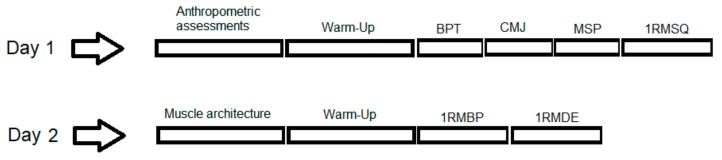
The aim of this study was to compare male vs. female athletes in strength and power performance relative to body mass (BM) and lean body mass (LBM) and to investigate the relationships between muscle architecture and strength in both genders. Sixteen men (age = 26.4 ± 5.0 years; body mass = 88.9 ± 16.6 kg; height = 177.6 ± 9.3 cm) and fourteen women (age = 25.1 ± 3.2 years; body mass = 58.1 ± 9.1 kg; height = 161.7 ± 4.8 cm) were tested for body composition and muscle thickness (MT) of vastus lateralis muscle (VT), pectoralis major (PEC), and trapezius (TRAP). In addition, participants were tested for lower body power at countermovement jump (CMJP) and upper-body power at bench press throw (BPT). Participants were also assessed for one repetition maximum (1RM) at bench press (1RMBP), deadlift (1RMDE), and squat (1RMSQ). Significantly greater ( < 0.01) MT of the VL, PEC and TRAP muscles and LBM were detected in men compared to women. Significantly greater ( < 0.05) 1RMBP and BPT adjusted for LBM were detected in men than in women. No significant gender differences after adjusting for LBM were detected for 1RMSQ ( = 0.945); 1RMDE ( = 0.472) and CMJP ( = 0.656). Significantly greater ( < 0.05) results in all performance assessments adjusted for MT of the specific muscles, were detected in males compared to females. Superior performances adjusted for MT and LBM in men compared to women, may be related to gender differences in muscle morphology and LBM distribution, respectively.
本研究的目的是比较男性与女性运动员在相对于体重(BM)和瘦体重(LBM)的力量和功率表现,并研究两性肌肉结构与力量之间的关系。对16名男性(年龄=26.4±5.0岁;体重=88.9±16.6千克;身高=177.6±9.3厘米)和14名女性(年龄=25.1±3.2岁;体重=58.1±9.1千克;身高=161.7±4.8厘米)进行了身体成分以及股外侧肌(VT)、胸大肌(PEC)和斜方肌(TRAP)肌肉厚度(MT)的测试。此外,对参与者进行了反向纵跳(CMJP)时的下肢功率和卧推投掷(BPT)时的上肢功率测试。还评估了参与者在卧推(1RMBP)、硬拉(1RMDE)和深蹲(1RMSQ)时的一次重复最大值(1RM)。与女性相比,男性的股外侧肌、胸大肌和斜方肌的MT以及LBM显著更大(<0.01)。调整LBM后,男性的1RMBP和BPT显著高于女性(<0.05)。调整LBM后,1RMSQ(=0.945)、1RMDE(=0.472)和CMJP(=0.656)未发现显著的性别差异。与女性相比,在针对特定肌肉的MT进行调整后的所有性能评估中,男性的结果显著更高(<0.05)。与女性相比,男性在针对MT和LBM调整后的优越表现可能分别与肌肉形态和LBM分布的性别差异有关。