School of Cognitive Sciences, Institute for Research in Fundamental Sciences (IPM), Tehran, Iran.
Division of Cerebral Circuitry, National Institute for Physiological Sciences (NIPS), Okazaki, Japan.
Front Neural Circuits. 2022 Jul 22;16:933201. doi: 10.3389/fncir.2022.933201. eCollection 2022.
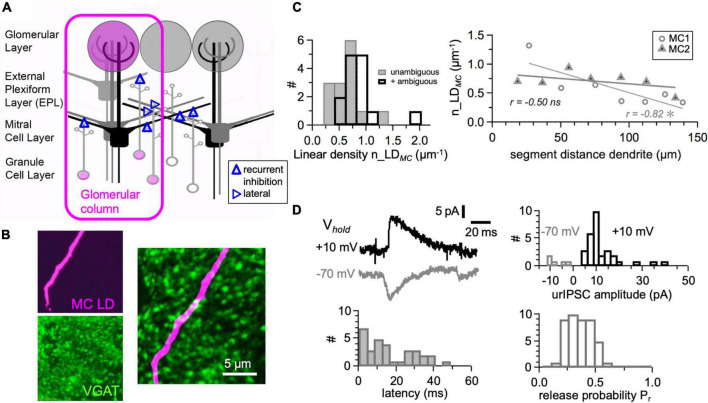
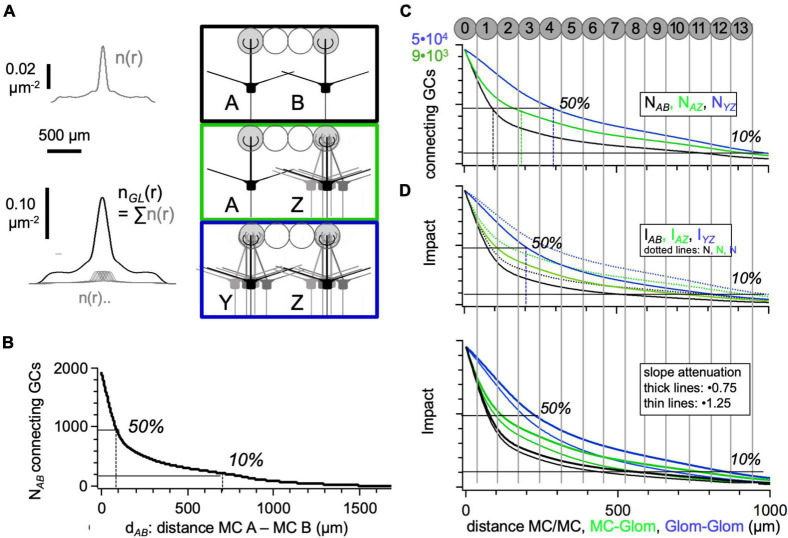
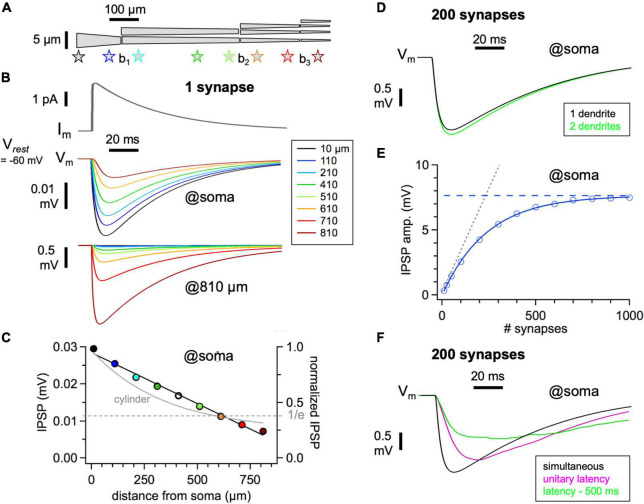
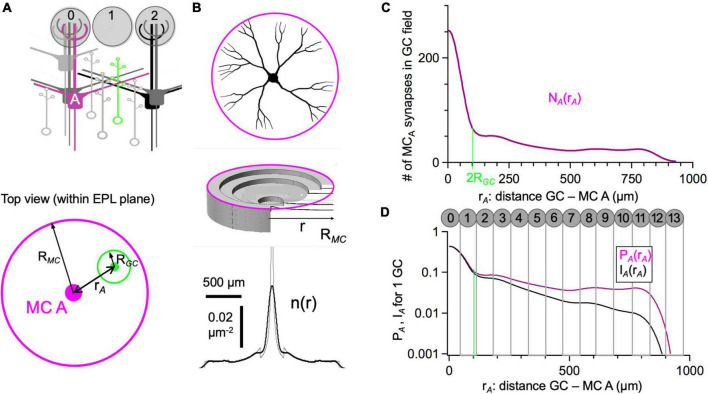
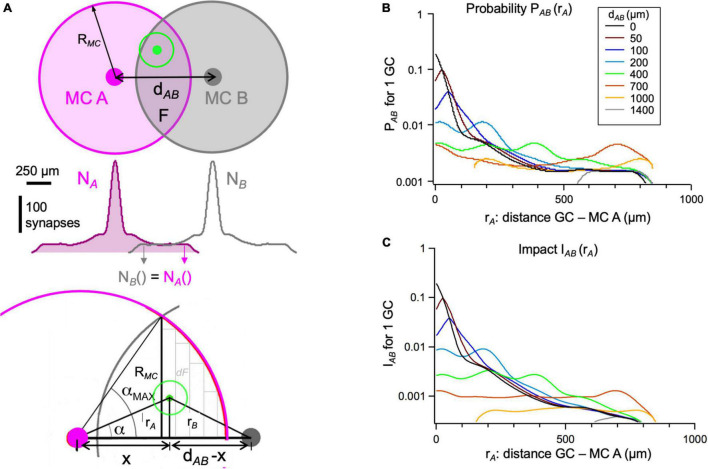
In the vertebrate olfactory bulb, reciprocal dendrodendritic interactions between its principal neurons, the mitral and tufted cells, and inhibitory interneurons in the external plexiform layer mediate both recurrent and lateral inhibition, with the most numerous of these interneurons being granule cells. Here, we used recently established anatomical parameters and functional data on unitary synaptic transmission to simulate the strength of recurrent inhibition of mitral cells specifically from the reciprocal spines of rat olfactory bulb granule cells in a quantitative manner. Our functional data allowed us to derive a unitary synaptic conductance on the order of 0.2 nS. The simulations predicted that somatic voltage deflections by even proximal individual granule cell inputs are below the detection threshold and that attenuation with distance is roughly linear, with a passive length constant of 650 μm. However, since recurrent inhibition in the wake of a mitral cell action potential will originate from hundreds of reciprocal spines, the summated recurrent IPSP will be much larger, even though there will be substantial mutual shunting across the many inputs. Next, we updated and refined a preexisting model of connectivity within the entire rat olfactory bulb, first between pairs of mitral and granule cells, to estimate the likelihood and impact of recurrent inhibition depending on the distance between cells. Moreover, to characterize the substrate of lateral inhibition, we estimated the connectivity granule cells between any two mitral cells or all the mitral cells that belong to a functional glomerular ensemble (i.e., which receive their input from the same glomerulus), again as a function of the distance between mitral cells and/or entire glomerular mitral cell ensembles. Our results predict the extent of the three regimes of anatomical connectivity between glomerular ensembles: high connectivity within a glomerular ensemble and across the first four rings of adjacent glomeruli, substantial connectivity to up to eleven glomeruli away, and negligible connectivity beyond. Finally, in a first attempt to estimate the functional strength of granule-cell mediated lateral inhibition, we combined this anatomical estimate with our above simulation results on attenuation with distance, resulting in slightly narrowed regimes of a functional impact compared to the anatomical connectivity.
在脊椎动物的嗅球中,其主要神经元——僧帽细胞和丛状细胞与外丛状层中的抑制性中间神经元之间的相互树突-树突相互作用介导了回返性和侧向抑制,其中数量最多的中间神经元是颗粒细胞。在这里,我们使用最近建立的解剖学参数和关于单位突触传递的功能数据,以定量方式模拟特定于大鼠嗅球颗粒细胞的相互刺突的回返性抑制对僧帽细胞的强度。我们的功能数据使我们能够推导出约 0.2 nS 的单位突触电导。模拟预测,即使是近端单个颗粒细胞输入的体电压偏移也低于检测阈值,并且随着距离的衰减大致呈线性,被动长度常数为 650 μm。然而,由于在僧帽细胞动作电位之后的回返性抑制将源自数百个相互刺突,因此总和的回返性 IPSP 将大得多,尽管在许多输入之间会有大量的相互分流。接下来,我们更新并改进了整个大鼠嗅球内已有连接模型,首先是在成对的僧帽细胞和颗粒细胞之间,以根据细胞之间的距离估计回返性抑制的可能性和影响。此外,为了表征侧向抑制的基质,我们估计了任何两个僧帽细胞或属于功能肾小球集合体(即,从同一肾小球接收输入)的所有僧帽细胞之间的颗粒细胞连接,再次作为僧帽细胞之间的距离的函数。和/或整个肾小球僧帽细胞集合体。我们的结果预测了肾小球集合体之间三种解剖连接状态的范围:肾小球集合体内部以及前四个相邻肾小球的环之间的高连接性、高达十一个肾小球的连接性、以及超过十一个肾小球的可忽略不计的连接性。最后,作为估计颗粒细胞介导的侧向抑制的功能强度的首次尝试,我们将这种解剖学估计与我们关于距离衰减的上述模拟结果相结合,导致与解剖连接相比,功能影响的范围略有缩小。