The First Clinical College, Zhejiang Traditional Chinese Medical University, Hangzhou, China.
Department of Orthopedics, Tongde Hospital of Zhejiang Province, Hangzhou, China.
Front Public Health. 2022 Jul 22;10:835449. doi: 10.3389/fpubh.2022.835449. eCollection 2022.
The COVID-19 pandemic has made many countries adopt restrictive measures like home quarantine. Children were required to study at home, which made parents worried about the rapid myopic progression of their children. To compare myopia progression during the COVID-19 pandemic home quarantine with the time before it and risk factors of myopia progression, we conducted this study.
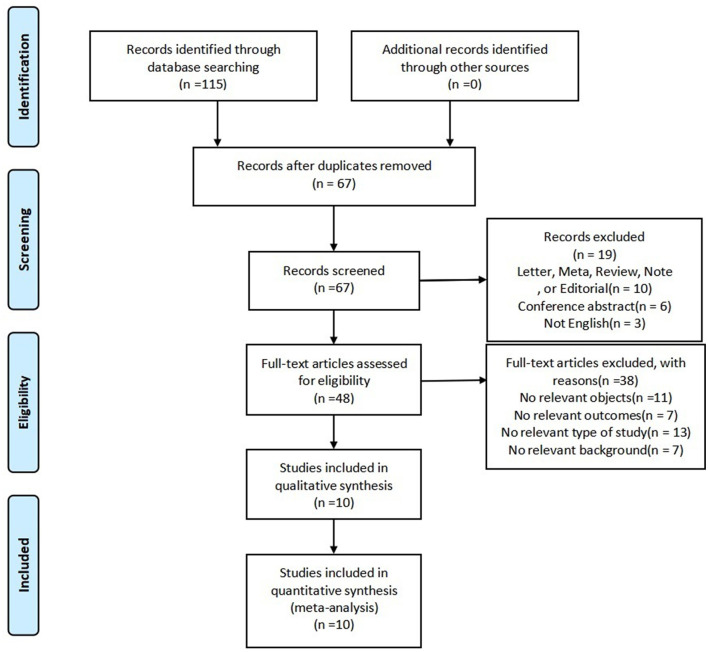
We searched PubMed, Embase, the Cochrane Library, and Web of Science to find literature from December 2019 to March 2022 related to COVID-19 pandemic home quarantine and children's myopia progression. Outcomes of myopia progression included axial length and spherical equivalent refraction. Factors of digital screen device time and outdoor activity time were analyzed.
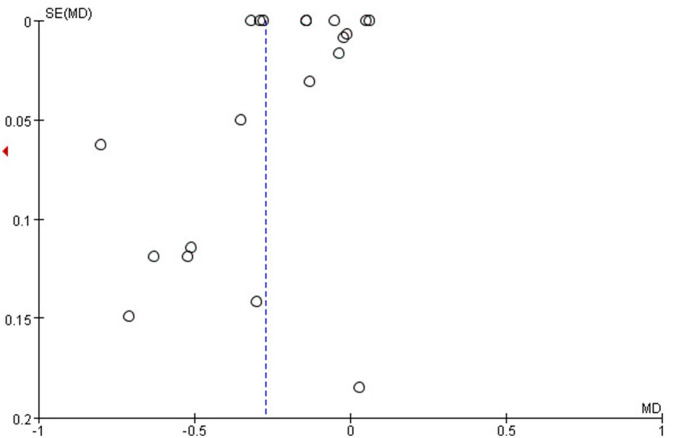
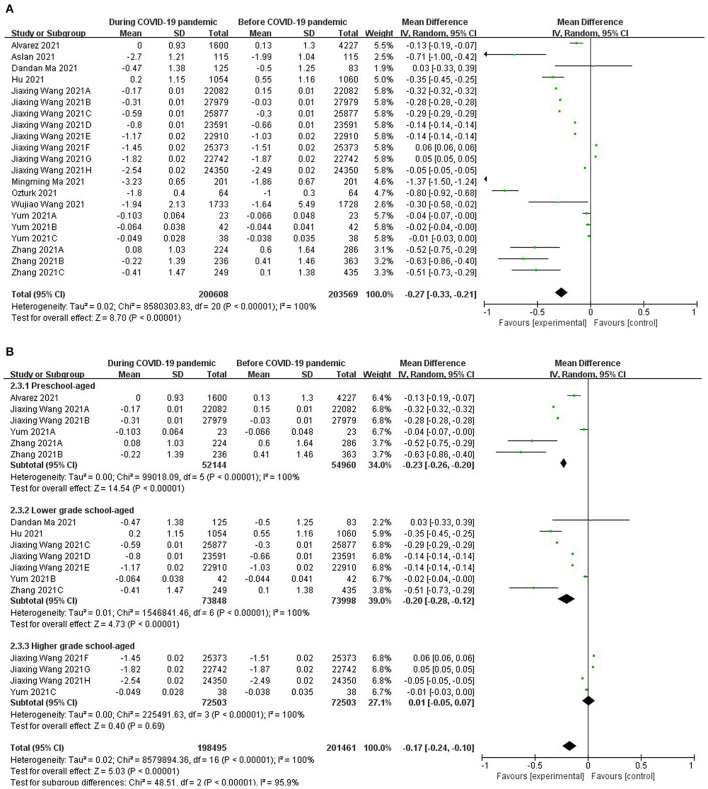
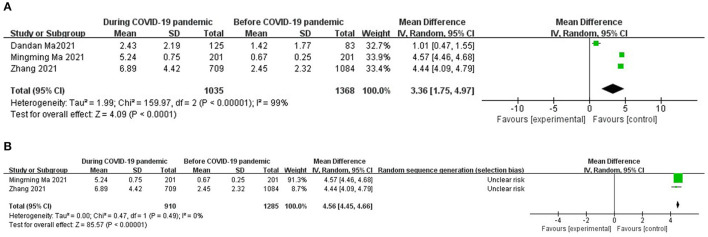
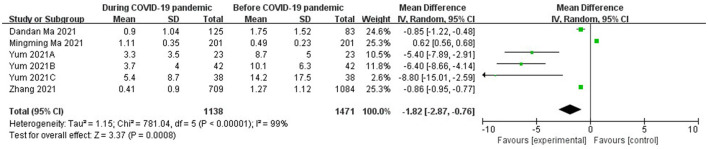
Ten studies were included in this meta-analysis. Compared to the same period before the COVID-19 pandemic, spherical equivalent refraction decreased (OR = -0.27; 95% CI = [-0.33, -0.21]; Z = 8.42; < 0.00001). However, the subgroup analysis showed that there were no significant differences in spherical equivalent refraction between the two groups in higher-grade school-aged children (grades 4 and above, 11 to 18 years old) (OR = 0.01; 95% CI = [-0.05, 0.07]; Z =0.4; = 0.69). The outcome of axial length showed no significant difference (OR = 0.06; 95% CI = [-0.31, 0.44]; Z = 0.34; = 0.74). As for risk factors, the forest plots showed that digital screen device time (OR = 4.56; 95% CI = [4.45, 4.66]; Z = 85.57; < 0.00001) and outdoor activity time (OR = -1.82; 95% CI = [-2.87, -0.76]; Z = 3.37; = 0.0008) were risk factors of myopia progression.
Compared with the time before the COVID-19 pandemic, myopia progression in children during COVID-19 pandemic home quarantine was accelerated, especially in younger children. Increased digital screen device and decreased outdoor activity times were risk factors. When home quarantine eases, more time on outdoor activities and less time on digital screen devices are needed for children.
COVID-19 大流行使许多国家采取了居家隔离等限制措施。儿童被迫在家学习,这让家长们担心孩子的近视会迅速发展。为了比较 COVID-19 大流行居家隔离期间与之前的近视进展情况以及近视进展的危险因素,我们进行了这项研究。
我们检索了 PubMed、Embase、Cochrane 图书馆和 Web of Science,以查找 2019 年 12 月至 2022 年 3 月期间与 COVID-19 大流行居家隔离和儿童近视进展相关的文献。近视进展的结果包括眼轴长度和球镜等效屈光度。分析了数字屏幕设备时间和户外活动时间的因素。
本荟萃分析纳入了 10 项研究。与 COVID-19 大流行之前的同一时期相比,球镜等效屈光度降低(OR=-0.27;95%CI=-0.33,-0.21;Z=8.42;<0.00001)。然而,亚组分析显示,在较高年级的学龄儿童(4 年级及以上,11-18 岁)中,两组之间的球镜等效屈光度无显著差异(OR=0.01;95%CI=-0.05,0.07;Z=0.4;=0.69)。眼轴长度的结果无显著差异(OR=0.06;95%CI=-0.31,0.44;Z=0.34;=0.74)。至于危险因素,森林图显示,数字屏幕设备时间(OR=4.56;95%CI=4.45,4.66;Z=85.57;<0.00001)和户外活动时间(OR=-1.82;95%CI=-2.87,-0.76;Z=3.37;=0.0008)是近视进展的危险因素。
与 COVID-19 大流行之前相比,COVID-19 大流行居家隔离期间儿童的近视进展加快,尤其是在年龄较小的儿童中。增加数字屏幕设备使用时间和减少户外活动时间是危险因素。当居家隔离放松时,儿童需要更多的户外活动时间和更少的数字屏幕设备使用时间。