Department of Ophthalmology and Visual Science, Eunpyeong St. Mary's Hospital, College of Medicine, The Catholic University of Korea, Seoul, Republic of Korea.
Department of Ophthalmology and Visual Science, Seoul St. Mary's Hospital, College of Medicine, The Catholic University of Korea, Seoul, Republic of Korea.
PLoS One. 2021 Sep 14;16(9):e0257480. doi: 10.1371/journal.pone.0257480. eCollection 2021.
The outbreak of coronavirus disease 2019 (COVID-19) has caused many children to stay indoors. Increased near work and insufficient outdoor activities are considered important risk factors for myopic progression. This study aimed to compare the changes in myopic progression before and after COVID-19 in children treated with low-concentration atropine.
The records of 103 eyes of 103 children who were treated with low-concentration atropine eye drops were retrospectively reviewed. We classified children according to the concentration of atropine eye drops and children's age. The beginning of the pre-COVID-19 period was set from January 2019 to May 2019, and the endpoint was set in March 2020. The beginning of the post-COVID-19 period was set in March 2020, and the endpoint was set from January 2021 to March 2021. We evaluated the questionnaires administered to children's parents.
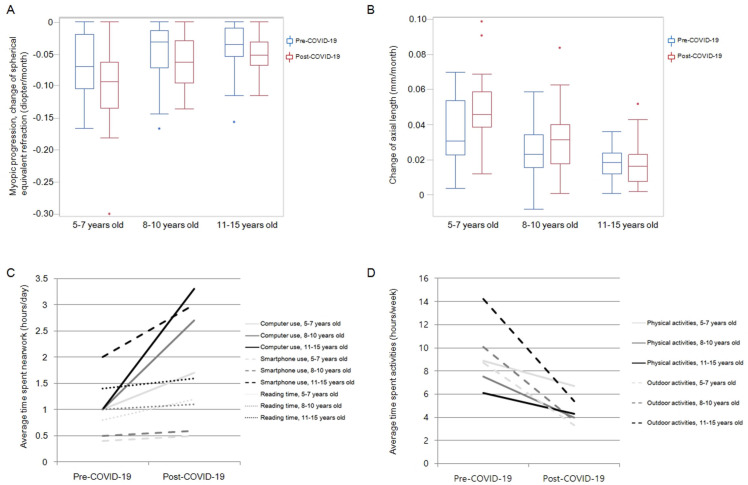
A significant myopic progression was observed in the post-COVID-19 period compared to the pre-COVID-19 period in the 0.05% and 0.025% atropine groups (P < 0.001 and P = 0.020, respectively). For children aged 5 to 7 and 8 to 10 years, the axial elongations were significantly faster in the post-COVID-19 period than in the pre-COVID-19 period (P = 0.022 and P = 0.005, respectively). However, the rates of axial elongation and myopic progression were not significantly different between pre- and post-COVID-19 in children aged 11 to 15 years (P = 0.065 and P = 0.792, respectively). The average time spent using computers and smartphones and reading time were significantly increased, and the times of physical and outdoor activity were significantly decreased in the post-COVID-19 period compared to the pre-COVID-19 period.
The rates of myopic progression have increased substantially after the spread of COVID-19 with an increase in the home confinement of children. Therefore, it is necessary to control the environmental risk factors for myopia, even in children undergoing treatment for the inhibition of myopic progression.
2019 年冠状病毒病(COVID-19)的爆发导致许多儿童待在室内。近距离用眼增加和户外活动不足被认为是近视进展的重要危险因素。本研究旨在比较 COVID-19 前后接受低浓度阿托品治疗的儿童近视进展的变化。
回顾性分析 103 例儿童 103 只眼接受低浓度阿托品滴眼治疗的记录。根据阿托品滴眼液浓度和儿童年龄对儿童进行分类。将 COVID-19 前时期的起始时间设置为 2019 年 1 月至 2019 年 5 月,终点时间设置为 2020 年 3 月。COVID-19 后时期的起始时间设置为 2020 年 3 月,终点时间设置为 2021 年 1 月至 2021 年 3 月。我们评估了向儿童家长发放的调查问卷。
与 COVID-19 前时期相比,0.05%和 0.025%阿托品组在 COVID-19 后时期观察到明显的近视进展(P<0.001 和 P=0.020)。对于 5 至 7 岁和 8 至 10 岁的儿童,COVID-19 后时期的眼轴伸长速度明显快于 COVID-19 前时期(P=0.022 和 P=0.005)。然而,11 至 15 岁儿童的眼轴伸长率和近视进展率在 COVID-19 前后无显著差异(P=0.065 和 P=0.792)。与 COVID-19 前时期相比,COVID-19 后时期儿童使用电脑和智能手机的时间以及阅读时间明显增加,而体育和户外活动时间明显减少。
随着儿童居家时间的增加,COVID-19 传播后近视进展速度显著加快。因此,即使在接受抑制近视进展治疗的儿童中,也有必要控制近视的环境危险因素。