Hagley Simon P, Kruppert Anne, Leal Rodolfo Oliveira, Pizarro Del Valle José Carlos, Iannucci Claudia, Hennink Imke, Boiron Ludivine, Hoehne Sabrina N
Emergency and Critical Care Department, Vets Now Referrals, Manchester, United Kingdom.
Division of Anaesthesia and Analgesia, Department of Clinical Veterinary Science, Vetsuisse Faculty, University of Bern, Bern, Switzerland.
Front Vet Sci. 2022 Jul 14;9:919206. doi: 10.3389/fvets.2022.919206. eCollection 2022.
The objective of this study was to assess whether small animal veterinarians across Western Europe are compliant with the 2012 cardiopulmonary resuscitation (CPR) guidelines by the Reassessment Campaign on Veterinary Resuscitation (RECOVER).
A previously published online questionnaire from Switzerland was adapted and translated into 7 languages, corresponding to national languages in Austria, France, Germany, Ireland, Italy, Liechtenstein, Netherlands, Portugal, Spain, and the United Kingdom. The survey was distributed via respective national veterinary organizations and social media outlets. A subset of questions was analyzed to evaluate respondent demographics, RECOVER guideline awareness, and to allocate composite compliance scores for CPR preparedness, basic life support (BLS) and advanced life support (ALS). Percentages of group total (95% confidence interval) were calculated. Multivariable logistic regression was used to evaluate the effects of region of practice, gender, age, specialty training, and guideline awareness on compliance. Odds ratios (95% confidence interval) were generated and significance set at < 0.05.
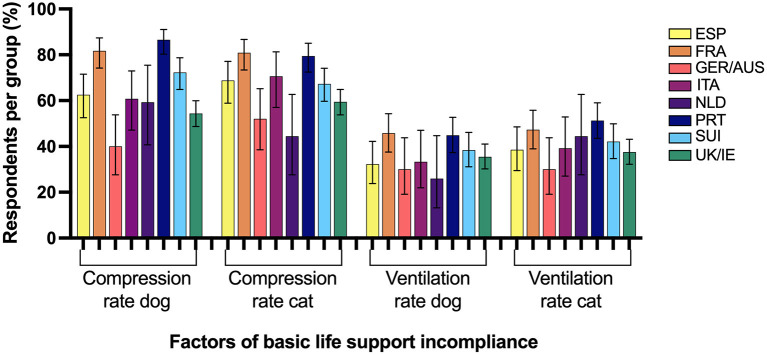
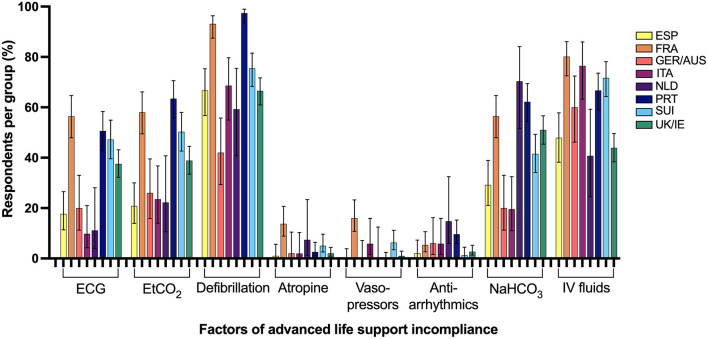
Nine-hundred and thirty respondents were included in analysis. Awareness of and compliance with RECOVER guidelines varied widely across regions. Compliance with all assessed RECOVER guideline recommendations was highest in Germany/Austria [14% (7- 27%)] and lowest in France and Portugal [0% (0-3%)]. CPR preparedness compliance was higher in participants aware of RECOVER guidelines [OR 10.1 (5.2-19.5)], those practicing in Germany/Austria [OR 4.1 (1.9-8.8)] or UK/Ireland [OR 2.2 (1.3-3.7)], and lower in those practicing in Portugal [OR 0.2 (0.1-0.9)]. Specialty training [OR 1.8 (1.1-2.9)], guideline awareness [OR 5.2 (3.2-8.6)], and practice in Germany/Austria [OR 3.1 (1.5-6.5)], UK/Ireland [OR 2.6 (1.7-4.1)], or the Netherlands [OR 5.3 (2.0-14.2)] were associated with increased BLS compliance. ALS compliance was higher in participants with guideline awareness [OR 7.0 (2.9-17.0)], specialty training [OR 6.8 (3.8-12.1)], those practicing in Germany/Austria [OR 3.5 (1.3-9.6)], UK/Ireland [OR 4.0 (1.9-8.3)], or Spain [OR 3.2 (1.2-8.3)] and in younger survey participants [OR 0.9 (0.9-1.0)].
Awareness and compliance with RECOVER guidelines varied widely among countries surveyed, however overall compliance scores in all countries were considered low. Further research may highlight factors surrounding poor guideline awareness and compliance so targeted efforts can be made to improve veterinary CPR in Europe.
本研究的目的是评估西欧的小动物兽医是否遵循了兽医复苏再评估运动(RECOVER)发布的2012年心肺复苏(CPR)指南。
一份先前发表的来自瑞士的在线调查问卷被改编并翻译成7种语言,对应奥地利、法国、德国、爱尔兰、意大利、列支敦士登、荷兰、葡萄牙、西班牙和英国的本国语言。该调查通过各自国家的兽医组织和社交媒体渠道进行分发。对一部分问题进行分析,以评估受访者的人口统计学特征、对RECOVER指南的认知度,并为CPR准备情况、基础生命支持(BLS)和高级生命支持(ALS)分配综合合规评分。计算组总数的百分比(95%置信区间)。使用多变量逻辑回归来评估执业地区、性别、年龄、专业培训和指南认知度对合规性的影响。生成优势比(95%置信区间),显著性设定为<0.05。
930名受访者被纳入分析。不同地区对RECOVER指南的认知度和遵循情况差异很大。德国/奥地利对所有评估的RECOVER指南建议的遵循率最高[14%(7 - 27%)],法国和葡萄牙最低[0%(0 - 3%)]。了解RECOVER指南的参与者的CPR准备合规率更高[优势比10.1(5.2 - 19.5)],在德国/奥地利执业的参与者[优势比4.1(1.9 - 8.8)]或英国/爱尔兰[优势比2.2()1.3 - 3.7)]也是如此,而在葡萄牙执业的参与者则较低[优势比0.2(0.1 - 0.9)]。专业培训[优势比1.8(1.1 - 2.9)]、指南认知度[优势比5.2(3.2 - 8.6)]以及在德国/奥地利[优势比3.1(1.5 - 6.5)]、英国/爱尔兰[优势比2.6(1.7 - 4.1)]或荷兰[优势比5.3(2.0 - 14.2)]执业与更高的BLS合规性相关。有指南认知度的参与者[优势比7.0(2.9 - 17.0)]、专业培训[优势比6.8(3.8 - 12.1)]、在德国/奥地利执业的参与者[优势比3.5(1.3 - 9.6)]、英国/爱尔兰[优势比4.0(1.9 - 8.3)]或西班牙[优势比3.2(1.2 - 8.3)]以及较年轻的调查参与者[优势比0.9(0.9 - 1.0)]的ALS合规率更高。
在所调查的国家中,对RECOVER指南的认知度和遵循情况差异很大,然而所有国家的总体合规评分都被认为较低。进一步的研究可能会突出导致指南认知度和遵循情况不佳的因素,以便能够针对性地努力改善欧洲的兽医CPR情况。