
提高外科学科对学生的吸引力:机器人辅助实践培训课程对医学教育的启示。
Increasing the attractiveness of surgical disciplines for students: Implications of a robot-assisted hands-on training course for medical education.
作者信息
Ekrutt Jonas, Leyh-Bannurah Sami-Ramzi, Knipper Sophie, Schramm Frederik, Beyer Burkhard, Maurer Tobias, Graefen Markus, Budäus Lars
机构信息
Martini-Klinik Prostate Cancer Center, University Hospital Hamburg-Eppendorf, Hamburg, Germany.
Department of Urology, St. Antonius-Hospital Gronau GmbH, Gronau, Germany.
出版信息
Front Surg. 2022 Jul 21;9:953565. doi: 10.3389/fsurg.2022.953565. eCollection 2022.
BACKGROUND
Structured implementation of robot-assisted surgery in the field of medical education is lacking. We assessed students' interest in robot-assisted surgery and tested if the implementation of a hands-on robotic course into the curriculum could increase the interest to join a surgical discipline in general and especially in female students, since women are clearly underrepresented in surgical disciplines.
METHODS
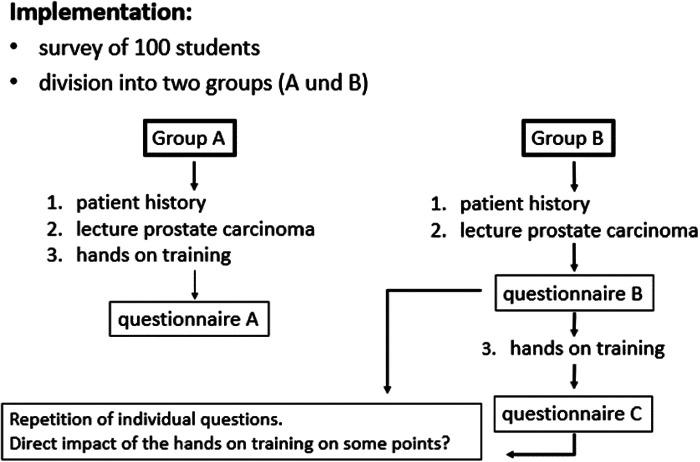
After a prostate cancer focused seminar, 100 students were 1:1 randomized into two groups. Group B: Baseline characteristics and professional interest were assessed prior and after a hands-on robotic course, using a da Vinci® console with simulator (da Vinci® Surgical training, Intuitive Surgical Inc., USA). Group A served as post-interventional consistency control group, received the questionnaire only once after the hands-on training.
RESULTS
The male to female ratio of students was 54% and 46%. The interest to turn into urology/surgery, categorized as yes", "no", "maybe" changed from 18 to 16%, 36 to 30% and 46 to 54% respectively after the hands-on robotic course ( < 0.001). Also, the positive attitude towards the surgical field significantly increased (20 vs. 48%; < 0.001). Comparing male and female students, virtually identical proportions (23 vs. 23%) opted for joining urology or surgery as a discipline, whereas rejection (45 vs. 25%) and perchance (32 vs. 50%) of that notion differed between genders ( = 0.12).
CONCLUSION
Our results demonstrate great demand for implementing robotic training into medical education for an up-to-date curriculum. Although the decision process on career choice is widely multifactorial, stereotypes associated with surgical disciplines should be eliminated. This could have a particularly positive effect on the recruitment of female medical students since women are clearly underrepresented in surgical disciplines although currently and with increasing proportions, more female students are enrolled in medical schools then male.
背景
医学教育领域缺乏机器人辅助手术的结构化实施。我们评估了学生对机器人辅助手术的兴趣,并测试了将实践机器人课程纳入课程是否能提高学生对一般外科专业尤其是女性学生加入外科专业的兴趣,因为女性在外科专业中的代表性明显不足。
方法
在一次聚焦前列腺癌的研讨会后,100名学生被1:1随机分为两组。B组:在使用达芬奇®模拟控制台(达芬奇®手术培训,直观外科公司,美国)进行实践机器人课程前后评估基线特征和专业兴趣。A组作为干预后一致性对照组,仅在实践培训后接受一次问卷调查。
结果
学生的男女比例分别为54%和46%。在实践机器人课程后,对转为泌尿外科/外科的兴趣,分为“是”“否”“也许”,分别从18%变为16%、36%变为30%、46%变为54%(P<0.001)。此外,对外科领域的积极态度显著增加(20%对48%;P<0.001)。比较男女学生,选择泌尿外科或外科作为专业的比例几乎相同(23%对23%),而对该想法的拒绝(45%对25%)和可能(32%对50%)在性别上存在差异(P=0.12)。
结论
我们的结果表明,为更新课程而在医学教育中实施机器人培训有很大需求。尽管职业选择的决策过程广泛涉及多因素,但与外科专业相关的刻板印象应被消除。这可能对招收女医学生产生特别积极的影响,因为尽管目前女医学生的入学比例在增加且高于男医学生,但女性在外科专业中的代表性仍明显不足。
 Zotero 插件