Department of Psychology, University of Oregon.
Cogn Sci. 2022 Aug;46(8):e13178. doi: 10.1111/cogs.13178.
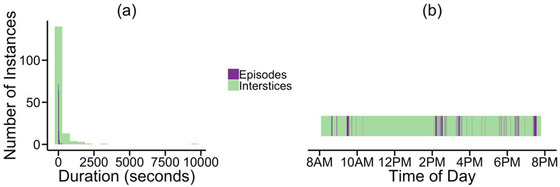
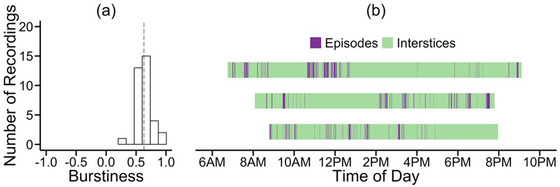
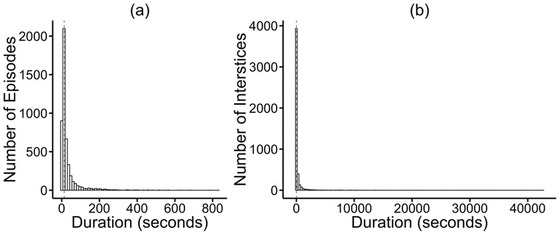
Experience-dependent change pervades early human development. Though trajectories of developmental change have been well charted in many domains, the episode-to-episode schedules of experiences on which they are hypothesized to depend have not. Here, we took up this issue in a domain known to be governed in part by early experiences: music. Using a corpus of longform audio recordings, we parameterized the daily schedules of music encountered by 35 infants ages 6-12 months. We discovered that everyday music episodes, as well as the interstices between episodes, typically persisted less than a minute, with most daily schedules also including some very extended episodes and interstices. We also discovered that infants encountered music episodes in a bursty rhythm, rather than a periodic or random rhythm, over the day. These findings join a suite of recent discoveries from everyday vision, motor, and language that expand our imaginations beyond artificial learning schedules and enable theorists to model the history-dependence of developmental process in ways that respect everyday sensory histories. Future theories about how infants build knowledge across multiple episodes can now be parameterized using these insights from infants' everyday lives.
经验依赖性变化贯穿人类早期发展。尽管许多领域都已经很好地描绘了发展变化的轨迹,但它们所依赖的经验的情节到情节的时间表尚未确定。在这里,我们在一个被部分认为由早期经验控制的领域中解决了这个问题:音乐。我们使用一个长格式音频记录的语料库,参数化了 35 名 6-12 个月大婴儿每天接触的音乐情节。我们发现,日常音乐情节以及情节之间的间隙通常持续不到一分钟,大多数日常时间表还包括一些非常长的情节和间隙。我们还发现,婴儿在一天中以突发的节奏而不是周期性或随机的节奏遇到音乐情节。这些发现与日常视觉、运动和语言中的一系列最新发现相结合,将我们的想象力扩展到了人为的学习时间表之外,并使理论家能够以尊重日常感觉历史的方式来模拟发展过程的历史依赖性。现在,未来关于婴儿如何在多个情节中构建知识的理论可以使用这些来自婴儿日常生活的见解进行参数化。