Poultry Department, Faculty of Agriculture, Zagazig University, Zagazig, 44511, Egypt.
Department of Agricultural Microbiology, Faculty of Agriculture, Zagazig University, Zagazig, 44511, Egypt.
Poult Sci. 2022 Sep;101(9):102021. doi: 10.1016/j.psj.2022.102021. Epub 2022 Jun 26.
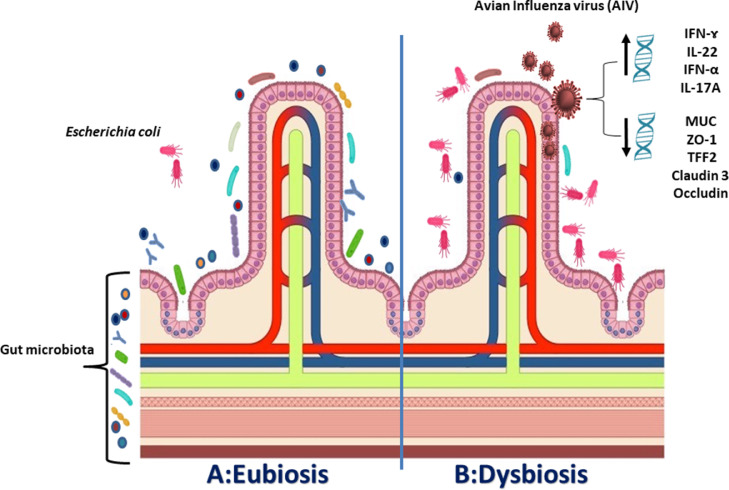
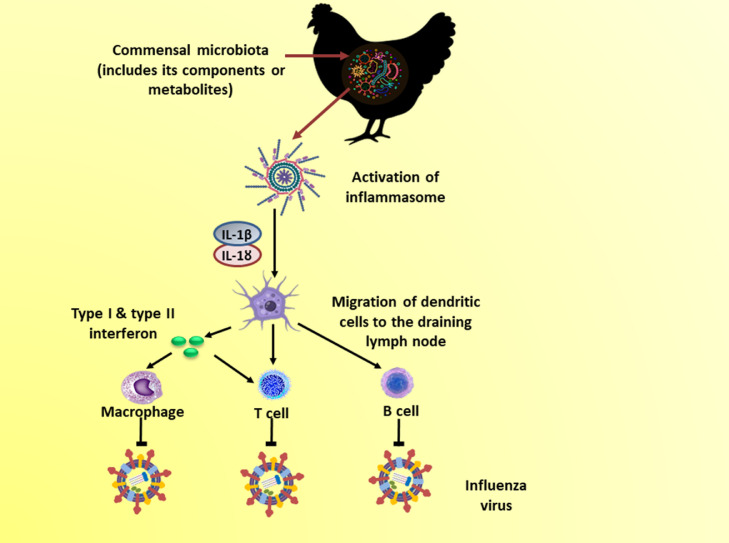
The alimentary tract in chickens plays a crucial role in immune cell formation and immune challenges, which regulate intestinal flora and sustain extra-intestinal immunity. The interaction between pathogenic microorganisms and the host commensal microbiota as well as the variety and integrity of gut microbiota play a vital role in health and disease conditions. Thus, several studies have highlighted the importance of gut microbiota in developing immunity against viral infections in chickens. The gut microbiota (such as different species of Lactobacillus, Blautia Bifidobacterium, Faecalibacterium, Clostridium XlVa, and members of firmicutes) encounters different pathogens through different mechanisms. The digestive tract is a highly reactive environment, and infectious microorganisms can disturb its homeostasis, resulting in dysbiosis and mucosal infections. Avian influenza viruses (AIV) are highly infectious zoonotic viruses that lead to severe economic losses and pose a threat to the poultry industry worldwide. AIV is a challenging virus that affects gut integrity, disrupts microbial homeostasis and induces inflammatory damage in the intestinal mucosa. H9N2 AIV infection elevates the expression of proinflammatory cytokines, such as interferon (IFN-γ and IFNα) and interleukins (IL-17A and IL-22), and increases the proliferation of members of proteobacteria, particularly Escherichia coli. On the contrary, it decreases the proliferation of certain beneficial bacteria, such as Enterococcus, Lactobacillus and other probiotic microorganisms. In addition, H9N2 AIV decreases the expression of primary gel-forming mucin, endogenous trefoil factor family peptides and tight junction proteins (ZO-1, claudin 3, and occludin), resulting in severe intestinal damage. This review highlights the relationship among AIV, gut microbiota and immunity in chicken.
禽类的消化道在免疫细胞的形成和免疫挑战中起着至关重要的作用,这些免疫挑战调节肠道菌群并维持肠外免疫。病原体微生物与宿主共生菌群的相互作用以及肠道菌群的多样性和完整性在健康和疾病状态中起着至关重要的作用。因此,许多研究强调了肠道菌群在鸡对抗病毒感染的免疫反应中的重要性。肠道菌群(如不同种类的乳酸杆菌、双歧杆菌、粪杆菌、梭菌 XlVa 和厚壁菌门成员)通过不同的机制与不同的病原体相互作用。消化道是一个高度反应性的环境,传染性微生物可以扰乱其体内平衡,导致菌群失调和粘膜感染。禽流感病毒(AIV)是一种高度传染性的人畜共患病病毒,会导致严重的经济损失,并对全球家禽业构成威胁。AIV 是一种具有挑战性的病毒,它会影响肠道完整性,破坏微生物的体内平衡,并在肠道黏膜中引起炎症损伤。H9N2 AIV 感染会提高促炎细胞因子(如干扰素(IFN-γ 和 IFNα)和白细胞介素(IL-17A 和 IL-22))的表达,并增加变形菌门成员(特别是大肠杆菌)的增殖。相反,它会降低某些有益细菌(如肠球菌、乳酸杆菌和其他益生菌微生物)的增殖。此外,H9N2 AIV 会降低主要凝胶形成粘蛋白、内源性三叶因子家族肽和紧密连接蛋白(ZO-1、claudin 3 和 occludin)的表达,导致严重的肠道损伤。本综述强调了 AIV、肠道菌群和鸡的免疫之间的关系。