Department of Physical Pharmacy and Pharmacokinetics, Poznan University of Medical Sciences, Rokietnicka 3 St, 60-806, Poznań, Poland.
Cardiovasc Drugs Ther. 2024 Jun;38(3):621-636. doi: 10.1007/s10557-022-07370-8. Epub 2022 Aug 9.
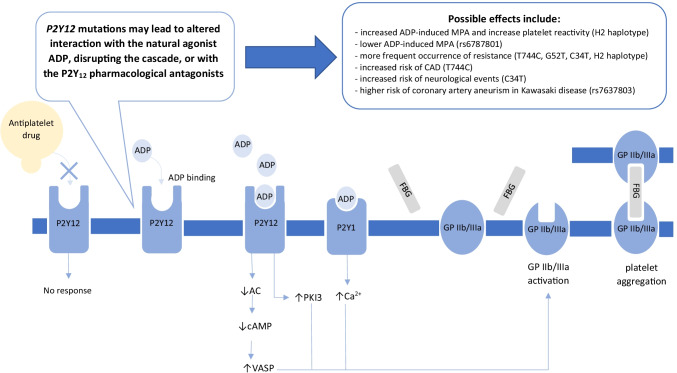
P2Y receptor inhibitors are drugs that decrease the risk of stent thrombosis and lower the long-term risk of non-stent-related myocardial infarction and stroke. They inhibit the binding of adenosine diphosphate (ADP) to the P2Y receptor and effectively reduce platelet reactivity. However, considerable variability in the pharmacodynamics response contributes to a failure of antiplatelet therapy; this phenomenon is especially notorious for older drugs, such as clopidogrel. Some genetic polymorphisms associated with these drugs' metabolic pathway, especially in the CYP2C19 gene, can significantly decrease antiplatelet efficacy. There are few reports on the variability stemming from the target of this drug class that is the P2Y receptor itself.
This review summarizes the results of research that focus on the influence of P2Y genetic polymorphisms on the pharmacodynamics and the efficacy of P2Y inhibitors. We found that the conclusions of the studies are unequivocal, and despite several strong candidates, such as G52T (rs6809699) or T744C (rs2046934), they may not be independent predictors of the inadequate response to the drug. Most probably, P2Y genetic polymorphisms contribute to the effect exerted by other gene variants (such as CYP2C19*2/*3/*17), drug interactions, or patient habits, such as smoking. Also, epigenetic modifications, such as methylation or miRNA levels, may play a role in the efficacy of antiplatelet treatment.
P2Y 受体抑制剂是一类可降低支架内血栓形成风险、降低非支架相关心肌梗死和中风长期风险的药物。它们可抑制二磷酸腺苷(ADP)与 P2Y 受体的结合,从而有效降低血小板反应性。然而,药物动力学反应的显著差异导致抗血小板治疗失败;这种现象在较老的药物(如氯吡格雷)中尤为明显。一些与这些药物代谢途径相关的遗传多态性,特别是 CYP2C19 基因,可显著降低抗血小板疗效。关于该药物类别(即 P2Y 受体本身)的作用靶点所导致的变异性的报道很少。
这篇综述总结了研究 P2Y 遗传多态性对 P2Y 抑制剂的药物动力学和疗效的影响。结果发现,尽管有几个强有力的候选基因,如 G52T(rs6809699)或 T744C(rs2046934),但这些研究的结论是明确的,它们可能不是药物反应不足的独立预测因子。很可能,P2Y 遗传多态性与其他基因变异(如 CYP2C19*2/*3/*17)、药物相互作用或患者习惯(如吸烟)共同作用影响药物疗效。此外,表观遗传修饰,如甲基化或 miRNA 水平,可能在抗血小板治疗的疗效中发挥作用。