Department of Radiology, Aarhus University Hospital, Aarhus, Denmark
Department of Surgery, Regional Hospital Randers, Randers, Denmark.
BMJ Open Qual. 2022 Aug;11(3). doi: 10.1136/bmjoq-2021-001716.
MRI interpretation and accurate radiological staging are crucial to the important treatment decisions and a consequent successful patient outcome in rectal cancer.
To investigate the effect of intensive training on rectal cancer MRI staging performance of radiologists and the impact of different course elements on learning outcomes.
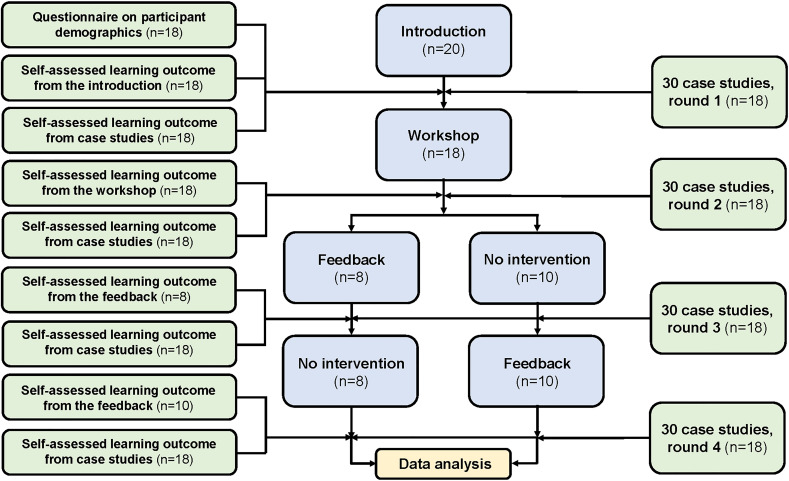
In this prospective intervention study, 17 radiology specialists and 1 radiology registrar participated in a training programme including a 6-hour imaging workshop, a 3-hour session of individual feedback and independent MRI readings of primary rectal cancer cases. Their rectal MRI interpretive performance was evaluated through repeated readings of 30 training cases before and after each course element and a time interval with no educational intervention. A proforma template for MRI staging of primary rectal cancer was used and the results were compared with a reference standard of an expert panel. Participants repeatedly reported on confidence scores and self-assessed learning outcome. Outcomes were analysed using mixed-effects models.
At baseline the quality of rectal MRI assessment varied significantly, with a higher interpretive performance among participants with shorter radiological experience (10.2 years vs 19.9 years, p=0.02). The ability to perform correct treatment allocation improved from 72% to 82% (adjusted OR=2.36, 95% CI 1.64 to 3.39). The improvement was largely driven by the participants with lower performance at baseline and by prevention of overstaging. Individual feedback had a significant impact on the improved interpretive performance (adjusted OR=1.82, 95% CI 1.27 to 2.63), whereas no significant change was seen after workshop or case readings only. Confidence scores increased significantly during training.
Targeted and individualised training improves the rectal cancer MRI interpretive performance essential to successful patient treatment, especially among radiology specialists with lower performance at baseline.
MRI 解读和准确的放射分期对直肠癌的重要治疗决策和患者的成功治疗结果至关重要。
探讨强化培训对放射科医生直肠癌 MRI 分期表现的影响,以及不同课程要素对学习效果的影响。
在这项前瞻性干预研究中,17 名放射科专家和 1 名放射科住院医师参加了一个培训计划,包括 6 小时的影像学研讨会、3 小时的个人反馈和独立阅读原发性直肠癌病例的 MRI。他们的直肠 MRI 解读表现通过在每次课程要素前后和没有教育干预的时间间隔内重复阅读 30 个培训病例进行评估。使用原发性直肠癌 MRI 分期的表格模板,并将结果与专家小组的参考标准进行比较。参与者反复报告信心评分和自我评估的学习成果。结果采用混合效应模型进行分析。
基线时,直肠 MRI 评估的质量差异很大,放射经验较短的参与者的解读表现更高(10.2 年与 19.9 年,p=0.02)。正确进行治疗分配的能力从 72%提高到 82%(调整后的 OR=2.36,95%CI 1.64 至 3.39)。这种改善主要是由基线表现较低的参与者和防止过度分期驱动的。个体化反馈对提高解读表现有显著影响(调整后的 OR=1.82,95%CI 1.27 至 2.63),而仅参加研讨会或病例阅读则没有显著变化。在培训过程中,信心评分显著提高。
有针对性和个体化的培训可以提高直肠癌 MRI 解读表现,这对成功治疗患者至关重要,特别是对基线表现较低的放射科专家。