Department of Radiology, The Netherlands Cancer Institute, P.O. Box 90203, 1106 BE, Amsterdam, The Netherlands.
GROW School for oncology and reproduction, University of Maastricht, Maastricht, The Netherlands.
Eur Radiol. 2024 Mar;34(3):1746-1754. doi: 10.1007/s00330-023-10167-4. Epub 2023 Aug 30.
To explore the potential impact of a dedicated virtual training course on MRI staging confidence and performance in rectal cancer.
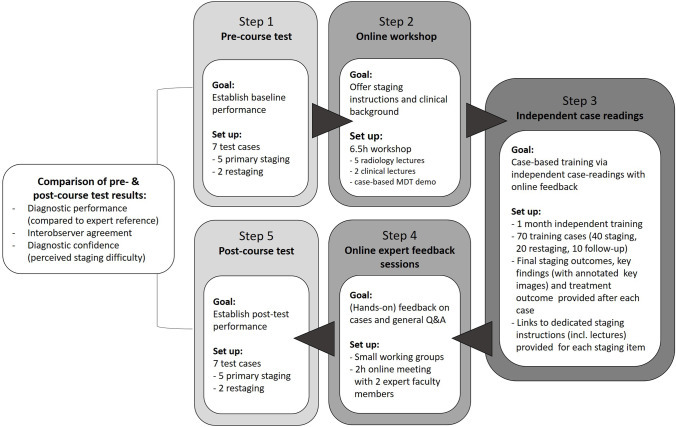
Forty-two radiologists completed a stepwise virtual training course on rectal cancer MRI staging composed of a pre-course (baseline) test with 7 test cases (5 staging, 2 restaging), a 1-day online workshop, 1 month of individual case readings (n = 70 cases with online feedback), a live online feedback session supervised by two expert faculty members, and a post-course test. The ESGAR structured reporting templates for (re)staging were used throughout the course. Results of the pre-course and post-course test were compared in terms of group interobserver agreement (Krippendorf's alpha), staging confidence (perceived staging difficulty), and diagnostic accuracy (using an expert reference standard).
Though results were largely not statistically significant, the majority of staging variables showed a mild increase in diagnostic accuracy after the course, ranging between + 2% and + 17%. A similar trend was observed for IOA which improved for nearly all variables when comparing the pre- and post-course. There was a significant decrease in the perceived difficulty level (p = 0.03), indicating an improved diagnostic confidence after completion of the course.
Though exploratory in nature, our study results suggest that use of a dedicated virtual training course and web platform has potential to enhance staging performance, confidence, and interobserver agreement to assess rectal cancer on MRI virtual training and could thus be a good alternative (or addition) to in-person training.
Rectal cancer MRI reporting quality is highly dependent on radiologists' expertise, stressing the need for dedicated training/teaching. This study shows promising results for a virtual web-based training program, which could be a good alternative (or addition) to in-person training.
• Rectal cancer MRI reporting quality is highly dependent on radiologists' expertise, stressing the need for dedicated training and teaching. • Using a dedicated virtual training course and web-based platform, encouraging first results were achieved to improve staging accuracy, diagnostic confidence, and interobserver agreement. • These exploratory results suggest that virtual training could thus be a good alternative (or addition) to in-person training.
探讨专门的虚拟培训课程对直肠癌 MRI 分期信心和表现的潜在影响。
42 名放射科医生完成了直肠癌 MRI 分期的分步式虚拟培训课程,该课程由预课程(基线)测试组成,共有 7 个测试案例(5 个分期,2 个重新分期)、为期 1 天的在线研讨会、1 个月的个人病例阅读(共 70 个病例,有在线反馈)、由两名专家教员监督的现场在线反馈会议,以及课程后的测试。整个课程中使用了 ESGAR 结构化报告模板进行(重新)分期。比较了预课程和课后测试的结果,包括组内观察者间一致性(Krippendorf 的α)、分期信心(感知分期难度)和诊断准确性(使用专家参考标准)。
虽然结果在很大程度上没有统计学意义,但在课程结束后,大多数分期变量的诊断准确性都有轻微提高,范围在+2%到+17%之间。当比较课前和课后时,IOA 也呈现出类似的趋势,几乎所有变量的观察者间一致性都有所提高。感知难度水平显著降低(p=0.03),表明课程完成后诊断信心有所提高。
尽管本研究结果具有探索性,但表明使用专门的虚拟培训课程和网络平台有可能提高评估直肠癌 MRI 虚拟培训的分期表现、信心和观察者间一致性,因此可能是一种很好的替代方法(或补充方法),可替代或补充面对面培训。
直肠癌 MRI 报告质量高度依赖于放射科医生的专业知识,强调了专门培训/教学的必要性。本研究显示出一种基于虚拟网络的培训计划有良好的前景,可能是一种很好的替代方法(或补充方法),可替代或补充面对面培训。
直肠癌 MRI 报告质量高度依赖于放射科医生的专业知识,强调了专门培训和教学的必要性。
使用专门的虚拟培训课程和基于网络的平台,取得了改善分期准确性、诊断信心和观察者间一致性的初步结果。
这些探索性结果表明,虚拟培训可能是一种很好的替代方法(或补充方法),可替代或补充面对面培训。