Institute of Pharmacy, University of Regensburg, 93040, Regensburg, Germany.
Clinical Trial Centre, University of Leipzig, Leipzig, Germany.
Eur J Drug Metab Pharmacokinet. 2022 Sep;47(5):749-755. doi: 10.1007/s13318-022-00789-2. Epub 2022 Aug 9.
Tigecycline, a broad-spectrum glycylcycline antibiotic, is approved for use at a fixed dose irrespective of body weight. However, its pharmacokinetics may be altered in obesity, which would impact on the antibiotic's effectiveness. The objective of this study was to investigate the plasma and subcutaneous tissue concentrations of tigecycline in obese patients compared with those in a non-obese control group.
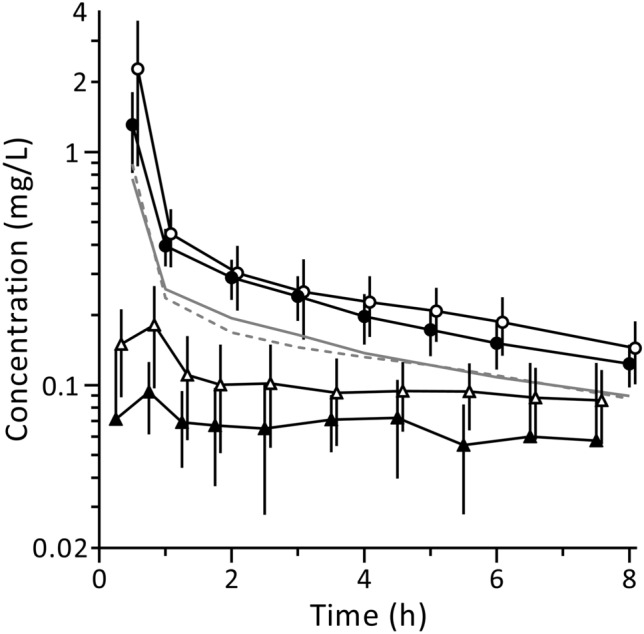
Fifteen obese patients (one class II and 14 class III) undergoing bariatric surgery and 15 non-obese patients undergoing intra-abdominal surgery (mainly tumour resection) received a single dose of 50 or 100 mg tigecycline as an intravenous short infusion. Tigecycline concentrations were measured up to 8 h after dosing in plasma (total concentration), in ultrafiltrate of plasma (free concentration), and in microdialysate from subcutaneous tissue, respectively.
In obese patients, total peak plasma concentration (1.31 ± 0.50 vs 2.27 ± 1.40 mg/L) and the area under the concentration-time curve from 0 to 8 h (AUC: 2.15 ± 0.42 vs 2.74 ± 0.73 h⋅mg/L), as normalized to a 100 mg dose, were significantly lower compared with those of non-obese patients. No significant differences were observed regarding the free plasma concentration, as determined by ultrafiltration, or the corresponding AUC (fAUC). Concentrations in interstitial fluid (ISF) of subcutaneous tissue were lower than the free plasma concentrations in both groups, and they were lower in obese compared to non-obese patients: the AUC in ISF (AUC) was 0.51 ± 0.22 h⋅mg/L in obese and 0.79 ± 0.23 h⋅mg/L in non-obese patients, resulting in a relative tissue drug exposure (AUC/fAUC) of 0.38 ± 0.19 and 0.63 ± 0.24, respectively.
Following a single dose of tigecycline, concentrations in the ISF of subcutaneous adipose tissue are decreased in heavily obese subjects, calling for an increased loading dose.
EudraCT No. 2012-004383-22.
替加环素是一种广谱甘氨酰环素抗生素,无论体重如何,均按固定剂量使用。然而,肥胖可能会改变其药代动力学,从而影响抗生素的疗效。本研究的目的是比较肥胖患者与非肥胖对照组患者体内替加环素的血浆和皮下组织浓度。
15 名接受减重手术的肥胖患者(1 名 II 类和 14 名 III 类)和 15 名接受腹腔内手术(主要为肿瘤切除术)的非肥胖患者分别单次静脉输注 50 或 100 mg 替加环素。分别于给药后 8 小时内测量血浆(总浓度)、血浆超滤液(游离浓度)和皮下组织微透析液中的替加环素浓度。
肥胖患者的总血浆峰浓度(1.31 ± 0.50 比 2.27 ± 1.40 mg/L)和 0 至 8 小时的浓度-时间曲线下面积(AUC:2.15 ± 0.42 比 2.74 ± 0.73 h·mg/L),按 100 mg 剂量标准化后,均显著低于非肥胖患者。通过超滤法测定的游离血浆浓度或相应 AUC(fAUC)无显著差异。皮下组织间质液(ISF)中的浓度在两组中均低于游离血浆浓度,且肥胖患者的浓度低于非肥胖患者:ISF 中的 AUC(AUC)在肥胖患者中为 0.51 ± 0.22 h·mg/L,在非肥胖患者中为 0.79 ± 0.23 h·mg/L,导致相对组织药物暴露(AUC/fAUC)分别为 0.38 ± 0.19 和 0.63 ± 0.24。
单次给予替加环素后,重度肥胖患者的皮下脂肪组织 ISF 中的浓度降低,需要增加负荷剂量。
EudraCT 编号 2012-004383-22。