Department of Internal Medicine, School of Medicine, University of New Mexico, Albuquerque, NM, 87131, USA.
Department of Medicine and School of Physiotherapy, University of Otago, Dunedin, 9054, New Zealand.
BMC Geriatr. 2022 Aug 9;22(1):652. doi: 10.1186/s12877-022-03335-6.
When a Zuni elder sustains a fall-related injury, the closest tribal skilled nursing facility is 100 miles from the Pueblo and no physical therapy services are available. Thus, fall prevention strategies as a primary intervention to avert injurious falls and preserve aging in place are needed. The objective of the study is to compare the effectiveness of a community health representative (CHR)-delivered, culturally-adapted Otago Exercise Program (OEP) fall prevention program compared to the standard of care education-based fall risk management.
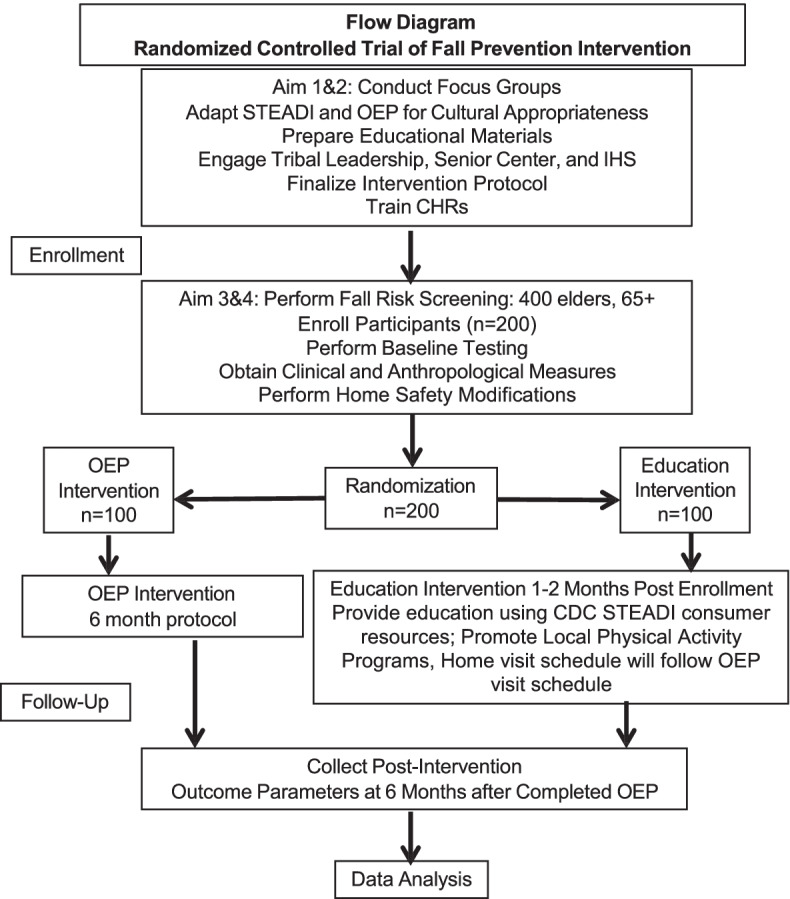
"Standing Strong in Tribal Communities: Assessing Elder Falls Disparity" is mixed-methods research with a randomized controlled trial. The CHRs will be trained to deliver the culturally-adapted OEP trial and offer advantages of speaking "Shiwi" (Zuni tribal language) and understanding Zuni traditions, family structures, and elders' preferences for receiving health information. Focus groups will be conducted to assure all materials are culturally appropriate, and adapted. A physical therapist will train CHRs to screen elders for falls risk and to deliver the OEP to the intervention group and education to the control group. Up to 400 Zuni elders will be screened by the CHRs for falls risk and 200 elders will be enrolled into the study (1:1 random allocation by household). The intervention is 6 months with measurements at baseline, 3, 6 and 12 months. The primary outcome is improved strength and balance (timed up and go, sit to stand and 4 stage balance test), secondary outcomes include falls incidence, self-efficacy using Attitudes to Falls-Related Interventions Scale, Medical Outcomes Study Short Form 12 (SF-12v2) and Self-Efficacy for Managing Daily Activities.
Fall prevention for Zuni elders was identified as a tribal priority and this trial is built upon longstanding collaborations between the investigative team, Zuni tribal leaders, and multiple tribal health programs. Delivery by the CHRs make this model more acceptable, and thus, more sustainable long term. This study has the potential to change best practice for elder care in tribal and rural areas with limited access to physical therapist-delivered fall prevention interventions and aligns with tribal goals to avert fall-related injury, reduce healthcare disparity, and preserve elder's independence.
NCT04876729.
当一名祖尼族老年人遭遇跌倒相关伤害时,最近的部落熟练护理机构距离普韦布洛有 100 英里,并且没有物理治疗服务。因此,需要采取跌倒预防策略作为避免伤害性跌倒和维持原地老化的主要干预措施。本研究的目的是比较社区卫生代表(CHR)提供的、文化适应性奥塔戈锻炼计划(OEP)跌倒预防计划与基于标准护理的跌倒风险管理的有效性。
“在部落社区中保持坚强:评估老年人跌倒差异”是一项混合方法研究,采用随机对照试验。将培训 CHR 提供文化适应性 OEP 试验,并提供讲“Shiwi”(祖尼部落语言)和了解祖尼传统、家庭结构和老年人接受健康信息偏好的优势。将进行焦点小组讨论,以确保所有材料都是文化上合适和适应的。一名物理治疗师将培训 CHR 筛查老年人跌倒风险,并向干预组提供 OEP 和对照组提供教育。将由 CHR 筛查 400 名祖尼老年人跌倒风险,200 名老年人将入组研究(按家庭 1:1 随机分配)。干预时间为 6 个月,测量时间为基线、3、6 和 12 个月。主要结局是改善力量和平衡(计时起立行走、坐立站起和 4 阶段平衡测试),次要结局包括跌倒发生率、使用跌倒相关干预措施态度量表的自我效能、医疗结果研究 12 项简短形式(SF-12v2)和日常活动管理自我效能。
祖尼族老年人的跌倒预防被确定为部落的优先事项,该试验是在调查小组、祖尼族部落领袖和多个部落健康项目之间建立的长期合作基础上进行的。由 CHR 提供服务使这种模式更能被接受,因此更具有长期可持续性。该研究有潜力改变部落和农村地区老年人护理的最佳实践,这些地区缺乏物理治疗师提供的跌倒预防干预措施,并符合部落的目标,即避免与跌倒相关的伤害、减少医疗保健差距和维持老年人的独立性。
NCT04876729。