Ultrasound department of the First Affiliated Hospital of Dalian Medical University.
Medicine (Baltimore). 2022 Aug 5;101(31):e29955. doi: 10.1097/MD.0000000000029955.
Abundant amount of literature that analyze the various detection of different ultrasound methods, no comprehensive literature that investigates the diagnostic values of breast cancer (BC) by different ultrasonography modalities through a network meta-analysis (NMA) has been made available. Each imaging diagnostic examination has its own advantages and disadvantages, and any imaging examination is not enough to make an accurate diagnosis of the disease. Thus, this study aimed to compare diagnostic values among different ultrasonography modalities, including the information of 2-dimension, stiffness and blood flow, by a network meta-analysis in the hopes of understanding which imaging methods are better and which combination of different ultrasonography modalities is more appropriate to diagnose BC.
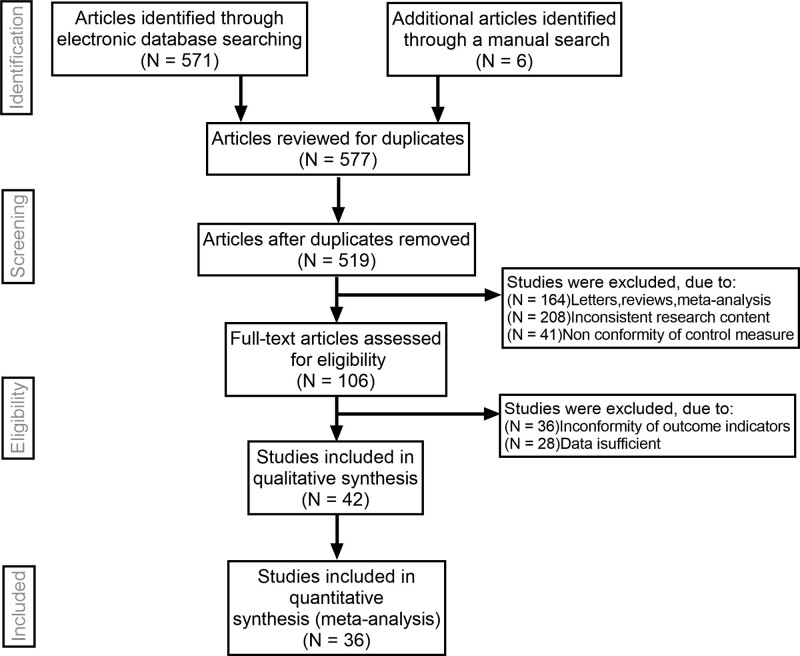
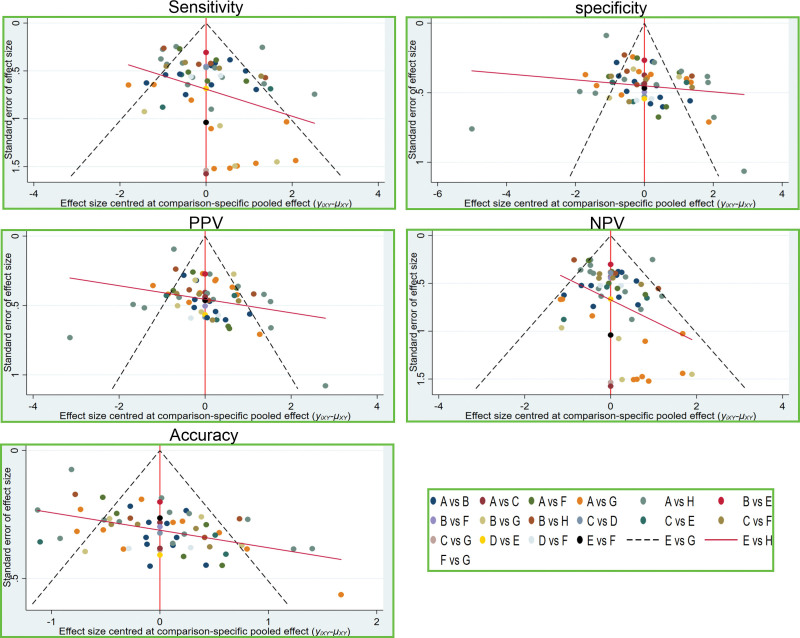
We made use of Cochrane Library, PubMed, and Embase in order to obtain literature and papers. The combination analysis of both direct and indirect evidence in terms of sensitivity, specificity, positive predictive value (PPV), negative predictive value(NPV) and accuracy was conducted so as to assess the odds ratios (ORs) and surface under the cumulative ranking curve (SUCRA) values of the 8 different ultrasound methods.
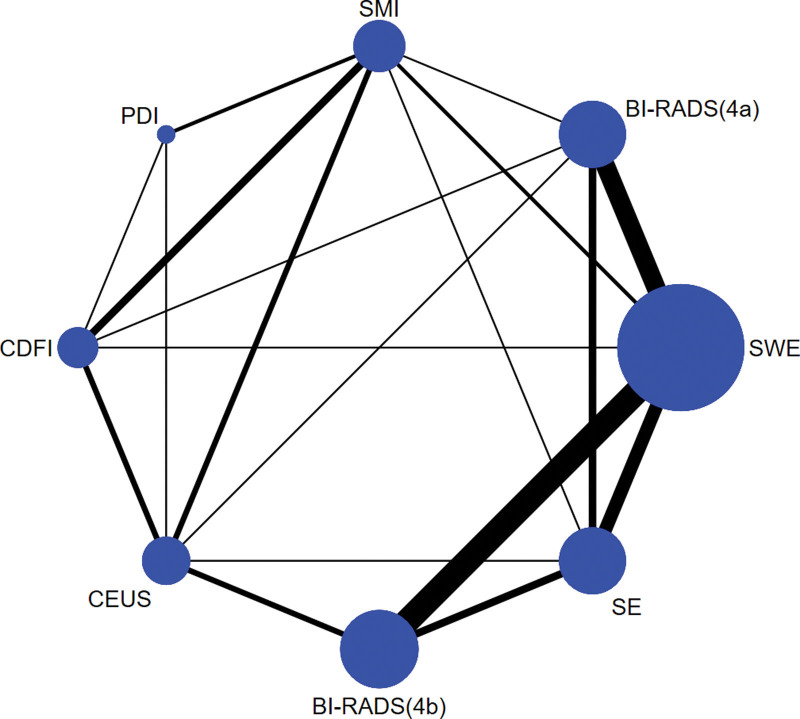
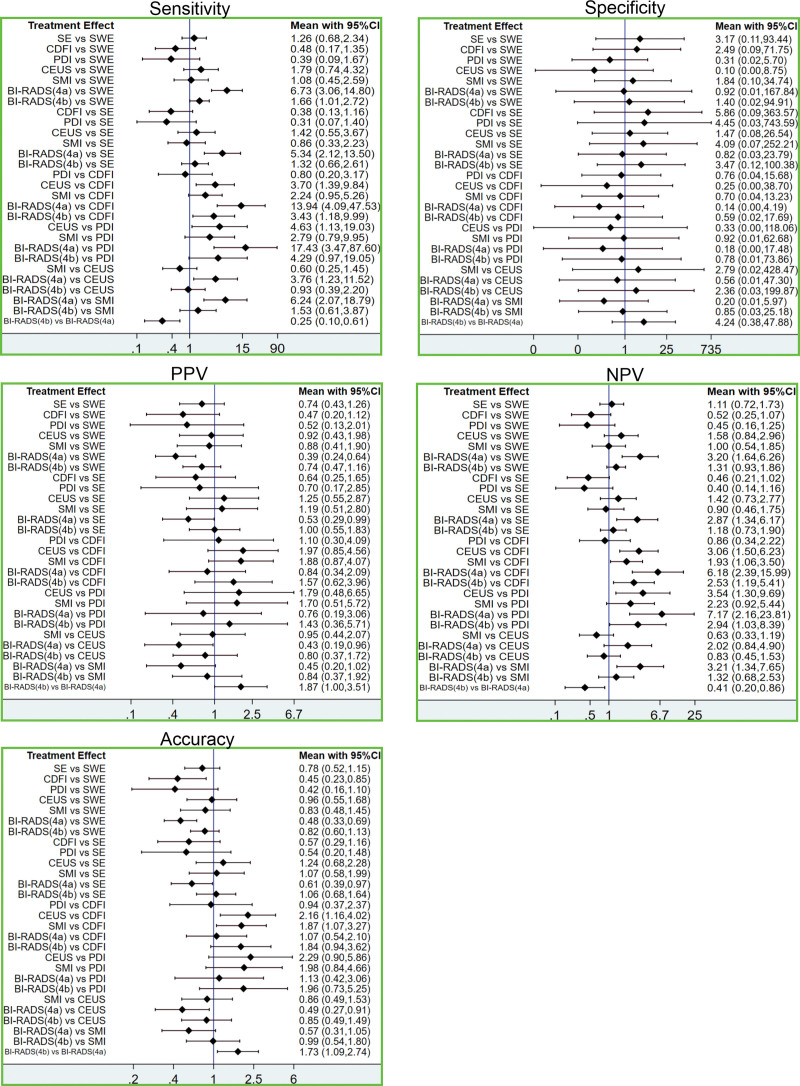
A total of 36 eligible diagnostic tests regarding 8 ultrasound methods were included in the study. According to this network meta-analysis, Breast Imaging Reporting and Data System (BI-RADS) 4b exhibited higher specificity, PPV, and accuracy and lower sensitivity and NPV than BI-RADS 4a. Contrast-enhanced ultrasound (CEUS) had the highest sensitivity, PPV, NPV and accuracy and superb microvascular imaging (SMI) had the highest specificity among color Doppler flow imaging (CDFI), power Doppler imaging(PDI), SMI and CEUS. There was no significant difference in diagnostic indexes between SMI and CEUS. Shear wave elastrography (SWE) had higher PPV and accuracy and lower sensitivity, specificity NPV than strain elastography (SE).
The results of this network meta-analysis suggested more appropriate combination of different ultrasound modalities is BI-RADS 4b, SMI, and SWE for the diagnosis of breast cancer.
有大量文献分析了各种不同超声方法的检测,但没有通过网络荟萃分析(NMA)综合评估不同超声模式诊断乳腺癌(BC)的诊断价值的文献。每种影像学诊断检查都有其自身的优缺点,任何影像学检查都不足以对疾病做出准确的诊断。因此,本研究旨在通过网络荟萃分析比较不同超声模式的诊断价值,包括二维、硬度和血流的信息,以期了解哪种成像方法更好,以及哪种不同超声模式的组合更适合诊断 BC。
我们利用 Cochrane Library、PubMed 和 Embase 来获取文献和论文。对直接和间接证据进行合并分析,评估 8 种不同超声方法的敏感性、特异性、阳性预测值(PPV)、阴性预测值(NPV)和准确性,以评估比值比(OR)和累积排序曲线下面积(SUCRA)值。
共有 36 项关于 8 种超声方法的诊断试验符合纳入标准。根据这项网络荟萃分析,乳腺影像报告和数据系统(BI-RADS)4b 比 BI-RADS 4a 具有更高的特异性、PPV 和准确性,以及更低的敏感性和 NPV。与彩色多普勒血流成像(CDFI)、能量多普勒成像(PDI)、SMI 和 CEUS 相比,对比增强超声(CEUS)具有更高的敏感性、PPV、NPV 和准确性,而 superb microvascular imaging(SMI)具有更高的特异性。SMI 和 CEUS 之间的诊断指标没有显著差异。与应变弹性成像(SE)相比,剪切波弹性成像(SWE)具有更高的 PPV 和准确性,以及更低的敏感性、特异性和 NPV。
这项网络荟萃分析的结果表明,对于诊断乳腺癌,更合适的不同超声模式的组合是 BI-RADS 4b、SMI 和 SWE。