Department of MedicineUniversity of Massachusetts Chan Medical SchoolWorcesterMassachusettsUSA.
Department of ChemistryMassachusetts Institute of TechnologyCambridgeMassachusettsUSA.
Hepatol Commun. 2022 Oct;6(10):2781-2797. doi: 10.1002/hep4.2058. Epub 2022 Aug 9.
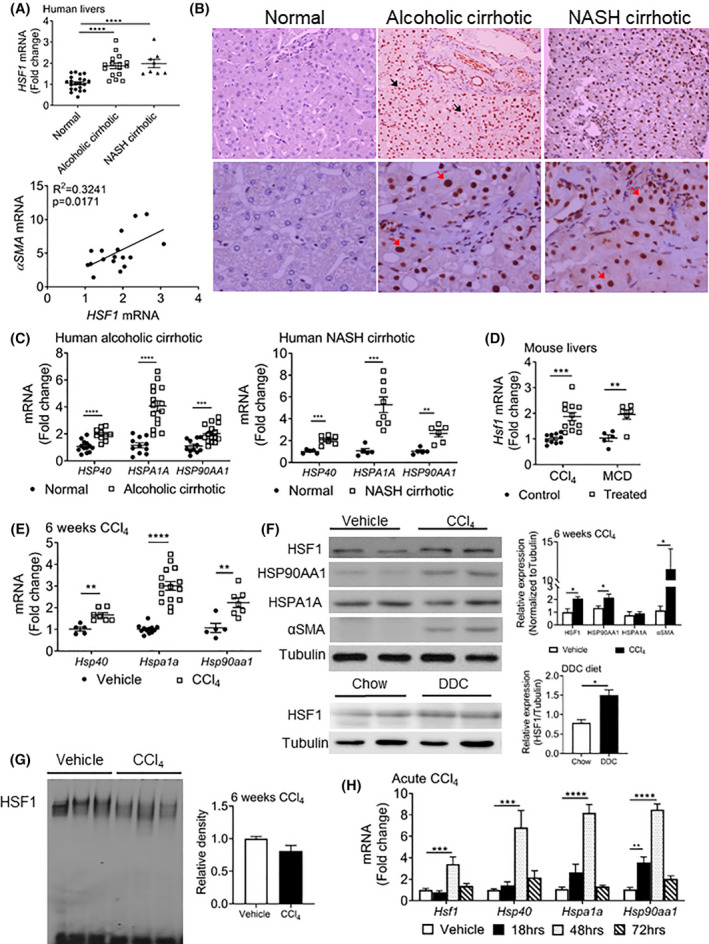
Liver fibrosis is an aberrant wound healing response that results from chronic injury and is mediated by hepatocellular death and activation of hepatic stellate cells (HSCs). While induction of oxidative stress is well established in fibrotic livers, there is limited information on stress-mediated mechanisms of HSC activation. Cellular stress triggers an adaptive defense mechanism via master protein homeostasis regulator, heat shock factor 1 (HSF1), which induces heat shock proteins to respond to proteotoxic stress. Although the importance of HSF1 in restoring cellular homeostasis is well-established, its potential role in liver fibrosis is unknown. Here, we show that HSF1 messenger RNA is induced in human cirrhotic and murine fibrotic livers. Hepatocytes exhibit nuclear HSF1, whereas stellate cells expressing alpha smooth muscle actin do not express nuclear HSF1 in human cirrhosis. Interestingly, despite nuclear HSF1, murine fibrotic livers did not show induction of HSF1 DNA binding activity compared with controls. HSF1-deficient mice exhibit augmented HSC activation and fibrosis despite limited pro-inflammatory cytokine response and display delayed fibrosis resolution. Stellate cell and hepatocyte-specific HSF1 knockout mice exhibit higher induction of profibrogenic response, suggesting an important role for HSF1 in HSC activation and fibrosis. Stable expression of dominant negative HSF1 promotes fibrogenic activation of HSCs. Overactivation of HSF1 decreased phosphorylation of JNK and prevented HSC activation, supporting a protective role for HSF1. Our findings identify an unconventional role for HSF1 in liver fibrosis. Conclusion: Our results show that deficiency of HSF1 is associated with exacerbated HSC activation promoting liver fibrosis, whereas activation of HSF1 prevents profibrogenic HSC activation.
肝纤维化是一种异常的伤口愈合反应,由慢性损伤引起,由肝细胞死亡和肝星状细胞(HSCs)激活介导。虽然纤维化肝脏中的氧化应激诱导是明确的,但关于 HSC 激活的应激介导机制的信息有限。细胞应激通过主蛋白稳态调节剂热休克因子 1(HSF1)触发适应性防御机制,该因子诱导热休克蛋白以响应蛋白毒性应激。尽管 HSF1 在恢复细胞内稳态中的重要性已得到充分确立,但它在肝纤维化中的潜在作用尚不清楚。在这里,我们表明 HSF1 信使 RNA 在人类肝硬化和小鼠纤维化肝脏中被诱导。肝细胞表现出核 HSF1,而在人类肝硬化中表达α平滑肌肌动蛋白的星状细胞不表达核 HSF1。有趣的是,尽管存在核 HSF1,与对照相比,小鼠纤维化肝脏并未显示出 HSF1 DNA 结合活性的诱导。尽管炎症细胞因子反应有限,但 HSF1 缺陷小鼠表现出增强的 HSC 激活和纤维化,并显示出延迟的纤维化消退。星状细胞和肝细胞特异性 HSF1 敲除小鼠表现出更高的致纤维化反应诱导,表明 HSF1 在 HSC 激活和纤维化中具有重要作用。稳定表达显性负性 HSF1 可促进 HSCs 的纤维生成激活。HSF1 的过度激活降低了 JNK 的磷酸化并防止了 HSC 的激活,支持了 HSF1 的保护作用。我们的发现确定了 HSF1 在肝纤维化中的非传统作用。结论:我们的结果表明,HSF1 缺乏与增强的 HSC 激活促进肝纤维化有关,而 HSF1 的激活可防止致纤维的 HSC 激活。