Rastädter Kerstin, Tramontano Andrea, Wurm David J, Spadiut Oliver, Quehenberger Julian
Research Division Biochemical Engineering, Faculty of Technical Chemistry, Institute of Chemical, Environmental and Bioscience Engineering, TU Wien, 1060, Vienna, Austria.
Department of Functional and Evolutionary Ecology, Archaea Biology and Ecogenomics Unit, University of Vienna, 1030, Vienna, Austria.
AMB Express. 2022 Aug 10;12(1):107. doi: 10.1186/s13568-022-01447-1.
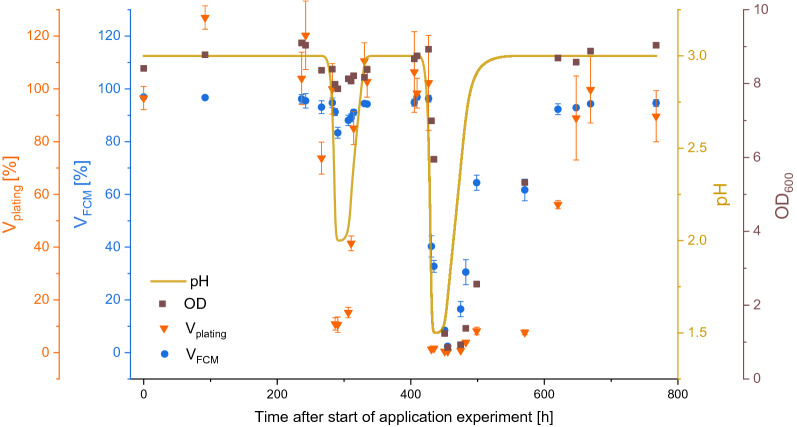
Determination of the viability, ratio of dead and live cell populations, of Sulfolobus acidocaldarius is still being done by tedious and material-intensive plating assays that can only provide time-lagged results. Although S. acidocaldarius, an extremophilic Archaeon thriving at 75 °C and pH 3.0, and related species harbor great potential for the exploitation as production hosts and biocatalysts in biotechnological applications, no industrial processes have been established yet. One hindrance is that during development and scaling of industrial bioprocesses timely monitoring of the impact of process parameters on the cultivated organism is crucial-a task that cannot be fulfilled by traditional plating assays. As alternative, flow cytometry (FCM) promises a fast and reliable method for viability assessment via the use of fluorescent dyes. In this study, commercially available fluorescent dyes applicable in S. acidocaldarius were identified. The dyes, fluorescein diacetate and concanavalin A conjugated with rhodamine, were discovered to be suitable for viability determination via FCM. For showing the applicability of the developed at-line tool for bioprocess monitoring, a chemostat cultivation on a defined growth medium at 75 °C, pH 3.0 was conducted. Over the timeframe of 800 h, this developed FCM method was compared to the plating assay by monitoring the change in viability upon controlled pH shifts. Both methods detected an impact on the viability at pH values of 2.0 and 1.5 when compared to pH 3.0. A logarithmic relationship between the viability observed via plating assay and via FCM was observed.
嗜酸热硫化叶菌(Sulfolobus acidocaldarius)活细胞、死细胞与活细胞群体比例的测定,目前仍需通过繁琐且耗费材料的平板接种试验来完成,而这种方法只能提供滞后的结果。尽管嗜酸热硫化叶菌是一种嗜热古菌,在75°C和pH 3.0的环境中生长旺盛,并且相关物种在生物技术应用中作为生产宿主和生物催化剂具有巨大的开发潜力,但尚未建立任何工业生产流程。其中一个障碍是,在工业生物过程的开发和扩大规模过程中,及时监测工艺参数对培养生物的影响至关重要,而传统的平板接种试验无法完成这项任务。作为替代方法,流式细胞术(FCM)有望通过使用荧光染料提供一种快速且可靠的活力评估方法。在本研究中,确定了适用于嗜酸热硫化叶菌的市售荧光染料。发现荧光素二乙酸酯和与罗丹明偶联的伴刀豆球蛋白A这两种染料适用于通过流式细胞术测定活力。为了展示所开发的在线工具在生物过程监测中的适用性,在75°C、pH 3.0的限定生长培养基上进行了恒化器培养。在800小时的时间范围内,通过监测在控制pH值变化时活力的变化,将这种开发的流式细胞术方法与平板接种试验进行了比较。与pH 3.0相比,两种方法都检测到在pH值为2.0和1.5时对活力有影响。观察到通过平板接种试验和流式细胞术观察到的活力之间存在对数关系。