Division of Pulmonary and Critical Care Medicine, Department of Medicine, Johns Hopkins University, Baltimore, Maryland; and.
Pulmonary, Allergy and Critical Care Division, Department of Medicine, Palliative and Advanced Illness Research Center, Perelman School of Medicine at the University of Pennsylvania, Philadelphia, Pennsylvania.
Ann Am Thorac Soc. 2023 Jan;20(1):83-93. doi: 10.1513/AnnalsATS.202204-349OC.
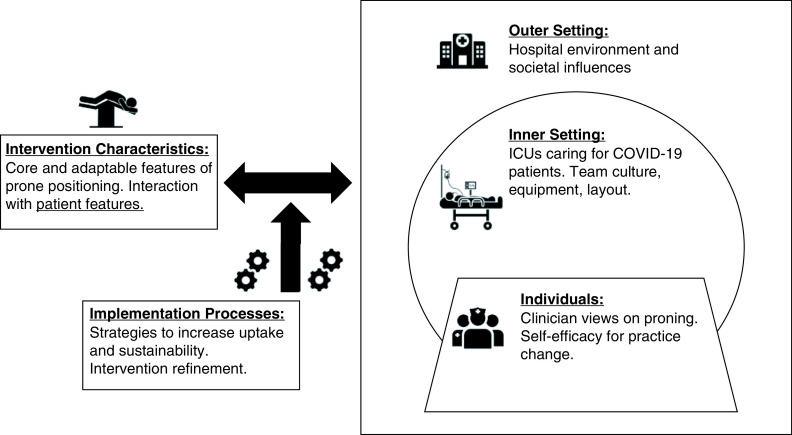
The adoption of prone positioning for patients with acute respiratory distress syndrome (ARDS) has historically been poor. However, in mechanically ventilated patients with coronavirus disease (COVID-19) ARDS, proning has increased. Understanding the factors influencing this change is important for further expanding and sustaining the use of prone positioning in appropriate clinical settings. To characterize factors influencing the implementation of prone positioning in mechanically ventilated patients with COVID-19 ARDS. We conducted a qualitative study using semistructured interviews with 40 intensive care unit (ICU) team members (physicians, nurses, advanced practice providers, respiratory therapists, and physical therapists) working at two academic hospitals. We used the Consolidated Framework for Implementation Research, a widely used implementation science framework outlining important features of implementation, to structure the interview guide and thematic analysis of interviews. ICU clinicians reported that during the COVID-19 pandemic, proning was viewed as standard early therapy for COVID-19 ARDS rather than salvage therapy for refractory hypoxemia. By caring for large volumes of proned patients, clinicians gained increased comfort with proning and now view proning as a low-risk, high-benefit intervention. Within ICUs, adequate numbers of trained staff members, increased team agreement around proning, and the availability of specific equipment (e.g., to limit pressure injuries) facilitated greater proning use. Hospital-level supports included proning teams, centralized educational resources specific to the management of COVID-19 (including a recommendation for prone positioning), and an electronic medical record proning order. Important implementation processes included informal dissemination of best practices through on-the-job learning and team interactions during routine bedside care. The implementation of prone positioning for COVID-19 ARDS took place in the context of evolving clinician viewpoints and ICU team cultures. Proning was facilitated by hospital support and buy-in and leadership from bedside clinicians. The successful implementation of prone positioning during the COVID-19 pandemic may serve as a model for the implementation of other evidence-based therapies in critical care.
俯卧位通气在急性呼吸窘迫综合征(ARDS)患者中的应用一直很差。然而,在患有冠状病毒病(COVID-19)ARDS 的机械通气患者中,俯卧位通气的应用有所增加。了解影响这一变化的因素对于进一步扩大和维持俯卧位通气在适当临床环境中的应用非常重要。本研究旨在描述影响 COVID-19 ARDS 机械通气患者实施俯卧位通气的因素。
我们对在两家学术医院工作的 40 名重症监护病房(ICU)团队成员(医生、护士、高级执业医师、呼吸治疗师和物理治疗师)进行了半结构式访谈,采用定性研究方法。我们使用了广泛应用于实施科学的整合实施研究框架(Consolidated Framework for Implementation Research),该框架概述了实施的重要特征,为访谈指南和访谈的主题分析提供了结构。
ICU 临床医生报告说,在 COVID-19 大流行期间,俯卧位通气被视为 COVID-19 ARDS 的早期标准治疗方法,而不是难治性低氧血症的挽救性治疗方法。通过护理大量俯卧位患者,临床医生对俯卧位通气的接受程度不断提高,现在将其视为一种低风险、高收益的干预措施。在 ICU 内,经过培训的足够数量的工作人员、团队对俯卧位通气的一致认可以及特定设备(例如,限制压疮)的可用性,促进了更多的俯卧位通气应用。医院层面的支持包括俯卧位通气团队、专门针对 COVID-19 管理的集中教育资源(包括对俯卧位通气的推荐)以及电子病历中的俯卧位通气医嘱。重要的实施流程包括通过在职学习和常规床边护理期间的团队互动,非正式传播最佳实践。
COVID-19 ARDS 患者俯卧位通气的实施是在临床医生观点和 ICU 团队文化不断发展的背景下进行的。医院支持、临床医生的投入和领导促进了俯卧位通气的实施。COVID-19 大流行期间俯卧位通气的成功实施可能为重症监护中其他循证治疗方法的实施提供范例。