Department of Periodontology, Service of Odontology, Rothschild Hospital, AP-HP, U.F.R. of Odontology-Garancière, University of Paris Cité, Paris, France.
INSERM U1153/INRAE U1125/CNAM, Nutritional Epidemiology Research Unit (EREN), Epidemiology and Statistics Research Center-University of Paris (CRESS), Sorbonne Paris Nord University, 74 Rue Marcel Cachin, 93017, Bobigny, France.
Qual Life Res. 2023 Jan;32(1):259-272. doi: 10.1007/s11136-022-03215-x. Epub 2022 Aug 10.
Periodontitis, as a chronic, multifactorial inflammatory disease, has complex relationships with other diseases and ultimately with well-being. The aim of this cross-sectional study was to investigate the association between self-report periodontitis, as measured with the recently developed and validated modified Periodontal Screening Score (mPESS), and oral health-related quality of life (OHRQol) in a large population-based sample derived from the French NutriNet-Santé e-cohort.
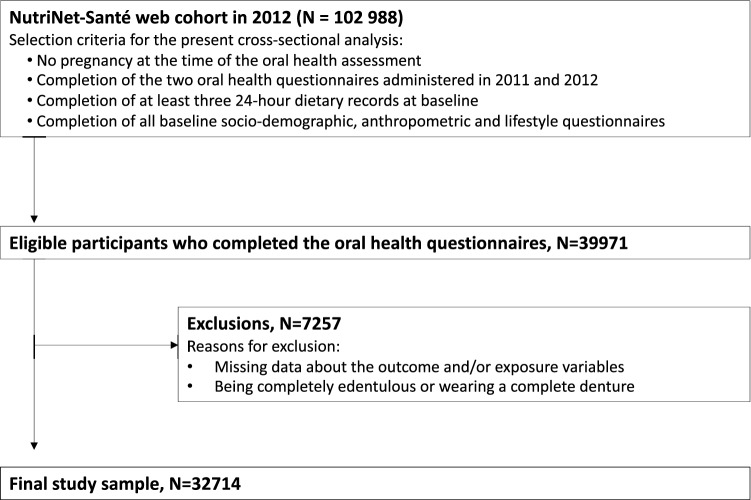
The sample was composed of 32,714 adults (75.5% women) with a mean age of 48.8 ± 13.9 years. Periodontitis was assessed based on age, smoking, and oral health status data obtained in 2011-2012, which allowed calculating the mPESS. An mPESS ≥ 5 was used to identify individuals at risk of severe periodontitis (main exposure). OHRQoL was measured with the Oral Health Impact Profile (OHIP-14) (main outcome) and the total score was dichotomized for analysis. Multivariable logistic regression analyses, considering physical health status, dietary and lifestyle confounding variables, were performed.
Overall, 6407 participants (19.6%) were at a high risk of severe periodontitis. A total of 7383 participants (22.6%) presented a relatively poor OHRQoL (OHIP-14 > 8, highest quartile). In the multivariable model, each of the following variables was independently and significantly associated with lower OHRQoL: older age (50-64 years), female sex, obesity, snacking between meals, frequent consumption of soft drinks and sweets/chocolate, risk of severe periodontitis, and having < 20 natural teeth were significantly. An mPESS ≥ 5 showed the highest odds for relatively poor OHRQoL (OR = 3.45; 95% CI 3.21-3.72).
The results support the association between periodontitis and OHRQoL in non-clinical samples. The use of mPESS could be tested in future prevention programs aiming at improving OHRQoL.
牙周炎是一种慢性、多因素炎症性疾病,与其他疾病,最终与健康状况有着复杂的关系。本横断面研究的目的是调查最近开发并验证的改良牙周筛查评分(mPESS)测量的自我报告牙周炎与来自法国 NutriNet-Santé 队列的大型基于人群样本的口腔健康相关生活质量(OHRQoL)之间的关联。
该样本由 32714 名成年人(75.5%为女性)组成,平均年龄为 48.8±13.9 岁。牙周炎的评估基于 2011-2012 年获得的年龄、吸烟和口腔健康状况数据,这允许计算 mPESS。mPESS≥5 用于识别有严重牙周炎风险的个体(主要暴露)。OHRQoL 采用 Oral Health Impact Profile (OHIP-14) 进行测量(主要结局),总分进行二分分析。进行多变量逻辑回归分析,考虑身体健康状况、饮食和生活方式混杂变量。
总体而言,6407 名参与者(19.6%)有严重牙周炎的高风险。共有 7383 名参与者(22.6%)的口腔健康相关生活质量较差(OHIP-14>8,最高四分位)。在多变量模型中,以下每个变量都与较低的 OHRQoL 独立且显著相关:年龄较大(50-64 岁)、女性、肥胖、两餐之间吃零食、经常食用软饮料和甜食/巧克力、严重牙周炎风险和天然牙齿数<20。mPESS≥5 显示出相对较差的 OHRQoL 的最高可能性(OR=3.45;95%CI 3.21-3.72)。
这些结果支持非临床样本中牙周炎与 OHRQoL 之间的关联。未来的预防计划可以测试使用 mPESS 来提高 OHRQoL。