Prokopczyk Adam, Wochyński Zbigniew
Department of Sports and Defence Education, Faculty of Sport Sciences, Poznan University of Physical Education, Poznan, Poland.
Department of Air Transport Safety, Polish Air Force University, Dęblin, Poland.
BMC Sports Sci Med Rehabil. 2022 Aug 10;14(1):153. doi: 10.1186/s13102-022-00547-6.
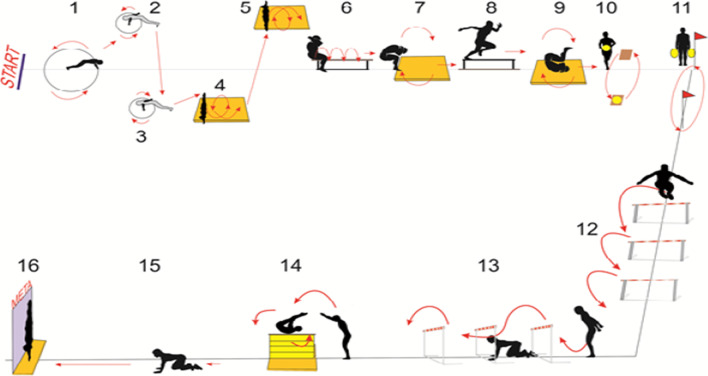
The aim of the study was to check the changes in the level of physical fitness and body composition after a directed training process in cadets-pilots, in relation to control group.
The study involved 29 cadets studying at the Air Force Military Academy in Dęblin. Group A (study group)-second year pilots (n = 17), male, with an average age of 19.94 ± 1.3 years, studying to become an aircraft pilot, who realized 35-h directed training process based on the Aviation Synthetic Efficiency Test (ASET) and group B (control group)-second year in the field of ground navigation (n = 12), male, with an average age of 19.83 ± 1.27 years, completing the standard physical education process. In both groups, the fitness tests and physiological studies were conducted twice time: before starting the training process-study I; after the training process-study II. Fat mass (FM), fat-free mass (FFM), muscle mass (MM), total body water (TBW), extracellular water (ECW) and intracellular water (ICW) were measurement with using the bioimpedance method with using body composition analyzer the AKERN 101 type BIA 101SE.
In group A in study II, fitness was at a good level, while in group B it was below the standard expected for pilots. There was statistically significant decrease in fat mass (FM) and increase in fat-free mass (FFM), muscle mass (MM), total body water (TBW) in group A compared to group B. In study II, group A showed no significant correlation between ASET and FM, FFM, MM, TBW while group B showed statistically significant correlations.
The results obtained in study II showed an increase in directed physical fitness in groups A and B, as measured by ASET. In both groups A and B, the training process decreased FM and increased FFM, MM, and TBW, but a greater effect of these changes was observed in group A.
本研究旨在检查定向训练过程后飞行学员的体能水平和身体成分变化,并与对照组进行比较。
本研究涉及29名在德布林空军军事学院学习的学员。A组(研究组)为二年级飞行员(n = 17),男性,平均年龄19.94 ± 1.3岁,正在接受成为飞机飞行员的培训,他们基于航空综合效率测试(ASET)进行了35小时的定向训练;B组(对照组)为地面导航专业二年级学生(n = 12),男性,平均年龄19.83 ± 1.27岁,完成标准体育课程。两组均在训练开始前(研究I)和训练结束后(研究II)进行了两次体能测试和生理研究。使用AKERN 101型BIA 101SE人体成分分析仪通过生物电阻抗法测量脂肪量(FM)、去脂体重(FFM)、肌肉量(MM)、全身水(TBW)、细胞外水(ECW)和细胞内水(ICW)。
在研究II中,A组的体能处于良好水平,而B组低于飞行员预期标准。与B组相比,A组的脂肪量(FM)显著降低,去脂体重(FFM)、肌肉量(MM)、全身水(TBW)增加。在研究II中,A组的ASET与FM、FFM、MM、TBW之间无显著相关性,而B组具有统计学显著相关性。
研究II获得的结果表明,通过ASET测量,A组和B组的定向体能均有所提高。A组和B组的训练过程均使FM降低,FFM、MM和TBW增加,但A组这些变化的效果更明显。