Department of Health Systems Governance and Financing, World Health Organization, avenue Appia 20, 1211 Geneva 27, Switzerland.
World Health Organization Regional Office for South-East Asia, New Delhi, India.
Bull World Health Organ. 2020 Feb 1;98(2):132-139. doi: 10.2471/BLT.19.234153. Epub 2019 Nov 29.
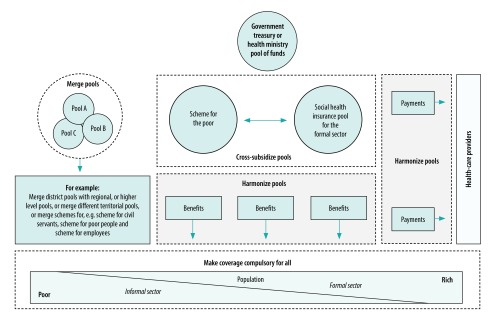
Universal health coverage (UHC) means that all people can access health services of good quality without experiencing financial hardship. Three health financing functions - revenue raising, pooling of funds and purchasing health services - are vital for UHC. This article focuses on pooling: the accumulation and management of prepaid financial resources. Pooling creates opportunities for redistribution of resources to support equitable access to needed services and greater financial protection even if additional revenues for UHC cannot be raised. However, in many countries pooling arrangements are very fragmented, which create barriers to redistribution. The purpose of this article is to provide an overview of pooling reform options to support countries who are exploring ways to enhance redistribution of funds. We outline four broad types of pooling reforms and discuss their potential and challenges in addressing fragmentation of health financing: (i) shifting to compulsory or automatic coverage for everybody; (ii) merging different pools to increase the number of pool members and the diversity of pool members' health needs and risks; (iii) cross-subsidization of pools that have members with lower revenues and higher health risks; and (iv) harmonization across pools, such as benefits, payment methods and rates. Countries can combine several reform elements. Whether the potential for redistribution is actually realized through a pooling reform also depends on the alignment of the pooling structure with revenue raising and purchasing arrangements. Finally, the scope for reform is constrained by institutional and political feasibility, and the political economy around pooling reforms needs to be anticipated and managed.
全民健康覆盖(UHC)是指所有人都能够获得高质量的卫生服务,而不会陷入经济困境。健康融资的三个功能——筹集资金、资金汇集和购买卫生服务——对 UHC 至关重要。本文重点介绍汇集:即预先筹集资金的积累和管理。汇集为资源的再分配提供了机会,有助于公平获得所需服务,并提供更大的财务保障,即使无法为 UHC 筹集更多资金。然而,在许多国家,汇集安排非常分散,这给资源再分配造成了障碍。本文的目的是概述汇集改革方案,以支持正在探索增强资金再分配途径的国家。我们概述了四种广泛的汇集改革类型,并讨论了它们在解决卫生融资碎片化方面的潜力和挑战:(i)转向对所有人的强制性或自动覆盖;(ii)合并不同的资金池,以增加资金池成员数量和成员的健康需求和风险多样性;(iii)对收入较低和健康风险较高的资金池进行交叉补贴;(iv)在资金池之间实现协调,例如福利、支付方式和费率。各国可以结合使用几种改革要素。汇集改革是否能够真正实现再分配潜力,还取决于汇集结构与资金筹集和购买安排的一致性。最后,改革的范围受到制度和政治可行性的限制,需要预测和管理汇集改革的政治经济。