Department of Pathophysiology, Faculty of Medicine University of Nis, Nis, Serbia.
Clinic of Cardiology, University Clinical Center of Nis, Nis, Serbia.
J Clin Lab Anal. 2022 Sep;36(9):e24652. doi: 10.1002/jcla.24652. Epub 2022 Aug 10.
Coronavirus disease 2019 (COVID-19) profoundly affects the immune and hematopoietic systems with various degrees of reactive changes in the blood cell counts. Immuno-inflammatory indices are considered a simple and effective tool in the prediction of COVID-19 outcomes. We aimed to evaluate and compare the usefulness of leukocyte and platelet counts-based immuno-inflammatory indices on admission to hospital in predicting COVID-19 progression and mortality.
A total of 945 patients were enrolled. In addition to blood cell counts, we assessed hemogram-derived immuno-inflammatory indices in relation to COVID-19 progression and death. The indices were tested by analysis of variance, receiver operating characteristic curve analysis, and binomial logistic regressions.
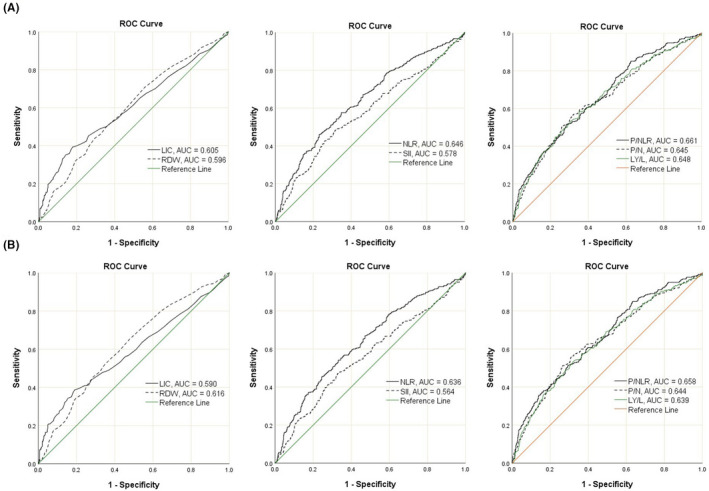
Patients with severe COVID-19 had significantly higher counts of neutrophils, eosinophils, and large immature cells (LIC), while decreased counts of platelets and monocytes. Lymphopenia was found in all of the patients, but without significant association with the outcomes. Patients with a LIC count ≥0.265 x 0 /L had 54.7% more odds of having COVID-19 progression. In multivariable analyses, platelets/neutrophil-to-lymphocyte ratio (P/NLR) and platelets-to-neutrophil radio (P/N) were significant independent predictors of COVID-19 progression and mortality. The odds of a poor outcome were two times higher in cases with P/NLR < 43 x 10 /L and P/N < 29 x 10 /L.
Indices that include platelet count in combination with neutrophil and/or lymphocyte counts displayed the best discriminatory ability and prognostic value of COVID-19 outcomes. Additionally, LIC showed promising results in the early identification of severe COVID-19.
2019 年冠状病毒病(COVID-19)对免疫系统和造血系统有深远影响,血细胞计数会发生不同程度的反应性变化。免疫炎症指标被认为是预测 COVID-19 结局的一种简单有效的工具。我们旨在评估和比较入院时基于白细胞和血小板计数的免疫炎症指标在预测 COVID-19 进展和死亡率方面的作用。
共纳入 945 例患者。除血细胞计数外,我们还评估了与 COVID-19 进展和死亡相关的基于全血细胞计数的免疫炎症指标。采用方差分析、受试者工作特征曲线分析和二项逻辑回归对这些指标进行了检验。
重症 COVID-19 患者的中性粒细胞、嗜酸性粒细胞和大未成熟细胞(LIC)计数明显升高,而血小板和单核细胞计数降低。所有患者均存在淋巴细胞减少症,但与结局无明显关联。LIC 计数≥0.265×0 /L 的患者发生 COVID-19 进展的几率增加 54.7%。多变量分析显示,血小板/中性粒细胞与淋巴细胞比值(P/NLR)和血小板/中性粒细胞比值(P/N)是 COVID-19 进展和死亡的独立预测因子。P/NLR<43×10 /L 和 P/N<29×10 /L 的患者不良结局的几率增加两倍。
包含血小板计数与中性粒细胞和/或淋巴细胞计数的指数对 COVID-19 结局的区分能力和预测价值最佳。此外,LIC 在早期识别重症 COVID-19 方面显示出良好的结果。