Mastronikolis Stylianos, Pagkalou Marina, Plotas Panagiotis, Kagkelaris Konstantinos, Georgakopoulos Constantinos D
Department of Ophthalmology, University Hospital of Patras, 26504 Patras, Greece.
Department of Neurosurgery, James Cook University Hospital, Middlesbrough TS4 3BW, UK.
Exp Ther Med. 2022 Jul 28;24(3):602. doi: 10.3892/etm.2022.11539. eCollection 2022 Sep.
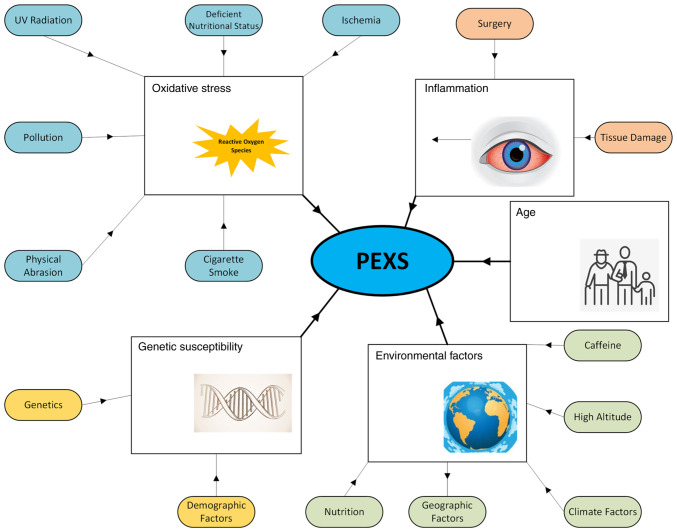
Pseudoexfoliation syndrome (PEXS) is a systemic disease caused by defects in the extracellular matrix (ECM) remodelling process leading to the chronic deposition of extracellular, fibrillary, white flaky pseudoexfoliation material (PEXM) throughout the body. Specifically, PEXM deposits on the lens capsule cause open-angle glaucoma, cataracts and blindness in patients with PEXS. Several gene single nucleotide polymorphisms are linked to the development of PEXS in humans, including lysyl oxidase-like 1 gene, clusterin and fibulin-5. The exact reason for the PEXM generation and its resulting pathogenesis is not well understood. However, defective ECM remodelling and oxidative stress (OS) have been hypothesized as significant events leading to the PEXM. Specifically, the link between OS and PEXS has been well studied, although the investigation is still ongoing. The present review explored recent advances in various aspects of PEXS and the involvement of OS in the eye for PEXS development.
假性剥脱综合征(PEXS)是一种由细胞外基质(ECM)重塑过程缺陷引起的全身性疾病,导致细胞外纤维状白色片状假性剥脱物质(PEXM)在全身慢性沉积。具体而言,PEXM沉积在晶状体囊上会导致PEXS患者发生开角型青光眼、白内障和失明。几种基因单核苷酸多态性与人类PEXS的发生有关,包括赖氨酰氧化酶样1基因、簇集蛋白和纤维连接蛋白-5。PEXM产生的确切原因及其发病机制尚不清楚。然而,ECM重塑缺陷和氧化应激(OS)被认为是导致PEXM的重要事件。具体而言,尽管相关研究仍在进行中,但OS与PEXS之间的联系已得到充分研究。本综述探讨了PEXS各方面的最新进展以及OS在PEXS眼部病变中的作用。