Fu Jun
Department of Gynecology and Obstetrics, Ningbo Women and Children's Hospital, Haishu, Ningbo, Zhejiang 315012, P.R. China.
Exp Ther Med. 2022 Jul 19;24(3):583. doi: 10.3892/etm.2022.11520. eCollection 2022 Sep.
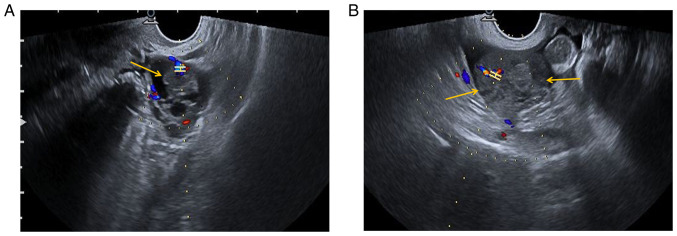
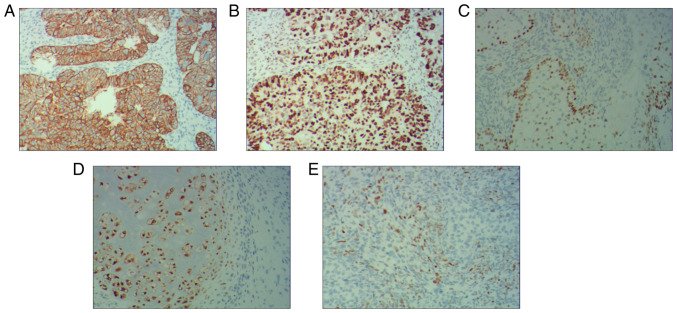
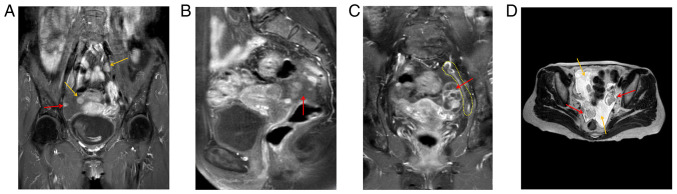
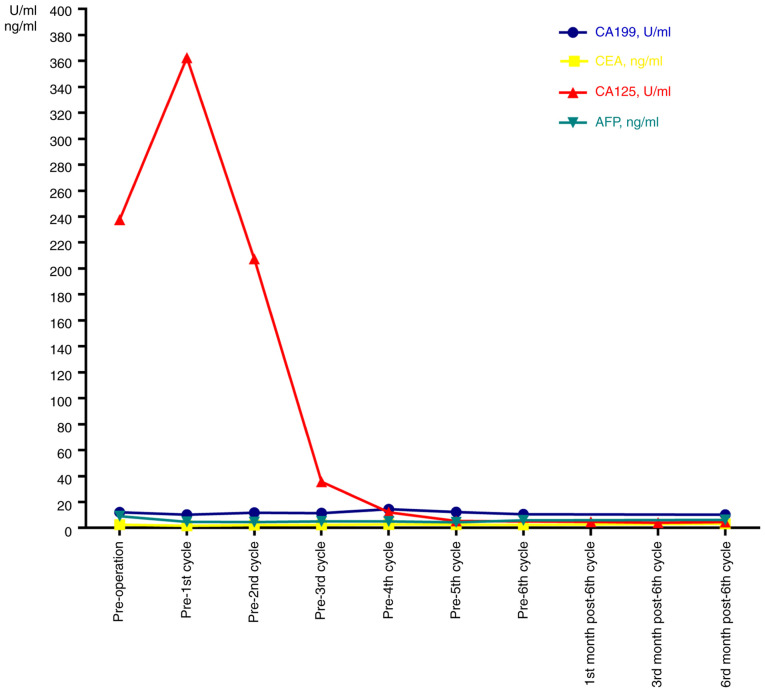
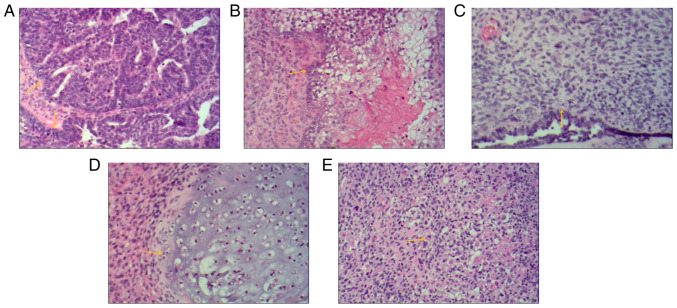
Ovarian carcinosarcoma (OCS) is a rare and lethal gynecological cancer. The present study reports on the case of a 61-year-old post-menopausal female with abdominal distension who was detected to have a large OCS. The patient underwent cytoreductive surgery, including sub-extensive hysterectomy, bilateral adnexectomy, sigmoid colon and partial rectal resection, and lymph node dissection. Postoperative pathology of the bilateral adnexal masses revealed carcinosarcoma. The main components of the carcinoma included serous carcinoma and a small amount of squamous cell carcinoma. The sarcoma components mainly contained fibrosarcoma, as well as a small amount of chondrosarcoma and rhabdomyosarcoma. Infiltrating cells in cancer tissues or metastasis were observed in the serosal surface, muscular and subserosal layers of the uterus, as well as the sigmoid colon and part of the rectum. The patient was diagnosed postoperatively with International Federation of Gynecology and Obstetrics stage IIIC ovarian carcinosarcoma and T3cN1M0 based on the TNM system. The patient then received six cycles of combination chemotherapy using carboplatin, paclitaxel plus bevacizumab. As severe myelosuppression occurred during and after chemotherapy, and bevacizumab was expensive, bevacizumab therapy was not maintained after chemotherapy. However, following chemotherapy, the patient received niraparib oral maintenance therapy. At 6 months after the sixth chemotherapy, cancer antigen 125 levels dropped to 4.55 U/ml (within normal range). Short-term follow-up of 6 months after the end of chemotherapy indicated that the patient had a remission prognosis based on the ultrasonography, computed tomography, magnetic resonance imaging examinations and serum tumor marker levels. The present study indicated that combined chemotherapy and targeted therapy after cytoreductive surgery may be a promising way for the treatment of OCS.
卵巢癌肉瘤(OCS)是一种罕见且致命的妇科癌症。本研究报告了一例61岁绝经后腹胀女性,经检查发现患有巨大卵巢癌肉瘤。患者接受了肿瘤细胞减灭术,包括次广泛子宫切除术、双侧附件切除术、乙状结肠和部分直肠切除术以及淋巴结清扫术。双侧附件肿块的术后病理显示为癌肉瘤。癌的主要成分包括浆液性癌和少量鳞状细胞癌。肉瘤成分主要包含纤维肉瘤,以及少量软骨肉瘤和横纹肌肉瘤。在子宫浆膜面、肌层和浆膜下层以及乙状结肠和部分直肠中观察到癌组织中的浸润细胞或转移。根据国际妇产科联盟(FIGO)分期,患者术后被诊断为IIIC期卵巢癌肉瘤,基于TNM系统为T3cN1M0。患者随后接受了六个周期的联合化疗,使用卡铂、紫杉醇加贝伐单抗。由于化疗期间及化疗后出现严重骨髓抑制,且贝伐单抗昂贵,化疗后未维持贝伐单抗治疗。然而,化疗后患者接受了尼拉帕利口服维持治疗。第六次化疗后6个月,癌抗原125水平降至4.55 U/ml(在正常范围内)。化疗结束后6个月的短期随访表明,根据超声、计算机断层扫描、磁共振成像检查和血清肿瘤标志物水平,患者预后缓解。本研究表明,肿瘤细胞减灭术后联合化疗和靶向治疗可能是治疗卵巢癌肉瘤的一种有前景的方法。