Children's Hospital of Philadelphia, Division of Oncology and Center for Childhood Cancer Research; Philadelphia PA.
Center for Cancer and Blood Disorders, Children's Hospital Colorado; Aurora, CO, USA; Department of Pediatrics, University of Colorado Anschutz Medical Campus; Aurora, CO.
Haematologica. 2023 Feb 1;108(2):457-471. doi: 10.3324/haematol.2022.281456.
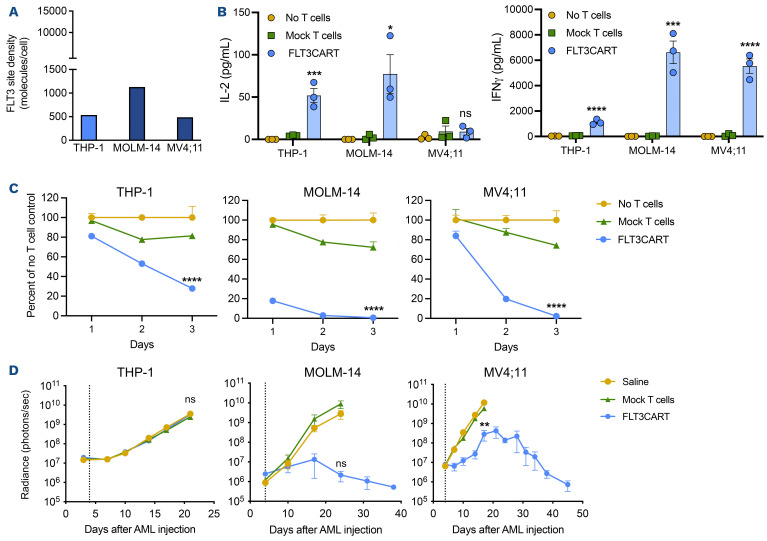
Chimeric antigen receptor (CAR) T-cell immunotherapies targeting CD19 or CD22 induce remissions in the majority of patients with relapsed/refractory B-cell acute lymphoblastic leukemia (ALL), although relapse due to target antigen loss or downregulation has emerged as a major clinical dilemma. Accordingly, great interest exists in developing CAR T cells directed against alternative leukemia cell surface antigens that may help to overcome immunotherapeutic resistance. The fms-like tyrosine kinase 3 receptor (FLT3) is constitutively activated via FLT3 mutation in acute myeloid leukemia (AML) or wild-type FLT3 overexpression in KMT2A (lysine-specific methyltransferase 2A)-rearranged ALL, which are associated with poor clinical outcomes in children and adults. We developed monovalent FLT3-targeted CAR T cells (FLT3CART) and bispecific CD19xFLT3CART and assessed their anti-leukemia activity in preclinical models of FLT3-mutant AML and KMT2A-rearranged infant ALL. We report robust in vitro FLT3CART-induced cytokine production and cytotoxicity against AML and ALL cell lines with minimal cross-reactivity against normal hematopoietic and non-hematopoietic tissues. We also observed potent in vivo inhibition of leukemia proliferation in xenograft models of both FLT3-mutant AML and KMT2A-rearranged ALL, including a post-tisagenlecleucel ALL-to-AML lineage switch patient-derived xenograft model pairing. We further demonstrate significant in vitro and in vivo activity of bispecific CD19xFLT3CART against KMT2Arearranged ALL and posit that this additional approach might also diminish potential antigen escape in these high-risk leukemias. Our preclinical data credential FLT3CART as a highly effective immunotherapeutic strategy for both FLT3- mutant AML and KMT2A-rearranged ALL which is poised for further investigation and clinical translation.
嵌合抗原受体 (CAR) T 细胞免疫疗法针对 CD19 或 CD22,可诱导大多数复发/难治性 B 细胞急性淋巴细胞白血病 (ALL) 患者缓解,但由于靶抗原丢失或下调导致的复发已成为一个主要的临床难题。因此,人们非常感兴趣开发针对替代白血病细胞表面抗原的 CAR T 细胞,这可能有助于克服免疫治疗耐药性。在急性髓系白血病 (AML) 中,Fms 样酪氨酸激酶 3 受体 (FLT3) 通过 FLT3 突变而持续激活,在 KMT2A(赖氨酸特异性甲基转移酶 2A)重排的 ALL 中,野生型 FLT3 过表达,这与儿童和成人的不良临床结局相关。我们开发了单价 FLT3 靶向 CAR T 细胞 (FLT3CART) 和双特异性 CD19xFLT3CART,并在 FLT3 突变型 AML 和 KMT2A 重排婴儿 ALL 的临床前模型中评估了它们的抗白血病活性。我们报告了强大的体外 FLT3CART 诱导的细胞因子产生和对 AML 和 ALL 细胞系的细胞毒性,对正常造血和非造血组织的交叉反应性最小。我们还观察到在 FLT3 突变型 AML 和 KMT2A 重排 ALL 的异种移植模型中,白血病增殖的强大体内抑制作用,包括在 tisagenlecleucel ALL 向 AML 谱系转换患者来源的异种移植模型配对中。我们进一步证明了双特异性 CD19xFLT3CART 对 KMT2A 重排 ALL 的显著体外和体内活性,并认为这种额外的方法也可能减少这些高危白血病中的潜在抗原逃逸。我们的临床前数据证明了 FLT3CART 是一种针对 FLT3 突变型 AML 和 KMT2A 重排 ALL 的高效免疫治疗策略,具有进一步研究和临床转化的潜力。