Department of Experimental Medicine, Sapienza University of Rome, Rome, Italy.
Department of Translational and Precision Medicine, Sapienza University of Rome, Rome, Italy.
J Thromb Haemost. 2022 Nov;20(11):2465-2474. doi: 10.1111/jth.15844. Epub 2022 Aug 21.
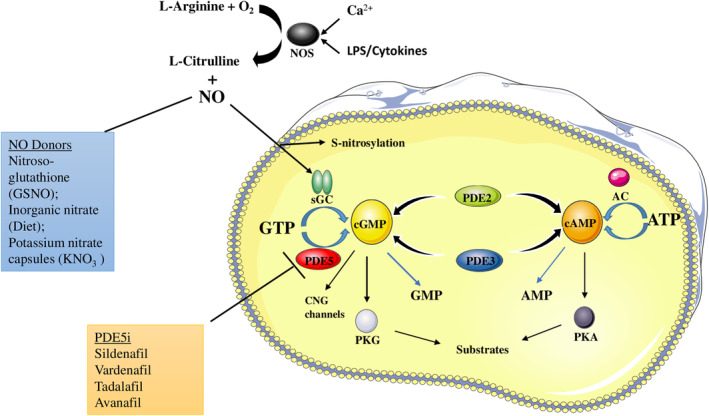
Platelets are the "guardians" of the blood circulatory system. At sites of vessel injury, they ensure hemostasis and promote immunity and vessel repair. However, their uncontrolled activation is one of the main drivers of thrombosis. To keep circulating platelets in a quiescent state, the endothelium releases platelet antagonists including nitric oxide (NO) that acts by stimulating the intracellular receptor guanylyl cyclase (GC). The latter produces the second messenger cyclic guanosine-3',5'-monophosphate (cGMP) that inhibits platelet activation by stimulating protein kinase G, which phosphorylates hundreds of intracellular targets. Intracellular cGMP pools are tightly regulated by a fine balance between GC and phosphodiesterases (PDEs) that are responsible for the hydrolysis of cyclic nucleotides. Phosphodiesterase type 5 (PDE5) is a cGMP-specific PDE, broadly expressed in most tissues in humans and rodents. In clinical practice, PDE5 inhibitors (PDE5i) are used as first-line therapy for erectile dysfunction, pulmonary artery hypertension, and lower urinary tract symptoms. However, several studies have shown that PDE5i may ameliorate the outcome of various other conditions, like heart failure and stroke. Interestingly, NO donors and cGMP analogs increase the capacity of anti-platelet drugs targeting the purinergic receptor type Y, subtype 12 (P2Y12) receptor to block platelet aggregation, and preclinical studies have shown that PDE5i inhibits platelet functions. This review summarizes the molecular mechanisms underlying the effect of PDE5i on platelet activation and aggregation focusing on the therapeutic potential of PDE5i in platelet disorders, and the outcomes of a combined therapy with PDE5i and NO donors to inhibit platelet activation.
血小板是血液循环系统的“守护者”。在血管损伤部位,它们确保止血,并促进免疫和血管修复。然而,它们的失控激活是血栓形成的主要驱动因素之一。为了使循环血小板保持静止状态,内皮细胞释放血小板拮抗剂,包括一氧化氮(NO),它通过刺激细胞内受体鸟苷酸环化酶(GC)起作用。后者产生第二信使环鸟苷酸-3',5'-单磷酸(cGMP),通过刺激蛋白激酶 G 来抑制血小板激活,蛋白激酶 G 使数百个细胞内靶点磷酸化。细胞内 cGMP 池通过 GC 和磷酸二酯酶(PDEs)之间的精细平衡来严格调节,PDEs 负责环核苷酸的水解。磷酸二酯酶 5(PDE5)是一种 cGMP 特异性 PDE,在人类和啮齿动物的大多数组织中广泛表达。在临床实践中,磷酸二酯酶 5 抑制剂(PDE5i)被用作治疗勃起功能障碍、肺动脉高压和下尿路症状的一线药物。然而,多项研究表明,PDE5i 可能改善各种其他疾病的预后,如心力衰竭和中风。有趣的是,NO 供体和 cGMP 类似物增加了针对嘌呤能受体 Y 亚型 12(P2Y12)受体的抗血小板药物阻断血小板聚集的能力,并且临床前研究表明 PDE5i 抑制血小板功能。本综述总结了 PDE5i 对血小板激活和聚集的作用的分子机制,重点介绍了 PDE5i 在血小板疾病中的治疗潜力,以及 PDE5i 与 NO 供体联合抑制血小板激活的治疗效果。