Utsunomiya University Center for Regional Design, Utsunomiya city, Tochigi, Japan.
Nagoya City University Graduate School of Medicine, Nagoya City, Aichi, Japan.
PLoS One. 2022 Aug 11;17(8):e0272996. doi: 10.1371/journal.pone.0272996. eCollection 2022.
The influence of human mobility to the domestic spread of COVID-19 in Japan using the approach of effective distance has not yet been assessed.
We calculated the effective distance between prefectures using the data on laboratory-confirmed cases of COVID-19 from January 16 to August 23, 2020, that were times in the 1st and the 2nd epidemic waves in Japan. We also used the aggregated data on passenger volume by transportation mode for the 47 prefectures, as well as those in the private railway, bus, ship, and aviation categories. The starting location (prefecture) was defined as Kanagawa and as Tokyo for the 1st and the 2nd waves, respectively. The accuracy of the spread models was evaluated using the correlation between time of arrival and effective distance, calculated according to the different starting locations.
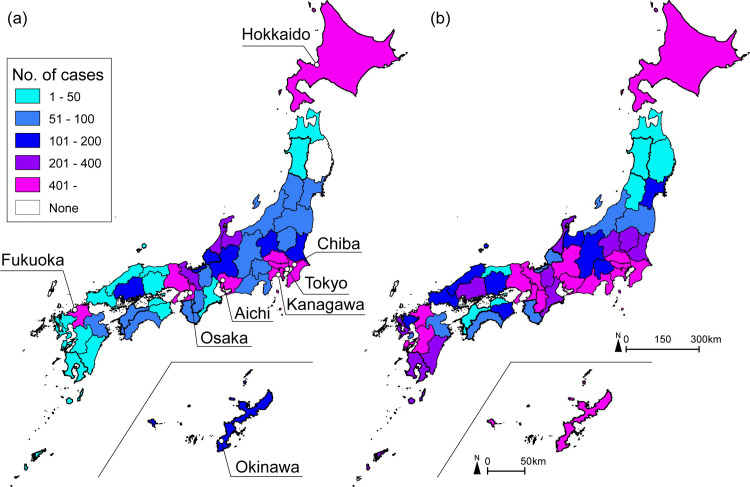
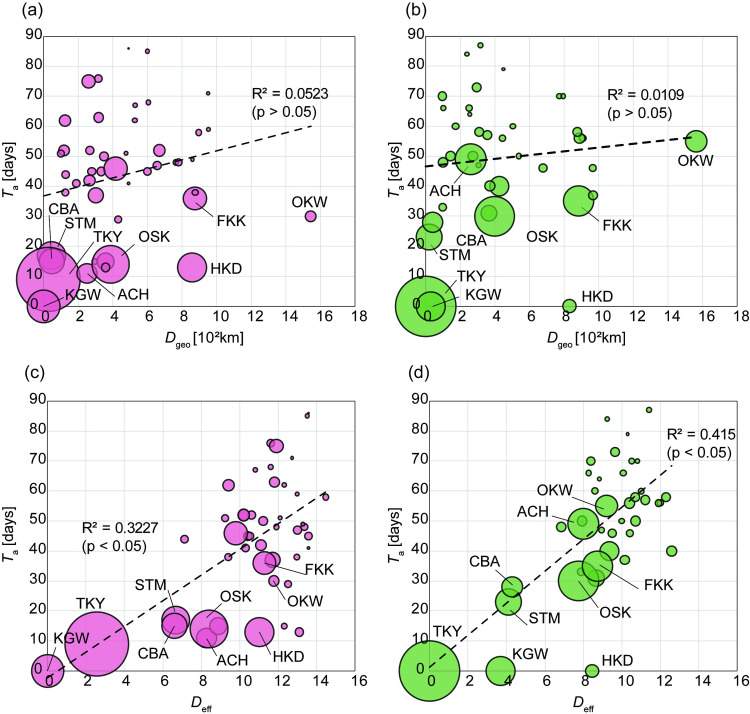
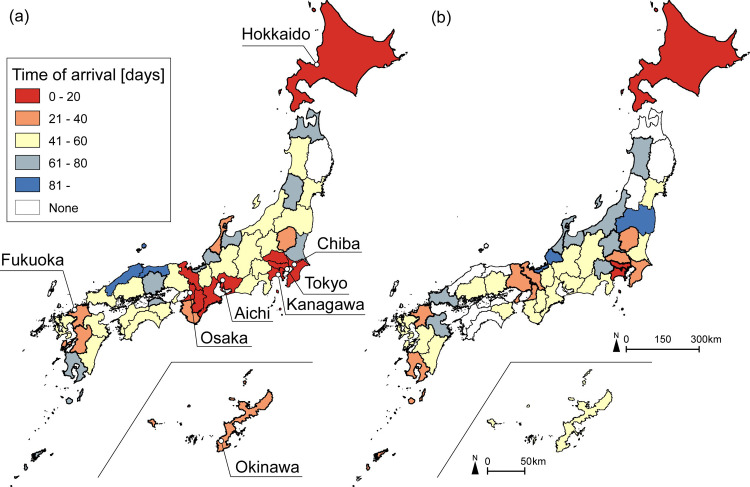
The number of cases in the analysis was 16,226 and 50,539 in the 1st and 2nd epidemic waves, respectively. The relationship between arrival time and geographical distance shows that the coefficient of determination was R2 = 0.0523 if geographical distance Dgeo and time of arrival Ta set to zero at Kanagawa and was R2 = 0.0109 if Dgeo and Ta set to zero at Tokyo. The relationship between arrival time and effective distance shows that the coefficient of determination was R2 = 0.3227 if effective distance Deff and Ta set to zero at Kanagawa and was R2 = 0.415 if Deff and time of arrival Ta set to zero at Tokyo. In other words, the effective distance taking into account the mobility network shows the spatiotemporal characteristics of the spread of infection better than geographical distance. The correlation of arrival time to effective distance showed the possibility of spreading from multiple areas in the 1st epidemic wave. On the other hand, the correlation of arrival time to effective distance showed the possibility of spreading from a specific area in the 2nd epidemic wave.
The spread of COVID-19 in Japan was affected by the mobility network and the 2nd epidemic wave is more affected than those of the 1st epidemic. The effective distance approach has the impact to estimate the domestic spreading COVID-19.
利用有效距离法评估人类流动对日本国内 COVID-19 传播的影响尚未得到评估。
我们使用 2020 年 1 月 16 日至 8 月 23 日期间日本第一波和第二波疫情期间实验室确诊的 COVID-19 病例数据计算了各县之间的有效距离。我们还使用了 47 个县以及私营铁路、公共汽车、船舶和航空类别的客运量汇总数据。起始位置(县)定义为神奈川县和东京都,分别用于第一波和第二波。根据不同的起始位置,根据到达时间和有效距离计算的相关性来评估传播模型的准确性。
第一波和第二波疫情分析病例数分别为 16226 例和 50539 例。到达时间与地理距离的关系表明,如果将地理距离 Dgeo 和到达时间 Ta 设置为神奈川县的零值,决定系数 R2 = 0.0523,如果将 Dgeo 和 Ta 设置为东京都的零值,R2 = 0.0109。到达时间与有效距离的关系表明,如果将有效距离 Deff 和 Ta 设置为神奈川县的零值,决定系数 R2 = 0.3227,如果将 Deff 和 Ta 设置为东京都的零值,R2 = 0.415。换句话说,考虑到流动网络的有效距离可以更好地显示感染传播的时空特征。到达时间与有效距离的相关性表明,第一波疫情存在从多个地区传播的可能性。另一方面,到达时间与有效距离的相关性表明,第二波疫情存在从特定地区传播的可能性。
日本 COVID-19 的传播受到流动网络的影响,第二波疫情比第一波疫情受到的影响更大。有效距离法对估计国内传播的 COVID-19 具有影响。