Assistance Publique des Hôpitaux de Marseille, Aix-Marseille University, CEReSS-Health Service Research and Quality of Life Center, 27, boulevard Jean -Moulin, 13005 Marseille, France; Fondation FondaMental, Créteil, France.
Assistance Publique des Hôpitaux de Marseille, Aix-Marseille University, CEReSS-Health Service Research and Quality of Life Center, 27, boulevard Jean -Moulin, 13005 Marseille, France.
Int J Nurs Stud. 2022 Nov;135:104328. doi: 10.1016/j.ijnurstu.2022.104328. Epub 2022 Jul 23.
There is now a wealth of evidence showing that work is a major determinant of physical and mental health. Recent studies have suggested increased rates of depression in healthcare workers (HCWs) in the context of the Covid-19 pandemic, with direct impact on care quality and productivity.
To determine the rate of clinical depression in a national sample of HCWs in France during the post-Covid-19 area and to identify related factors (professional, individual and health-related risk behaviors) using a structural equation modeling analysis.
A survey comprising a number of standardized scales was sent to public and private national healthcare facilities through the mail or disseminated through emails from professional associations and social networks.
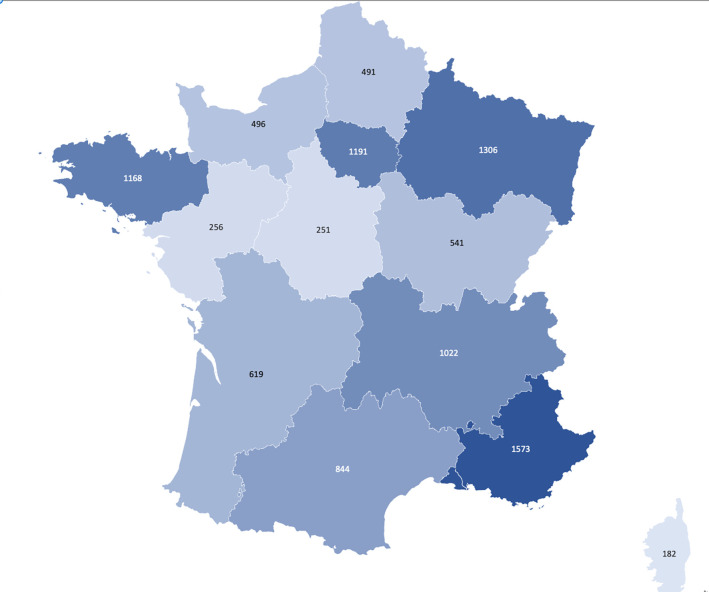
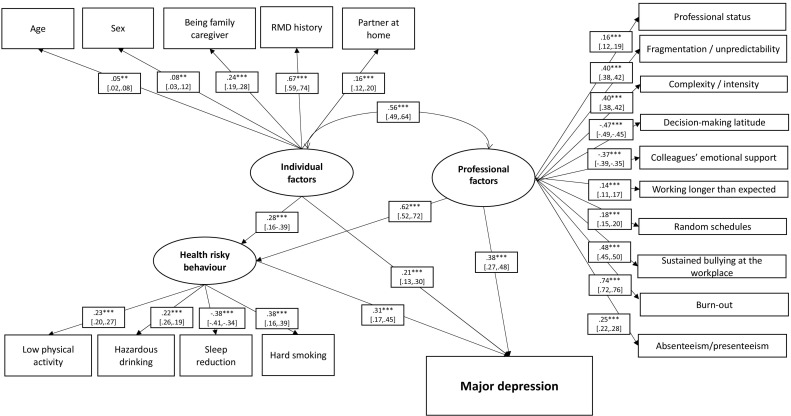
10,325 participants were recruited; 3122 (30.2%, 95% confidence interval [29.4-31.1]) met likely diagnostic criteria for clinical depression. Professional factors had the largest total effect (β = 0.57) (burn-out: β = 0.74, sustained bullying at the workplace β = 0.48 and decision-making latitude β = -0.47), followed by individual factors (β = 0.30) (the main individual factor was recurrent major depression, path coefficient = 0.67). Professional factors had both a direct (path coefficient = 0.38) and indirect (through health risk behaviors, path coefficient = 0.19) effect on depression. Individual factors had a direct (path coefficient 0.21) and indirect (through health risk behaviors (path coefficient = 0.09) effect on depression. Health risk behaviors had a direct effect on depression (path coefficient = 0.31).
These results provide potential explanations for the likely causes of poor psychological health among HCWs. We propose several potential interventions related to professional factors and health risk behaviors. Our results suggest that improving organizational issues, reducing exposure to potentially morally injurious events, promoting brief naps at work and provision of evidence-based prevention approaches have been reported to be helpful in supporting the mental health of hospital staff (not only relaxation or stress management but training in leadership aspects, increasing the knowledge and practice of giving efficient performance feedback, reducing conflicting demands and peer support programs such as Trauma Risk Management. Our data suggest that developing caregivers reported experience and outcome measures (CREMs/CROMs) would be helpful to monitor work environment and its effect on depression in healthcare workers.
现在有大量证据表明,工作是身心健康的主要决定因素。最近的研究表明,在 COVID-19 大流行背景下,医护人员(HCWs)的抑郁率有所上升,直接影响到护理质量和生产力。
在法国 COVID-19 疫情后,确定全国范围内 HCWs 的临床抑郁症发生率,并使用结构方程模型分析确定相关因素(职业、个体和与健康相关的风险行为)。
通过邮件或专业协会和社交网络的电子邮件向公共和私人国家医疗保健机构发送了一项包含多项标准化量表的调查。
共招募了 10325 名参与者;3122 名(30.2%,95%置信区间[29.4-31.1])符合临床抑郁症可能的诊断标准。职业因素的总效应最大(β=0.57)(倦怠:β=0.74,持续工作场所欺凌:β=0.48,决策幅度:β=-0.47),其次是个体因素(β=0.30)(主要个体因素是复发性重度抑郁症,路径系数=0.67)。职业因素对抑郁有直接(路径系数=0.38)和间接(通过健康风险行为,路径系数=0.19)影响。个体因素对抑郁有直接(路径系数 0.21)和间接(通过健康风险行为(路径系数=0.09)影响。健康风险行为对抑郁有直接影响(路径系数=0.31)。
这些结果为 HCWs 心理健康状况不佳的可能原因提供了潜在解释。我们提出了一些与职业因素和健康风险行为相关的潜在干预措施。我们的结果表明,改善组织问题、减少接触潜在道德伤害事件、促进工作中短暂小睡以及提供基于证据的预防方法已被证明有助于支持医院工作人员的心理健康(不仅是放松或压力管理,还有领导力方面的培训、提高知识和实践高效绩效反馈、减少冲突需求和同伴支持计划,如创伤风险管理。我们的数据表明,开发护理人员报告的经验和结果衡量标准(CREMs/CROMs)将有助于监测工作环境及其对医护人员抑郁的影响。