Department of Medical Microbiology, University Medical Centre Utrecht, Utrecht University, Utrecht, The Netherlands.
Julius Center for Health Sciences and Primary Care, University Medical Center Utrecht, Utrecht University, Utrecht, The Netherlands.
BMC Infect Dis. 2022 Aug 11;22(1):687. doi: 10.1186/s12879-022-07653-3.
The Dutch Working Party on Antibiotic Policy (SWAB) in collaboration with relevant professional societies, has updated their evidence-based guidelines on empiric antibacterial therapy of sepsis in adults.
Our multidisciplinary guideline committee generated ten population, intervention, comparison, and outcome (PICO) questions relevant for adult patients with sepsis. For each question, a literature search was performed to obtain the best available evidence and assessed using the Grading of Recommendations Assessment, Development, and Evaluation (GRADE) system. The quality of evidence for clinically relevant outcomes was graded from high to very low. In structured consensus meetings, the committee formulated recommendations as strong or weak. When evidence could not be obtained, recommendations were provided based on expert opinion and experience (good practice statements).
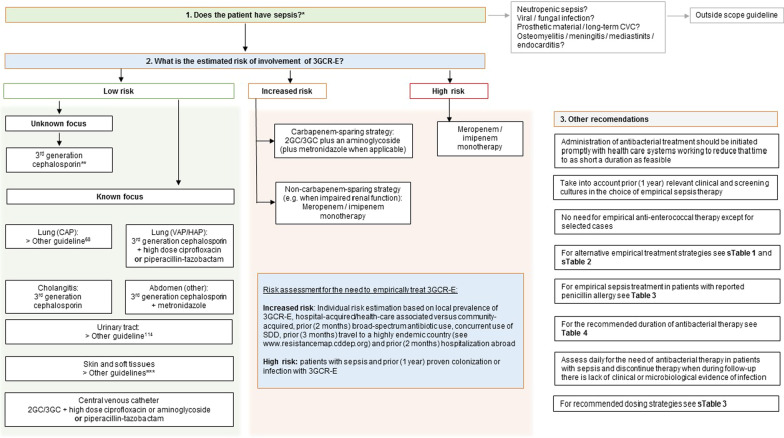
Fifty-five recommendations on the antibacterial therapy of sepsis were generated. Recommendations on empiric antibacterial therapy choices were differentiated for sepsis according to the source of infection, the potential causative pathogen and its resistance pattern. One important revision was the distinction between low, increased and high risk of infection with Enterobacterales resistant to third generation cephalosporins (3GRC-E) to guide the choice of empirical therapy. Other new topics included empirical antibacterial therapy in patients with a reported penicillin allergy and the role of pharmacokinetics and pharmacodynamics to guide dosing in sepsis. We also established recommendations on timing and duration of antibacterial treatment.
Our multidisciplinary committee formulated evidence-based recommendations for the empiric antibacterial therapy of adults with sepsis in The Netherlands.
荷兰抗生素政策工作组(SWAB)与相关专业学会合作,更新了成人脓毒症经验性抗菌治疗的循证指南。
我们的多学科指南委员会提出了十个与成人脓毒症患者相关的人群、干预、比较和结局(PICO)问题。针对每个问题,进行文献检索以获取最佳可用证据,并使用推荐评估、制定与评估分级(GRADE)系统进行评估。对与临床相关结局的证据质量进行了从高到极低的分级。在结构化共识会议上,委员会制定了强弱不同的推荐。当无法获得证据时,根据专家意见和经验(良好实践声明)提供建议。
制定了 55 条关于脓毒症抗菌治疗的建议。根据感染源、潜在病原体及其耐药模式,对脓毒症的经验性抗菌治疗选择进行了区分。一个重要的修订是区分了感染第三代头孢菌素耐药肠杆菌科(3GRC-E)风险低、增加和高的患者,以指导经验性治疗的选择。其他新主题包括有青霉素过敏报告的患者的经验性抗菌治疗以及药代动力学和药效学在脓毒症中的指导剂量作用。我们还制定了抗菌治疗的时机和持续时间的建议。
我们的多学科委员会为荷兰成人脓毒症的经验性抗菌治疗制定了循证建议。