Section for Parasitology, Department of Biomedical Sciences and Veterinary Public Health, Swedish University of Agricultural Sciences, Uppsala, Sweden.
Parasit Vectors. 2022 Aug 11;15(1):290. doi: 10.1186/s13071-022-05399-0.
Next-generation sequencing (NGS) has provided an alternative strategy to study the composition of nematode communities with increased resolution and sensitivity. However, the handling and processing of gigabytes worth of amplicon sequence data produced by an NGS platform is still a major hurdle, limiting the use and adoption of faster and more convenient analysis software.
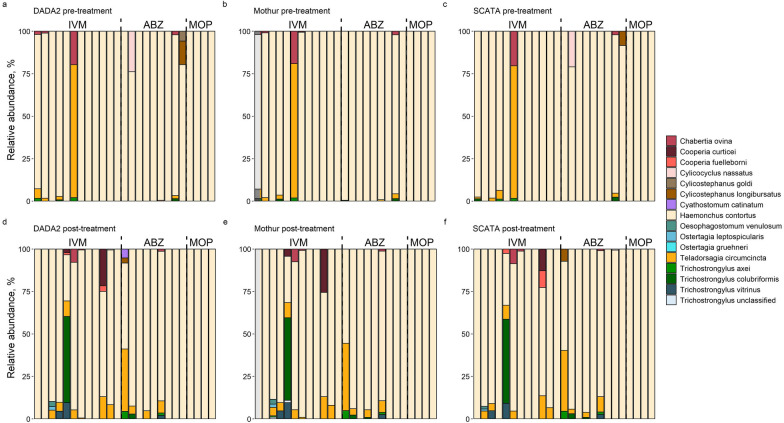
In total 32 paired, fecal samples from Swedish sheep flocks were cultured and the larvae subsequently harvested subjected to internal transcribed spacer 2 (ITS2) amplicon sequencing using the PacBio platform. Samples were analyzed with three different bioinformatic pipelines, i.e. the DADA2, Mothur and SCATA pipelines, to determine species composition and richness.
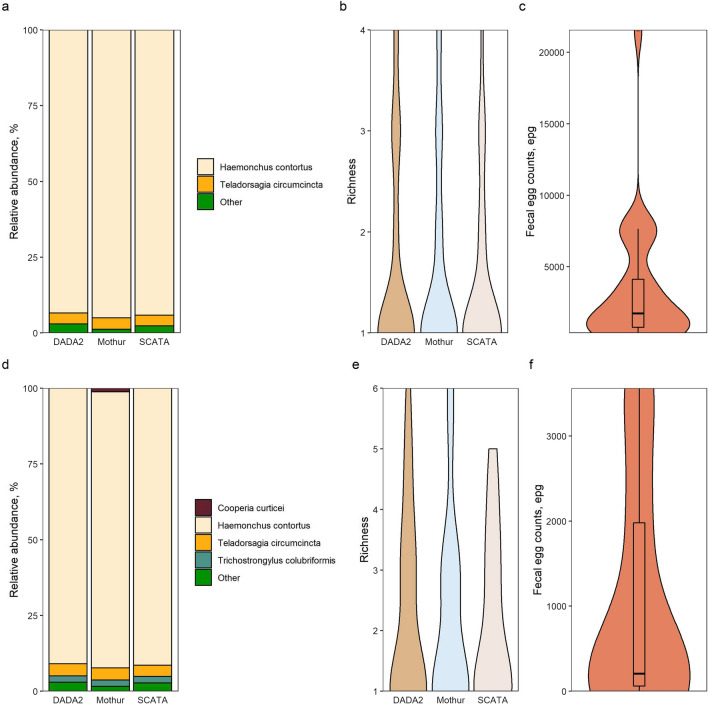
For the the major species tested in this study (Haemonchus contortus, Teladorsagia circumcinta and Trichostrongylus colubriformis) neither relative abundances nor species diversity differed significantly between the three pipelines, effectively showing that all three analysis pipelines, although different in their approaches, yield nearly identical outcomes. In addition, the samples analyzed here had especially high frequencies of H. contortus (90-95% across the three pipelines) both before and after sample treatment, followed by T. circumcinta (3.5-4%). This shows that H. contortus is the parasite of primary importance in contemporary Swedish sheep farms struggling with anthelmintic resistance. Finally, although on average a significant reduction in egg counts was achieved post-treatment, no significant shifts in major species relative frequencies occurred, indicating highly rigid community structures at sheep farms where anthelmintic resistance has been reported.
The findings presented here further contribute to the development and application of NGS technology to study nemabiome compositions in sheep, in addition to expanding our understanding about the most recent changes in parasite species abundances from Swedish sheep farms struggling with anthelmintic resistance.
下一代测序(NGS)为研究线虫群落的组成提供了一种替代策略,具有更高的分辨率和灵敏度。然而,处理和处理 NGS 平台产生的千兆字节级别的扩增子序列数据仍然是一个主要障碍,限制了更快、更方便的分析软件的使用和采用。
共采集了 32 对瑞典绵羊粪便样本进行培养,随后从幼虫中提取内部转录间隔区 2(ITS2)扩增子进行 PacBio 平台测序。使用三种不同的生物信息学管道,即 DADA2、Mothur 和 SCATA 管道,对样本进行分析,以确定物种组成和丰富度。
对于本研究中测试的主要物种(扭毛线虫、卷曲毛线虫和弯角毛线虫),三种管道的相对丰度和物种多样性均无显著差异,有效地表明,尽管三种分析管道的方法不同,但它们的结果几乎完全相同。此外,在此处分析的样本中,H. contortus 的频率特别高(三种管道的比例均为 90-95%),无论是在样本处理之前还是之后,其次是 T. circumcinta(3.5-4%)。这表明 H. contortus 是当代瑞典绵羊养殖场中对抗寄生虫药物产生抗药性的主要寄生虫。最后,尽管治疗后平均卵数显著减少,但主要物种相对频率没有发生显著变化,表明在报告抗寄生虫药物耐药性的绵羊养殖场中,群落结构非常稳定。
本研究结果进一步促进了 NGS 技术在研究绵羊中 nemabiome 组成方面的发展和应用,此外还扩大了我们对瑞典受抗寄生虫药物影响的绵羊养殖场中寄生虫物种丰度最新变化的理解。