Department of Infection Biology and Microbiomes, Institute of Infection, Veterinary and Ecological Sciences, University of Liverpool, Neston, Cheshire CH64 7TE, UK.
Institute for Global Food Security, Queen's University Belfast, Biological Sciences, 19 Chlorine Gardens, Belfast BT9 5DL, UK.
Parasite. 2020;27:69. doi: 10.1051/parasite/2020062. Epub 2020 Dec 4.
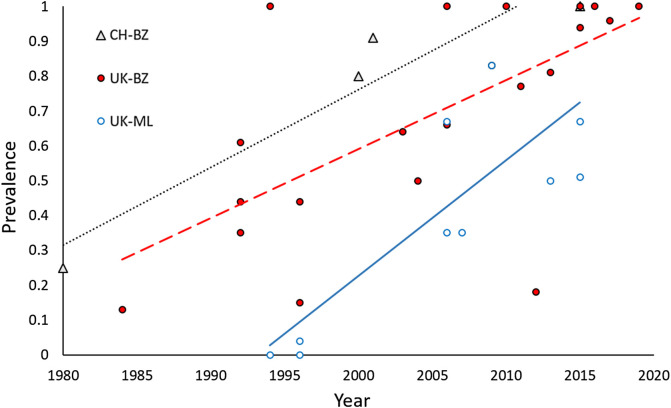
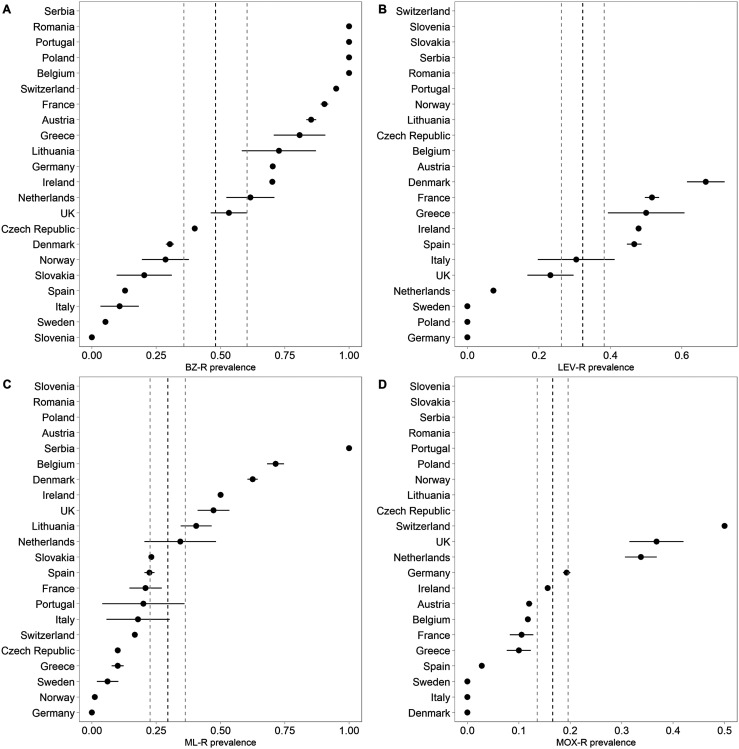
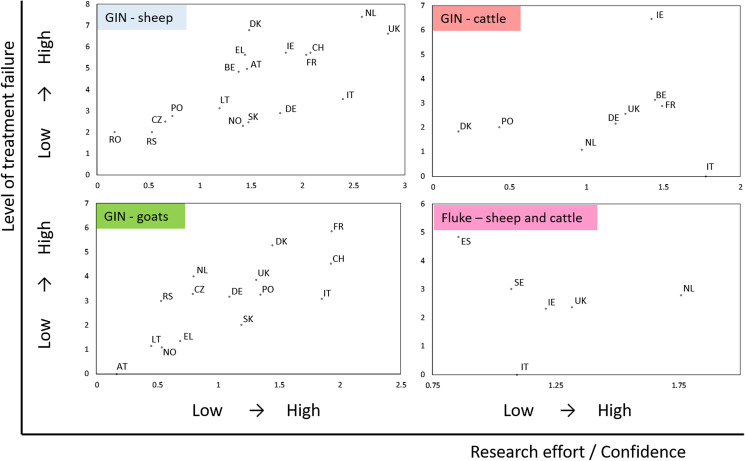
Helminth infections are ubiquitous in grazing ruminant production systems, and are responsible for significant costs and production losses. Anthelmintic Resistance (AR) in parasites is now widespread throughout Europe, although there are still gaps in our knowledge in some regions and countries. AR is a major threat to the sustainability of modern ruminant livestock production, resulting in reduced productivity, compromised animal health and welfare, and increased greenhouse gas emissions through increased parasitism and farm inputs. A better understanding of the extent of AR in Europe is needed to develop and advocate more sustainable parasite control approaches. A database of European published and unpublished AR research on gastrointestinal nematodes (GIN) and liver fluke (Fasciola hepatica) was collated by members of the European COST Action "COMBAR" (Combatting Anthelmintic Resistance in Ruminants), and combined with data from a previous systematic review of AR in GIN. A total of 197 publications on AR in GIN were available for analysis, representing 535 studies in 22 countries and spanning the period 1980-2020. Reports of AR were present throughout the European continent and some reports indicated high within-country prevalence. Heuristic sample size-weighted estimates of European AR prevalence over the whole study period, stratified by anthelmintic class, varied between 0 and 48%. Estimated regional (country) prevalence was highly heterogeneous, ranging between 0% and 100% depending on livestock sector and anthelmintic class, and generally increased with increasing research effort in a country. In the few countries with adequate longitudinal data, there was a tendency towards increasing AR over time for all anthelmintic classes in GIN: aggregated results in sheep and goats since 2010 reveal an average prevalence of resistance to benzimidazoles (BZ) of 86%, macrocyclic lactones except moxidectin (ML) 52%, levamisole (LEV) 48%, and moxidectin (MOX) 21%. All major GIN genera survived treatment in various studies. In cattle, prevalence of AR varied between anthelmintic classes from 0-100% (BZ and ML), 0-17% (LEV) and 0-73% (MOX), and both Cooperia and Ostertagia survived treatment. Suspected AR in F. hepatica was reported in 21 studies spanning 6 countries. For GIN and particularly F. hepatica, there was a bias towards preferential sampling of individual farms with suspected AR, and research effort was biased towards Western Europe and particularly the United Kingdom. Ongoing capture of future results in the live database, efforts to avoid bias in farm recruitment, more accurate tests for AR, and stronger appreciation of the importance of AR among the agricultural industry and policy makers, will support more sophisticated analyses of factors contributing to AR and effective strategies to slow its spread.
在放牧反刍动物生产系统中,寄生虫感染普遍存在,这给畜牧业造成了重大的经济损失。寄生虫对抗寄生虫药物的耐药性(AR)目前在整个欧洲广泛存在,尽管在某些地区和国家,我们对抗寄生虫药物耐药性的了解仍然存在差距。AR 是现代反刍动物生产可持续性的主要威胁,导致生产力下降、动物健康和福利受损,以及通过增加寄生虫感染和农场投入而增加温室气体排放。因此,需要更好地了解欧洲 AR 的程度,以便制定和倡导更可持续的寄生虫控制方法。
欧洲 COST 行动“COMBAR”(反刍动物对抗寄生虫药物耐药性)的成员汇编了一份关于胃肠道线虫(GIN)和肝片吸虫(Fasciola hepatica)的欧洲已发表和未发表的 AR 研究的数据库,并结合了之前对 GIN 中 AR 的系统评价的数据。共有 197 篇关于 GIN 中 AR 的论文可供分析,代表了 22 个国家的 535 项研究,研究时间跨度为 1980 年至 2020 年。整个欧洲大陆都有关于 AR 的报告,一些报告表明,国内的流行率很高。根据驱虫剂类别对整个研究期间欧洲 AR 流行率的启发式样本量加权估计值,在 0 到 48%之间变化。估计的区域(国家)流行率差异很大,取决于牲畜部门和驱虫剂类别,在一个国家的研究工作增加的情况下,流行率从 0%到 100%不等。在少数具有足够纵向数据的国家中,所有驱虫剂类别在 GIN 中的 AR 呈上升趋势:自 2010 年以来,绵羊和山羊的综合结果显示,对苯并咪唑(BZ)的耐药率平均为 86%,大环内酯类除莫昔克丁(ML)外为 52%,左旋咪唑(LEV)为 48%,莫昔克丁(MOX)为 21%。各种研究中各种主要的 GIN 属都能在治疗后存活。在牛中,AR 的流行率因驱虫剂类别而异,从 0-100%(BZ 和 ML)、0-17%(LEV)和 0-73%(MOX)不等,而 Coopria 和 Ostertagia 都能在治疗后存活。在跨越 6 个国家的 21 项研究中报告了疑似对 F. hepatica 的耐药性。对于 GIN 特别是 F. hepatica,存在对疑似 AR 的单个农场进行优先抽样的偏差,并且研究工作偏向于西欧,特别是英国。在实时数据库中持续捕获未来的结果,努力避免农场招募的偏差,对 AR 进行更准确的测试,以及农业产业和政策制定者更加强烈地认识到 AR 的重要性,这将支持对抗寄生虫药物耐药性的更复杂分析和减缓其传播的有效策略。