Occupational Therapy Department, Faculty of Medicine, Nursing and Health Sciences, Monash University, Level 3, Building G, Peninsula Campus 47-49 Moorooduc Hwy, Frankston, VIC 3199, Australia.
Rehabilitation, Ageing and Independent Living (RAIL) Research Centre, Faculty of Medicine, Nursing and Health Sciences, Monash University, Level 3, Building G, Peninsula Campus 47-49 Moorooduc Hwy, Frankston, VIC 3199, Australia.
Int J Environ Res Public Health. 2022 Aug 5;19(15):9681. doi: 10.3390/ijerph19159681.
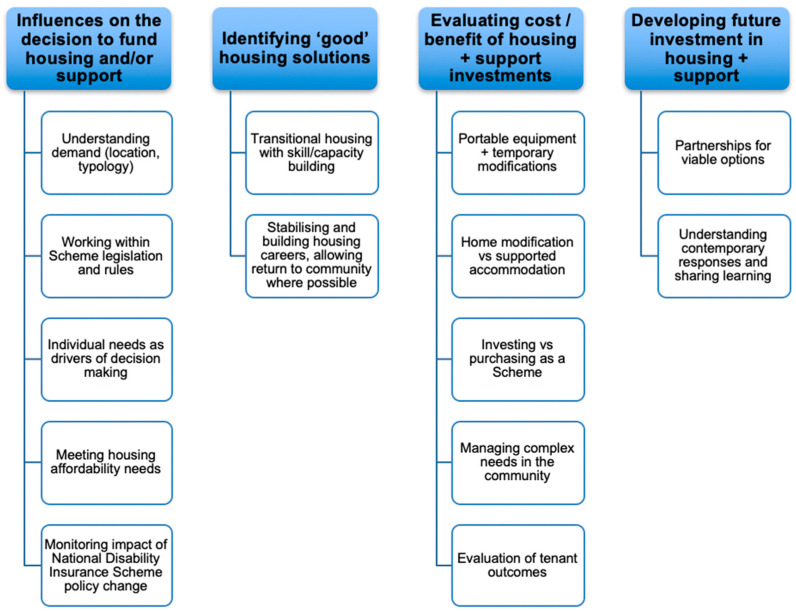
Housing is a critical enabler of a dignified life, civic participation and the achievement of human rights. Providing appropriate housing for people who experience neurotrauma as a result of road or workplace injury, with both the assistive technology and human support required, continues however to be a policy and practice challenge. Australian and New Zealand motor accident, disability and injury insurers have high and enduring liability in this area, and their under-researched perspectives are needed to strengthen the evidence base for policy and practice development. This qualitative study utilised focus group methodology with representatives from government injury and disability insurers across Australia and New Zealand (n = 8). The study aimed to identify (a) issues and trends; (b) factors for decision making; and (c) service impacts relating to housing and support for people with disability and high daily support needs. Thematic analysis generated results across four key areas: influences on the decision to fund housing and/or support; identifying 'good' housing solutions; evaluating cost-benefit of housing and support investments; and developing future investment in housing and support. Findings such as those regarding decision-making, and investment, attest to the value of capturing the perspectives of this key group of stakeholders to assist to envision better housing and support for people with disability.
住房是实现有尊严的生活、公民参与和人权的关键因素。为因道路或工作场所受伤而经历神经创伤的人提供适当的住房,并提供所需的辅助技术和人力支持,然而,这仍然是一个政策和实践挑战。澳大利亚和新西兰的汽车事故、残疾和伤害保险公司在这方面承担着高且持久的责任,需要他们经过深入研究的观点来加强政策和实践发展的证据基础。本定性研究采用焦点小组方法,邀请了来自澳大利亚和新西兰政府伤害和残疾保险公司的代表(n = 8)参与。该研究旨在确定:(a)问题和趋势;(b)决策因素;以及(c)与残疾人和高日常支持需求者的住房和支持相关的服务影响。主题分析生成了四个关键领域的结果:影响住房和/或支持资金决策的因素;确定“良好”的住房解决方案;评估住房和支持投资的成本效益;以及未来在住房和支持方面的投资。诸如决策和投资等发现证明了,为了更好地设想残疾人士的住房和支持,需要获取这一关键利益相关者群体的观点。