Institute of Health Sciences, Medical College, Rzeszow University, Warzywna St. 1, 35-310 Rzeszow, Poland.
Division for Clinical Geriatrics, Department of Neurobiology, Care Sciences and Society (NVS), Karolinska Institutet, 14152 Huddinge, Sweden.
Int J Environ Res Public Health. 2022 Aug 6;19(15):9712. doi: 10.3390/ijerph19159712.
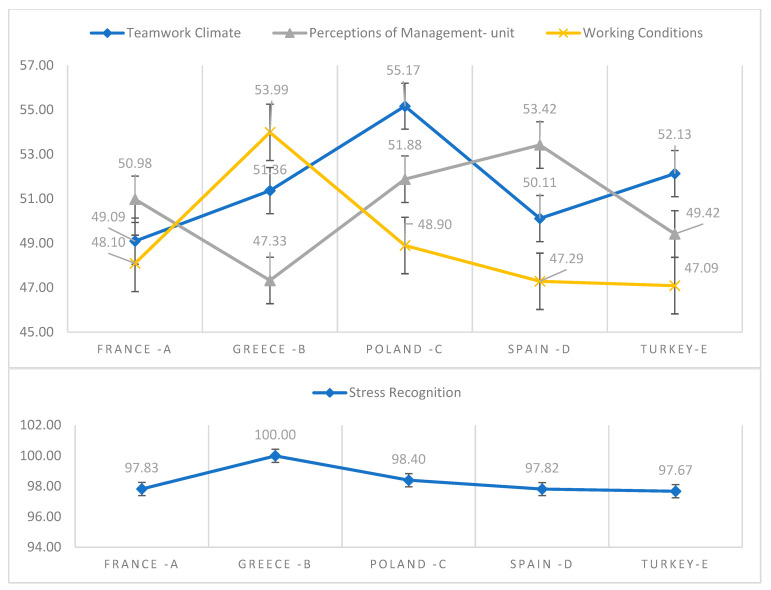
The patient safety climate is a key element of quality in healthcare. It should be a priority in the healthcare systems of all countries in the world. The goal of patient safety programs is to prevent errors and reduce the potential harm to patients when using healthcare services. A safety climate is also necessary to ensure a safe working environment for healthcare professionals. The attitudes of healthcare workers toward patient safety in various aspects of work, organization and functioning of the ward are important elements of the organization’s safety culture. The aim of this study was to determine the perception of the patient safety climate by healthcare workers during the COVID-19 pandemic. Methods: The study was conducted in five European countries. The Safety Attitude Questionnaire (SAQ) short version was used for the study. A total of 1061 healthcare workers: physicians, nurses and paramedics, participated in this study. Results: All groups received the highest mean results on the stress recognition subscale (SR): nurses 98.77, paramedics 96.39 and physician 98.28. Nurses and physicians evaluated work conditions (WC) to be the lowest (47.19 and 44.99), while paramedics evaluated perceptions of management (PM) as the worst (46.44). Paramedics achieved statistically significantly lower scores compared to nurses and physicians in job satisfaction (JS), stress recognition (SR) and perception of management (PM) (p < 0.0001). Paramedics compared to nurses and physicians rank better in working conditions (WC) in relation to patient safety (16.21%). Most often, persons of lower seniority scored higher in all subscales (p = 0.001). In Poland, Spain, France, Turkey, and Greece, healthcare workers scored highest in stress recognition (SR). In Poland, Spain, France, and Turkey, they assessed working conditions (WC) as the worst, while in Greece, the perception of management (PM) had the lowest result. Conclusion: Participant perceptions about the patient safety climate were not at a particularly satisfactory level, and there is still a need for the development of patient safety culture in healthcare in Europe. Overall, positive working conditions, good management and effective teamwork can contribute to improving employees’ attitudes toward patient safety. This study was carried out during the COVID-19 pandemic and should be repeated after its completion, and comparative studies will allow for a more precise determination of the safety climate in the assessment of employees.
患者安全氛围是医疗保健质量的关键要素。它应该成为世界上所有国家医疗体系的优先事项。患者安全计划的目标是防止错误发生,并降低患者在使用医疗服务时潜在的伤害。安全氛围也是确保医疗保健专业人员安全工作环境的必要条件。医疗工作者对工作各个方面、病房组织和运作中的患者安全的态度是组织安全文化的重要组成部分。本研究的目的是确定 COVID-19 大流行期间医疗保健工作者对患者安全氛围的感知。
本研究在五个欧洲国家进行。使用简短版安全态度问卷(SAQ)进行研究。共有 1061 名医疗保健工作者:医生、护士和辅助医务人员参与了这项研究。
所有组在压力识别分量表(SR)上获得了最高的平均分数:护士 98.77、辅助医务人员 96.39 和医生 98.28。护士和医生评估工作条件(WC)最低(分别为 47.19 和 44.99),而辅助医务人员对管理感知(PM)的评价最差(46.44)。与护士和医生相比,辅助医务人员在工作满意度(JS)、压力识别(SR)和管理感知(PM)方面的得分明显较低(p < 0.0001)。与护士和医生相比,辅助医务人员在与患者安全相关的工作条件(WC)方面的得分更高(16.21%)。在所有分量表中,资历较低的人得分更高(p = 0.001)。在波兰、西班牙、法国、土耳其和希腊,医疗保健工作者在压力识别(SR)方面的得分最高。在波兰、西班牙、法国和土耳其,他们将工作条件(WC)评估为最差,而在希腊,管理感知(PM)的得分最低。
参与者对患者安全氛围的看法并没有达到特别满意的水平,因此欧洲的医疗保健领域仍然需要发展患者安全文化。总体而言,积极的工作条件、良好的管理和有效的团队合作可以有助于改善员工对患者安全的态度。本研究是在 COVID-19 大流行期间进行的,应该在其结束后重复进行,比较研究将更准确地确定员工评估中的安全氛围。