Endocrinology and Nutrition Division, University Hospital Virgen del Rocío, 41013 Sevilla, Spain.
Bone Metabolic Unit, Endocrinology and Nutrition Division, University Hospital Clínico San Cecilio, 18016 Granada, Spain.
Int J Mol Sci. 2022 Jul 27;23(15):8303. doi: 10.3390/ijms23158303.
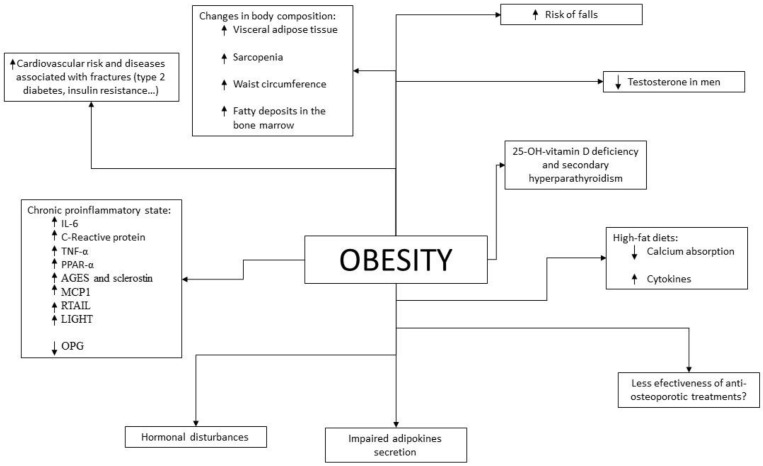
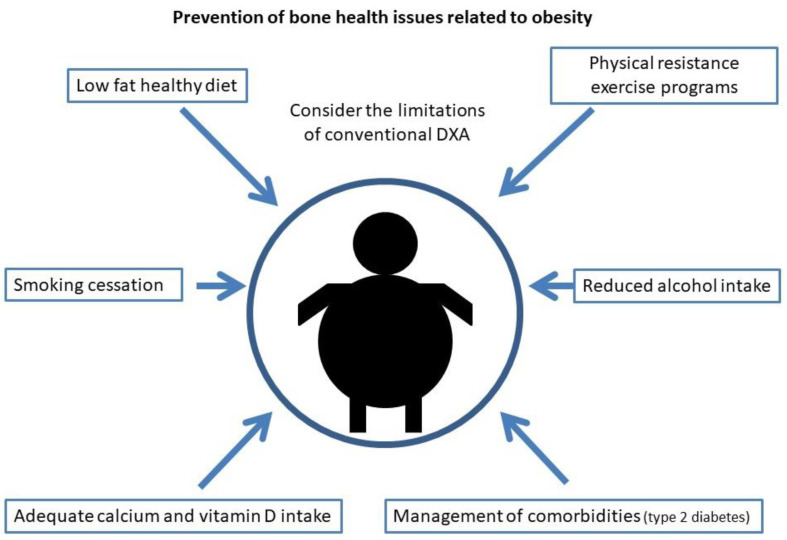
Recent scientific evidence has shown an increased risk of fractures in patients with obesity, especially in those with a higher visceral adipose tissue content. This contradicts the old paradigm that obese patients were more protected than those with normal weight. Specifically, in older subjects in whom there is a redistribution of fat from subcutaneous adipose tissue to visceral adipose tissue and an infiltration of other tissues such as muscle with the consequent sarcopenia, obesity can accentuate the changes characteristic of this age group that predisposes to a greater risk of falls and fractures. Other factors that determine a greater risk in older subjects with obesity are chronic proinflammatory status, altered adipokine secretion, vitamin D deficiency, insulin resistance and reduced mobility. On the other hand, diagnostic tests may be influenced by obesity and its comorbidities as well as by body composition, and risk scales may underestimate the risk of fractures in these patients. Weight loss with physical activity programs and cessation of high-fat diets may reduce the risk. Finally, more research is needed on the efficacy of anti-osteoporotic treatments in obese patients.
最近的科学证据表明,肥胖患者骨折的风险增加,尤其是那些内脏脂肪组织含量较高的患者。这与肥胖患者比体重正常的患者受到更好保护的旧观念相矛盾。具体来说,在脂肪从皮下脂肪组织重新分布到内脏脂肪组织并渗透到其他组织(如肌肉)从而导致肌肉减少症的老年患者中,肥胖会加剧使该年龄组更容易发生跌倒和骨折的特征性变化。肥胖的老年患者存在其他一些决定更高风险的因素,如慢性炎症状态、脂联素分泌改变、维生素 D 缺乏、胰岛素抵抗和活动能力降低。另一方面,肥胖及其合并症以及身体成分可能会影响诊断测试,而风险评估可能会低估这些患者的骨折风险。通过体育活动计划减轻体重和停止高脂肪饮食可能会降低风险。最后,需要对肥胖患者的抗骨质疏松治疗的疗效进行更多的研究。