Molecular Recognition and Encapsulation Research Group (REM), Health Sciences Department, Universidad Católica de Murcia (UCAM), Campus de los Jerónimos 135, E-30107 Guadalupe, Spain.
Research Group on Quality, Safety and Bioactivity of Plant Foods, Department of Food Science and Technology, CEBAS-CSIC, University Campus of Espinardo, Edif. 25, E-30100 Espinardo, Spain.
Int J Mol Sci. 2022 Jul 29;23(15):8406. doi: 10.3390/ijms23158406.
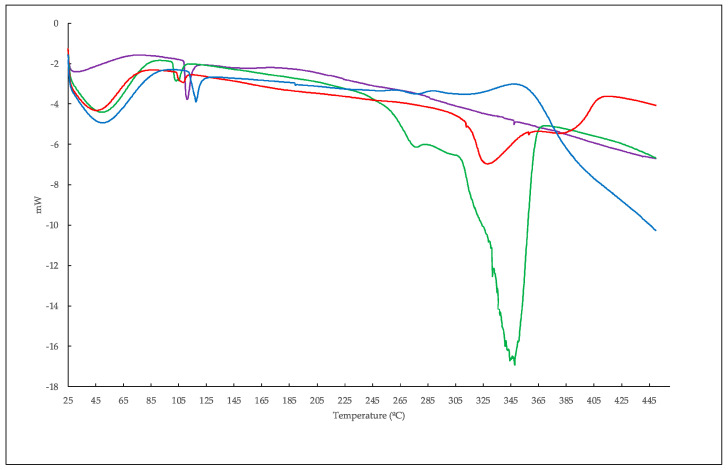
Water pollution by dyes is a huge environmental problem; there is a necessity to produce new decolorization methods that are effective, cost-attractive, and acceptable in industrial use. Magnetic cyclodextrin polymers offer the advantage of easy separation from the dye solution. In this work, the β-CD-EPI-magnetic (β-cyclodextrin-epichlorohydrin) polymer was synthesized, characterized, and tested for removal of the azo dye Direct Red 83:1 from water, and the fraction of non-adsorbed dye was degraded by an advanced oxidation process. The polymer was characterized in terms of the particle size distribution and surface morphology (FE-SEM), elemental analysis (EA), differential scanning calorimetry (DSC), thermal gravimetric analysis (TGA), infrared spectrophotometry (IR), and X-ray powder diffraction (XRD). The reported results hint that 0.5 g and pH 5.0 were the best conditions to carry out both kinetic and isotherm models. A 30 min contact time was needed to reach equilibrium with a qmax of 32.0 mg/g. The results indicated that the pseudo-second-order and intraparticle diffusion models were involved in the assembly of Direct Red 83:1 onto the magnetic adsorbent. Regarding the isotherms discussed, the Freundlich model correctly reproduced the experimental data so that adsorption was confirmed to take place onto heterogeneous surfaces. The calculation of the thermodynamic parameters further demonstrates the spontaneous character of the adsorption phenomena (ΔG° = −27,556.9 J/mol) and endothermic phenomena (ΔH° = 8757.1 J/mol) at 25 °C. Furthermore, a good reusability of the polymer was evidenced after six cycles of regeneration, with a negligible decline in the adsorption extent (10%) regarding its initial capacity. Finally, the residual dye in solution after treatment with magnetic adsorbents was degraded by using an advanced oxidation process (AOP) with pulsed light and hydrogen peroxide (343 mg/L); >90% of the dye was degraded after receiving a fluence of 118 J/cm2; the discoloration followed a pseudo first-order kinetics where the degradation rate was 0.0196 cm2/J. The newly synthesized β-CD-EPI-magnetic polymer exhibited good adsorption properties and separability from water which, when complemented with a pulsed light-AOP, may offer a good alternative to remove dyes such as Direct Red 83:1 from water. It allows for the reuse of both the polymer and the dye in the dyeing process.
水污染是一个巨大的环境问题;有必要开发新的脱色方法,这些方法必须有效、有成本效益,并且在工业应用中是可接受的。磁性环糊精聚合物具有易于从染料溶液中分离的优点。在这项工作中,合成了β-CD-EPI-磁性(β-环糊精-表氯醇)聚合物,并对其进行了表征,用于去除水中的偶氮染料直接红 83:1,未被吸附的染料部分通过高级氧化过程进行降解。该聚合物通过粒径分布和表面形态(FE-SEM)、元素分析(EA)、差示扫描量热法(DSC)、热重分析(TGA)、红外分光光度法(IR)和X 射线粉末衍射(XRD)进行了表征。报道的结果表明,在 0.5 g 和 pH 5.0 的最佳条件下,动力学和等温线模型均能达到最佳条件。达到平衡需要 30 分钟的接触时间,最大吸附量为 32.0 mg/g。结果表明,伪二阶和内扩散模型都参与了直接红 83:1 到磁性吸附剂上的组装。关于讨论的等温线,Freundlich 模型正确地再现了实验数据,因此证实了吸附是在非均相表面上发生的。热力学参数的计算进一步证明了吸附现象(ΔG°=−27,556.9 J/mol)和吸热现象(ΔH°=8757.1 J/mol)的自发性质在 25°C 下发生。此外,聚合物在经过六次再生循环后表现出良好的可重复使用性,其吸附程度(10%)相对于初始容量仅略有下降。最后,在用脉冲光和过氧化氢(343 mg/L)处理过的磁性吸附剂处理后的溶液中残留的染料,通过高级氧化过程(AOP)进行降解;在接受 118 J/cm2 的辐射后,超过 90%的染料被降解;褪色遵循准一级动力学,降解速率为 0.0196 cm2/J。新合成的β-CD-EPI-磁性聚合物表现出良好的吸附性能和从水中分离的能力,当与脉冲光-AOP 相结合时,可能是去除直接红 83:1 等染料的一种很好的替代方法。它允许聚合物和染料在染色过程中重复使用。