Laboratorio de Investigación Clínica, Facultad de Ciencias Químico Biológicas, Universidad Autónoma de Guerrero, Chilpancingo 39087, Guerrero, Mexico.
Laboratorio de Investigación en Biomoléculas, Facultad de Ciencias Químico Biológicas, Universidad Autónoma de Guerrero, Chilpancingo 39087, Guerrero, Mexico.
Int J Mol Sci. 2022 Aug 8;23(15):8801. doi: 10.3390/ijms23158801.
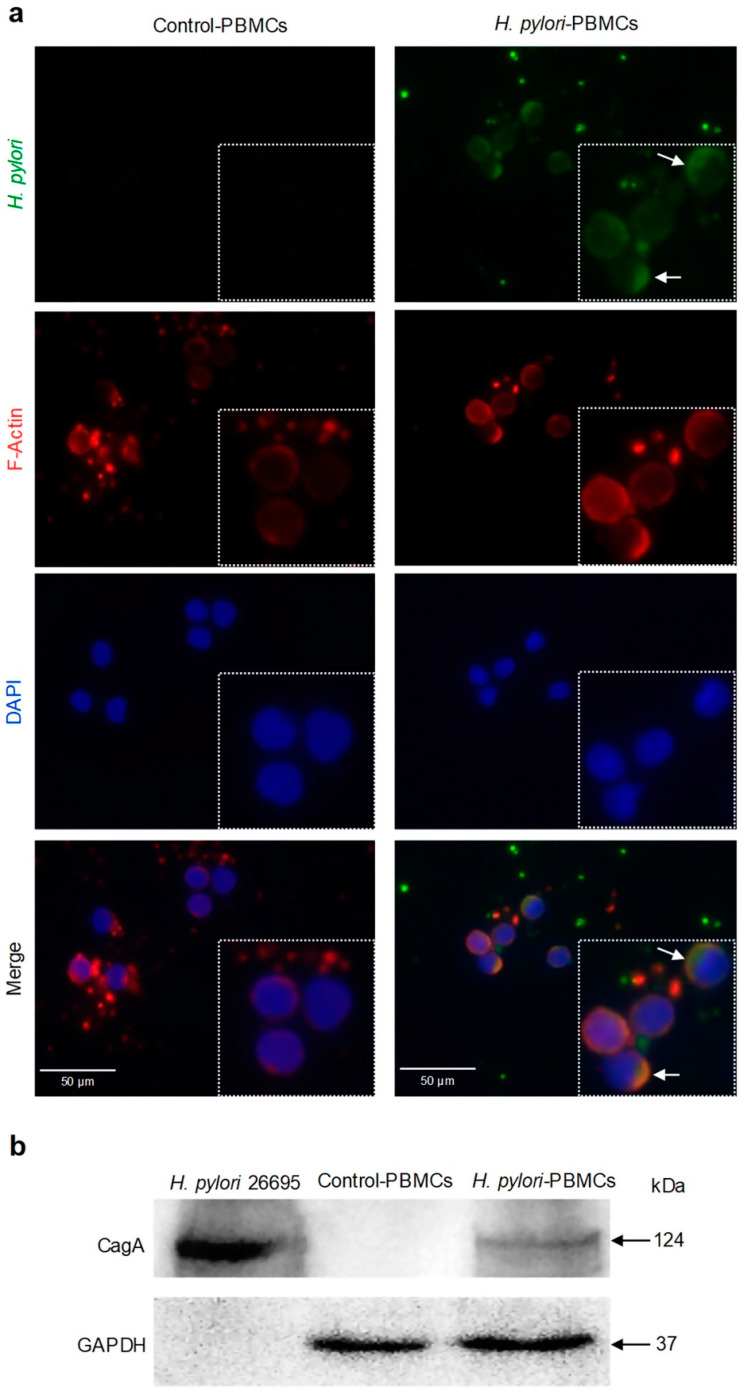
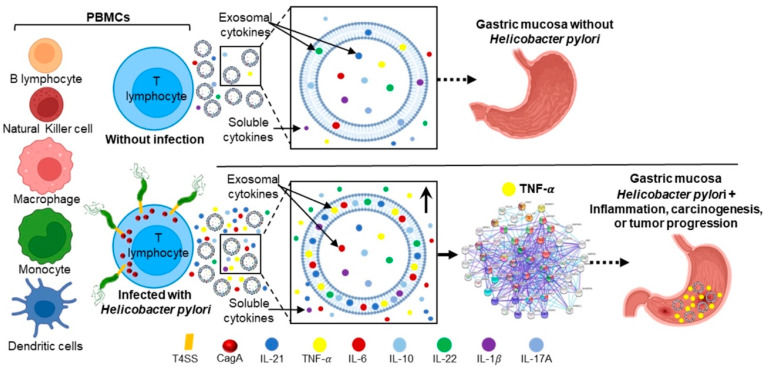
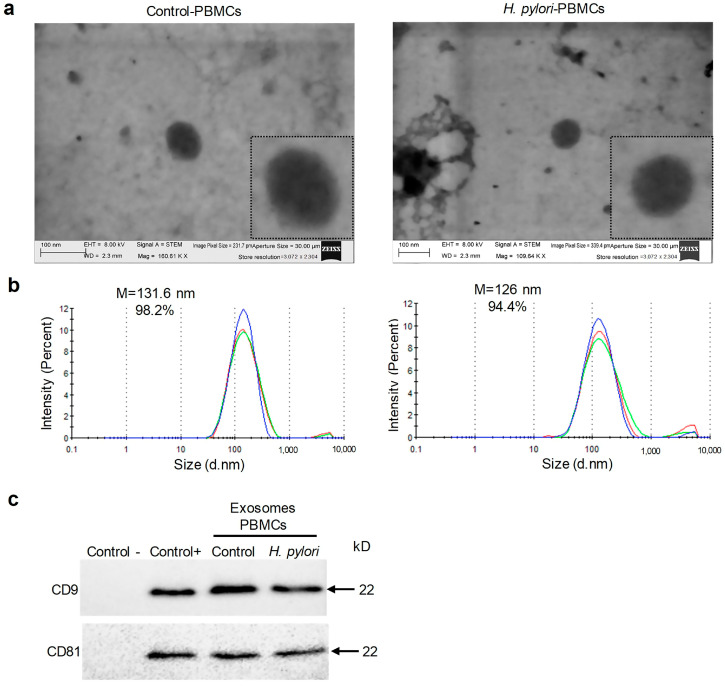
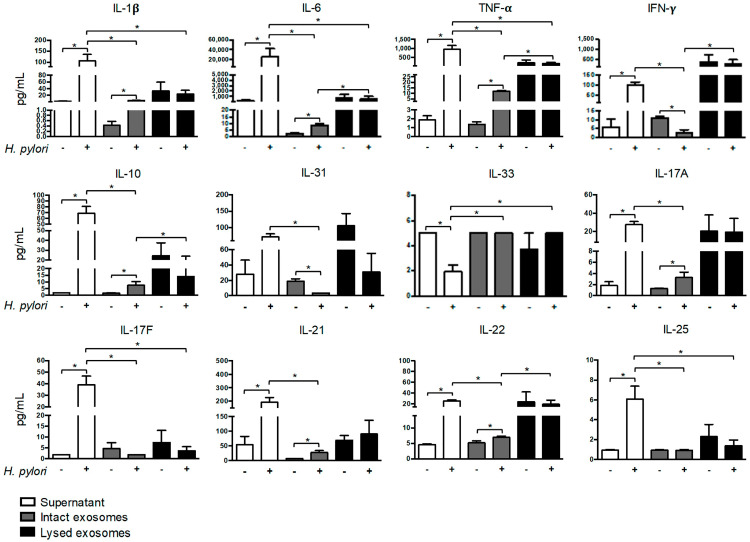
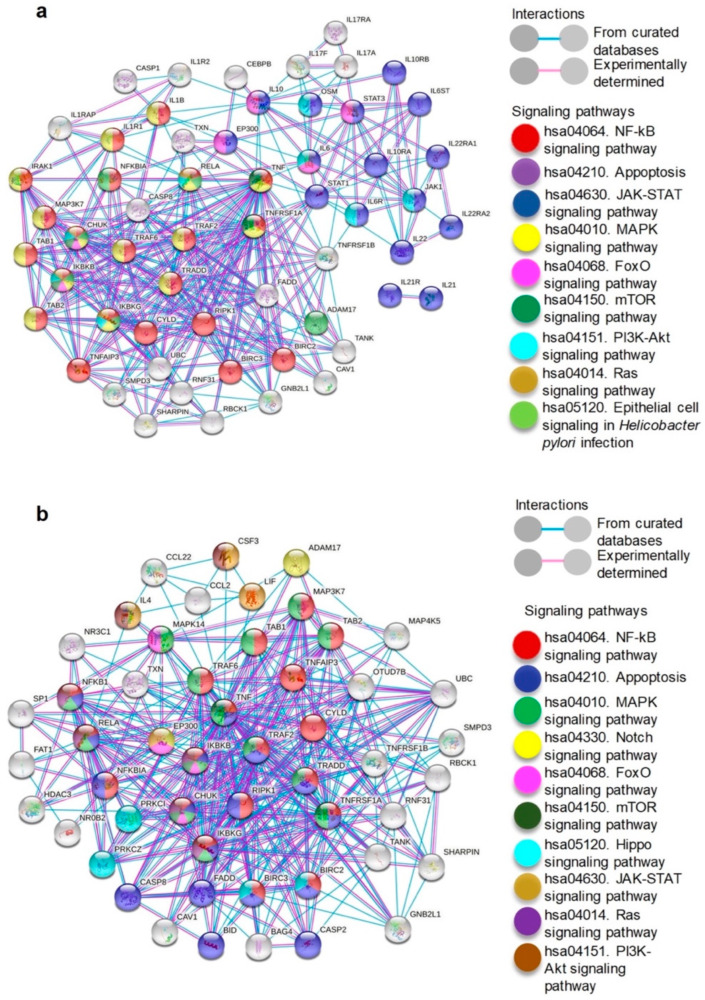
promotes the secretion of cytokines that regulate inflammation and carcinogenesis. Immune cells secrete cytokines into the extracellular medium or packaged in exosomes. The objective of this study was to analyze the profile of soluble and exosomal cytokines that were secreted by human peripheral blood mononuclear cells (PBMCs) that were infected with and to build a network of interaction between cytokines and cellular proteins. PBMCs were obtained by density gradient centrifugation and infected with for 24 h. The infection was verified by immunofluorescence and Western blot for CagA. The exosomes were obtained from culture supernatant by ultracentrifugation and characterized by transmission electron microscopy, particle size analysis, and Western blot for CD9 and CD81. Cytokines were quantified using a multiplex immunoassay in the culture supernatant, intact exosomes, and lysed exosomes. adheres to lymphocytes and translocates CagA. In PBMCs, induces an increase in the soluble and exosomal IL-1β, IL-6, TNF-α, IL-10, IL-17A, IL-21, and IL-22. The protein-protein interaction (PPI) network shows that soluble and exosomal cytokines interact with proteins that participate in signaling pathways such as NF-κB, MAPK, PI3K-Akt, Jak-STAT, FoxO, and mTOR, that are related to carcinogenesis; moreover, TNF-α had the highest number of interactions. Cytokine-loaded exosomes represent another means of intercellular communication that is activated by to stimulate inflammation, carcinogenesis, or cancer progression. Cytokine-loaded exosomes are likely to be associated with extragastrointestinal diseases of inflammatory origin.
促进调节炎症和癌变的细胞因子的分泌。免疫细胞将细胞因子分泌到细胞外基质或包裹在细胞外小泡中。本研究旨在分析感染后人类外周血单核细胞(PBMC)分泌的可溶性和细胞外小泡细胞因子谱,并构建细胞因子与细胞蛋白相互作用的网络。通过密度梯度离心从 PBMC 中获得细胞,并感染 24 小时。通过免疫荧光和 Western blot 检测 CagA 验证感染。通过超速离心从培养上清液中获得外泌体,并通过透射电子显微镜、粒径分析和 CD9 和 CD81 的 Western blot 进行特征分析。通过培养上清液、完整外泌体和裂解外泌体中的多重免疫分析定量细胞因子。 附着在淋巴细胞上并易位 CagA。在 PBMC 中, 诱导可溶性和细胞外小泡 IL-1β、IL-6、TNF-α、IL-10、IL-17A、IL-21 和 IL-22 的增加。蛋白质-蛋白质相互作用(PPI)网络显示,可溶性和细胞外小泡细胞因子与参与 NF-κB、MAPK、PI3K-Akt、Jak-STAT、FoxO 和 mTOR 等信号通路的蛋白质相互作用,与癌变有关;此外,TNF-α的相互作用数量最多。细胞因子负载的外泌体代表另一种细胞间通讯方式,被 激活以刺激炎症、癌变或癌症进展。负载细胞因子的外泌体可能与炎症来源的胃肠道外疾病有关。