Department of Biomolecular Sciences, University of Urbino Carlo Bo, 61122 Urbino, Italy.
Department of Internal Medicine, Infermi Hospital, AUSL Romagna, 47921 Rimini, Italy.
Int J Mol Sci. 2022 Aug 8;23(15):8829. doi: 10.3390/ijms23158829.
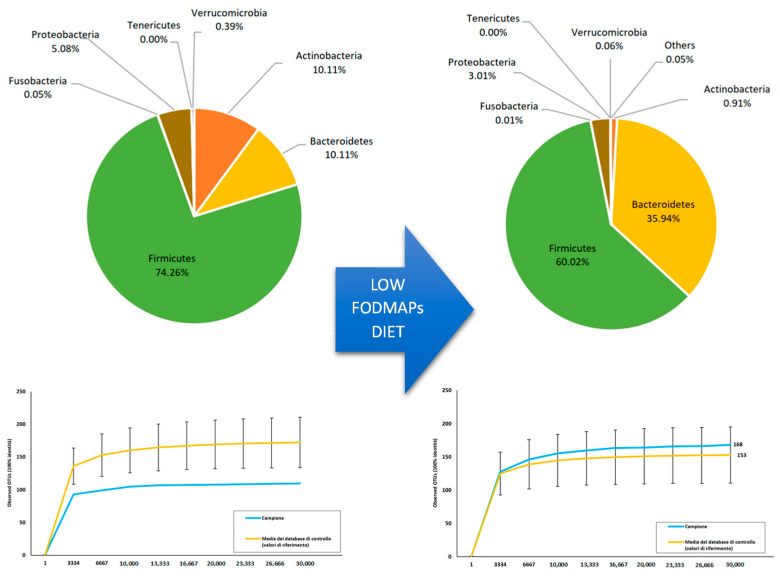
Autism spectrum disorder (ASD) is often associated with several intestinal and/or metabolic disorders as well as neurological manifestations such as epilepsy (ASD-E). Those presenting these neuropathological conditions share common aspects in terms of gut microbiota composition. The use of microbiota intervention strategies may be an approach to consider in the management of these cases. We describe the case of a 17-year-old girl affected by ASD, reduced growth, neurological development delay, mutations in the PGM1 and EEF1A2 genes (in the absence of clinically manifested disease) and, intestinal disorders such as abdominal pain and diarrhea associated with weight loss. As she demonstrated poor responsiveness to the therapies provided, we attempted two specific dietary patterns: a ketogenic diet, followed by a low fermentable oligosaccharides, disaccharides, monosaccharides and polyols (FODMAP) diet, with the aim of improving her neurological, metabolic, and intestinal symptoms through modulation of the gut microbiota's composition. The ketogenic diet (KD) provided a reduction in , , and . Although her intestinal symptoms improved, KD was poorly tolerated. On the other hand, the passage to a low FODMAPs diet produced a significant improvement in all neurological, intestinal, and metabolic symptoms and was well-tolerated. The following gut microbiota analysis showed reductions in Actinobacteria, , , and . The alpha biodiversity was consistently increased and the / ratio decreased, reducing the extent of fermentative dysbiosis. Gut microbiota could be a therapeutic target to improve ASD-related symptoms. Further studies are needed to better understand the correlation between gut microbiota composition and ASD, and its possible involvement in the physiopathology of ASD.
自闭症谱系障碍(ASD)常与多种肠道和/或代谢紊乱以及癫痫(ASD-E)等神经表现相关。那些表现出这些神经病理状况的人在肠道微生物群组成方面具有共同的方面。使用微生物群干预策略可能是考虑这些病例管理的一种方法。我们描述了一名 17 岁女孩的病例,她患有 ASD、生长受限、神经发育迟缓、PGM1 和 EEF1A2 基因突变(无临床表现疾病)以及肠道疾病,如腹痛和腹泻伴有体重减轻。由于她对提供的治疗反应不佳,我们尝试了两种特定的饮食模式:生酮饮食,随后是低可发酵寡糖、双糖、单糖和多元醇(FODMAP)饮食,旨在通过调节肠道微生物群的组成来改善她的神经、代谢和肠道症状。生酮饮食(KD)可减少、、和。尽管她的肠道症状有所改善,但 KD 耐受性差。另一方面,过渡到低 FODMAPs 饮食可显著改善所有神经、肠道和代谢症状,且耐受性良好。以下肠道微生物组分析显示放线菌、、、减少。α 生物多样性持续增加,/ 比例降低,减少发酵失调的程度。肠道微生物群可能是改善与 ASD 相关症状的治疗靶点。需要进一步的研究来更好地了解肠道微生物群组成与 ASD 之间的相关性及其在 ASD 病理生理学中的可能参与。