Buonsenso Danilo, Valentini Piero, De Rose Cristina, Tredicine Maria, Pereyra Boza Maria Del Carmen, Camponeschi Chiara, Morello Rosa, Zampino Giuseppe, Brooks Anna E S, Rende Mario, Ria Francesco, Sanguinetti Maurizio, Delogu Giovanni, Sali Michela, Di Sante Gabriele
Department of Laboratory and Infectivology Sciences, Fondazione Policlinico Universitario A. Gemelli IRCCS, 00168 Rome, Italy.
Department of Woman and Child Health and Public Health, Fondazione Policlinico Universitario A. Gemelli IRCCS, 00168 Rome, Italy.
J Clin Med. 2022 Jul 27;11(15):4363. doi: 10.3390/jcm11154363.
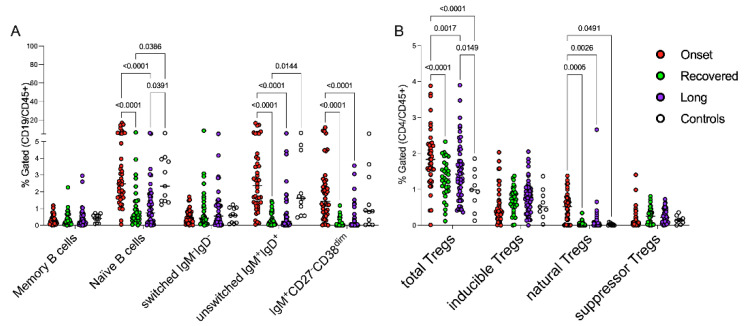
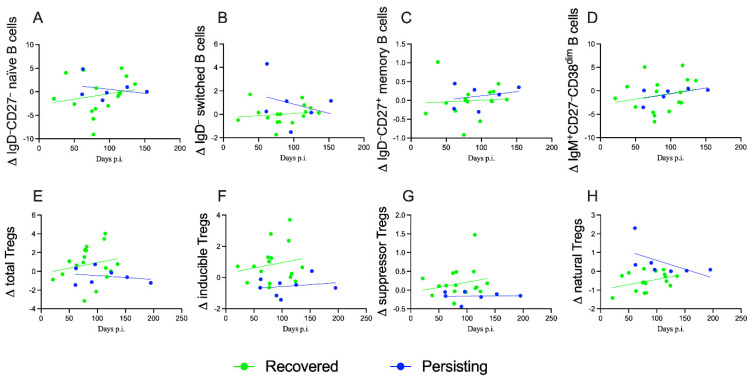
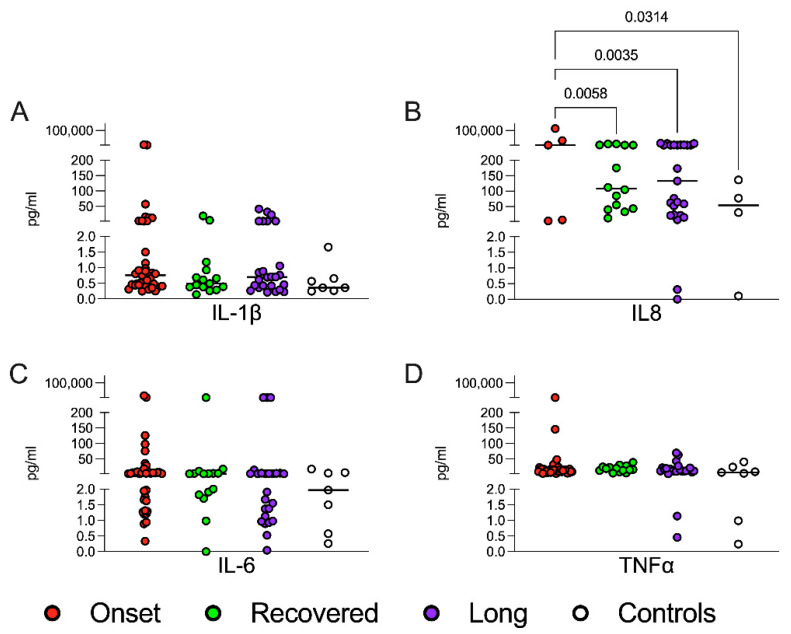
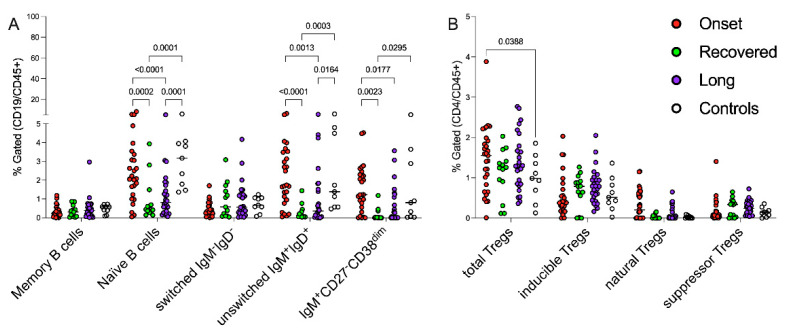
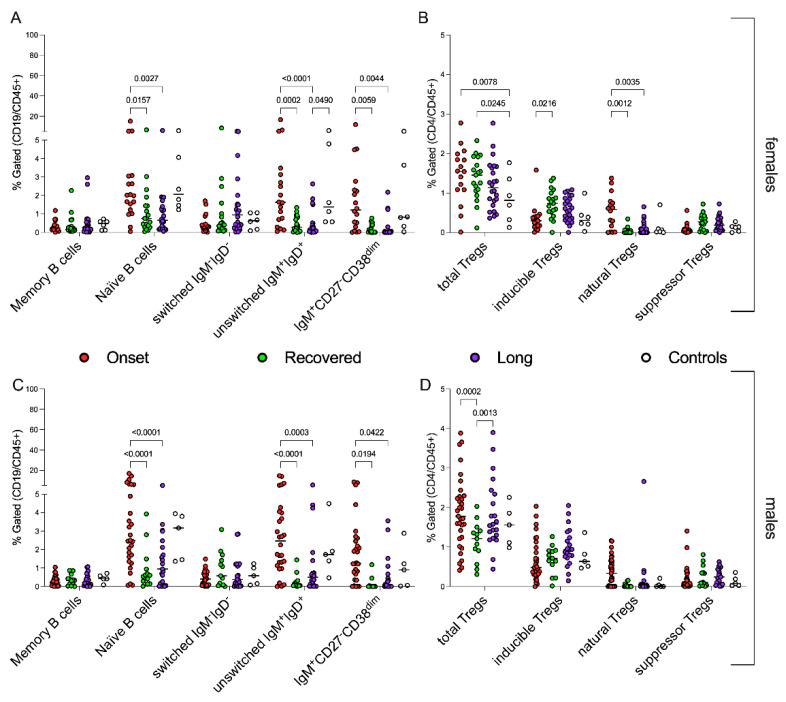
Background. The profile of cellular immunological responses of children across the spectrum of COVID-19, ranging from acute SARS-CoV-2 infection to full recovery or Long COVID, has not yet been fully investigated. Methods. We examined and compared cytokines in sera and cell subsets in peripheral blood mononuclear cells (B and regulatory T lymphocytes) collected from four distinct groups of children, distributed as follows: younger than 18 years of age with either acute SARS-CoV-2 infection (n = 49); fully recovered from COVID-19 (n = 32); with persistent symptoms (Long COVID, n = 51); and healthy controls (n = 9). Results. In the later stages after SARS-CoV-2 infection, the cohorts of children, both with recovered and persistent symptoms, showed skewed T and B subsets, with remarkable differences when compared with children at the onset of the infection and with controls. The frequencies of IgD+CD27− naïve B cells, IgD+IgM+ and CD27−IgM+CD38dim B cells were higher in children with recent infection than in those with an older history of disease (p < 0.0001 for all); similarly, the total and natural Tregs compartments were more represented in children at onset when compared with Long COVID (p < 0.0001 and p = 0.0005, respectively). Despite the heterogeneity, partially due to age, sex and infection incidence, the susceptibility of certain children to develop persistent symptoms after infection appeared to be associated with the imbalance of the adaptive immune response. Following up and comparing recovered versus Long COVID patients, we analyzed the role of circulating naïve and switched B and regulatory T lymphocytes in counteracting the evolution of the symptomatology emerged, finding an interesting correlation between the amount and ability to reconstitute the natural Tregs component with the persistence of symptoms (linear regression, p = 0.0026). Conclusions. In this study, we suggest that children affected by Long COVID may have a compromised ability to switch from the innate to the adaptive immune response, as supported by our data showing a contraction of naïve and switched B cell compartment and an unstable balance of regulatory T lymphocytes occurring in these children. However, further prospective immunological studies are needed to better clarify which factors (epigenetic, diet, environment, etc.) are involved in the impairment of the immunological mechanisms in the Long COVID patients.
背景。从急性SARS-CoV-2感染到完全康复或长期新冠(Long COVID),新冠疫情全病程中儿童的细胞免疫反应情况尚未得到充分研究。方法。我们检测并比较了从四组不同儿童中采集的血清细胞因子和外周血单个核细胞(B细胞和调节性T淋巴细胞)中的细胞亚群,分组如下:18岁以下的急性SARS-CoV-2感染儿童(n = 49);新冠康复儿童(n = 32);有持续症状的儿童(长期新冠,n = 51);以及健康对照儿童(n = 9)。结果。在SARS-CoV-2感染后的后期阶段,康复和有持续症状的儿童队列均显示T细胞和B细胞亚群失衡,与感染初期儿童及对照组相比存在显著差异。近期感染儿童中IgD+CD27−幼稚B细胞、IgD+IgM+和CD27−IgM+CD38dim B细胞的频率高于病程较长的儿童(所有p值均<0.0001);同样,与长期新冠儿童相比,感染初期儿童的总调节性T细胞(Tregs)和天然Tregs亚群占比更高(分别为p < 0.0001和p = 0.0005)。尽管存在异质性,部分原因是年龄、性别和感染发生率不同,但某些儿童感染后出现持续症状的易感性似乎与适应性免疫反应失衡有关。在对康复患者和长期新冠患者进行随访和比较时,我们分析了循环幼稚和转换型B细胞以及调节性T淋巴细胞在对抗已出现症状演变中的作用,发现天然Tregs成分的数量和重建能力与症状持续之间存在有趣的相关性(线性回归,p = 0.0026)。结论。在本研究中,我们认为长期新冠患儿从先天免疫反应转换为适应性免疫反应的能力可能受损,我们的数据显示这些儿童的幼稚和转换型B细胞区室收缩以及调节性T淋巴细胞平衡不稳定,支持了这一观点。然而,需要进一步的前瞻性免疫学研究,以更好地阐明哪些因素(表观遗传、饮食、环境等)与长期新冠患者免疫机制受损有关。