Liu Yan, Gu Xiaoying, Li Haibo, Zhang Hui, Xu Jiuyang
National Center for Respiratory Medicine; State Key Laboratory of Respiratory Health and Multimorbidity; National Clinical Research Center for Respiratory Diseases; Institute of Respiratory Medicine, Chinese Academy of Medical Sciences; Department of Pulmonary and Critical Care Medicine, Center of Respiratory Medicine, China-Japan Friendship Hospital, Beijing 100029, China.
Department of Infectious Disease, The Affiliated Yantai Yuhuangding Hospital of Qingdao University, Yantai, Shandong 264000, China.
Chin Med J Pulm Crit Care Med. 2023 Dec 6;1(4):231-240. doi: 10.1016/j.pccm.2023.10.003. eCollection 2023 Dec.
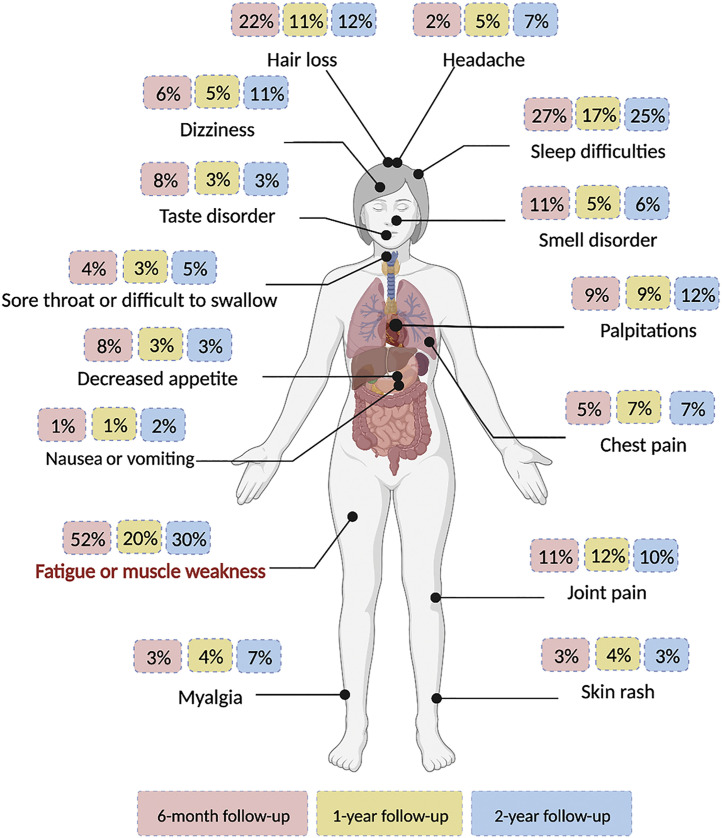
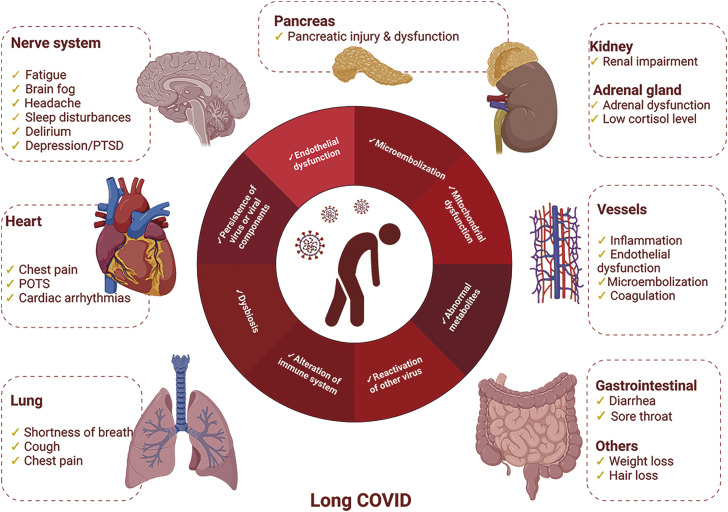
The coronavirus disease 2019 (COVID-19) pandemic has been ongoing for more than 3 years, with an enormous impact on global health and economies. In some patients, symptoms and signs may remain after recovery from severe acute respiratory syndrome coronavirus 2 (SARS-CoV-2) infection, which cannot be explained by an alternate diagnosis; this condition has been defined as long COVID. Long COVID may exist in patients with both mild and severe disease and is prevalent after infection with different SARS-CoV-2 variants. The most common symptoms include fatigue, dyspnea, and other symptoms involving multiple organs. Vaccination results in lower rates of long COVID. To date, the mechanisms of long COVID remain unclear. In this narrative review, we summarized the clinical presentations and current evidence regarding the pathogenesis of long COVID.
2019冠状病毒病(COVID-19)大流行已经持续了3年多,对全球健康和经济产生了巨大影响。在一些患者中,从严重急性呼吸综合征冠状病毒2(SARS-CoV-2)感染中恢复后,症状和体征可能仍然存在,而无法用其他诊断来解释;这种情况被定义为长期新冠。长期新冠可能存在于轻症和重症患者中,并且在感染不同SARS-CoV-2变体后很普遍。最常见的症状包括疲劳、呼吸困难以及涉及多个器官的其他症状。接种疫苗可降低长期新冠的发生率。迄今为止,长期新冠的发病机制仍不清楚。在这篇叙述性综述中,我们总结了长期新冠的临床表现和关于其发病机制的现有证据。