Department of Research and Development in Teacher Education, University College of Teacher Education Tyrol, 6010 Innsbruck, Austria.
Department of Sport Science, Leopold-Franzens University of Innsbruck, 6020 Innsbruck, Austria.
Nutrients. 2022 Jul 30;14(15):3151. doi: 10.3390/nu14153151.
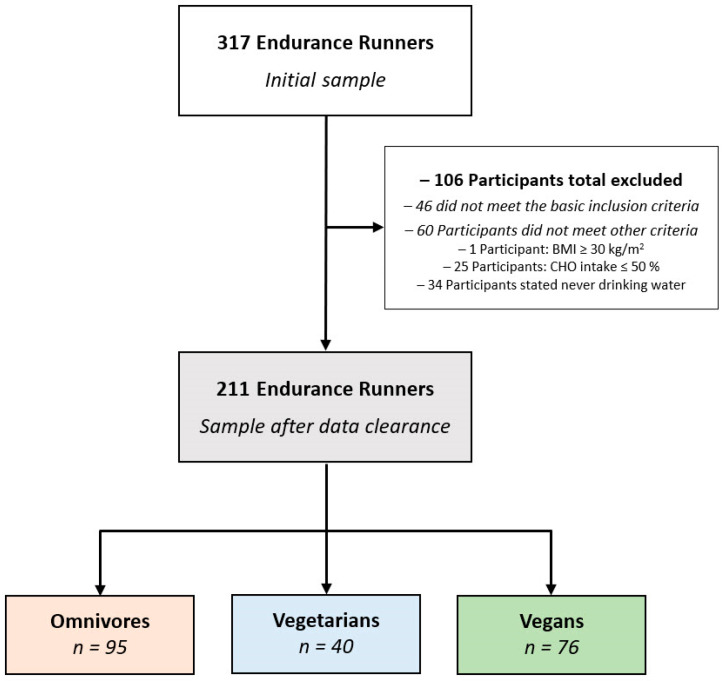
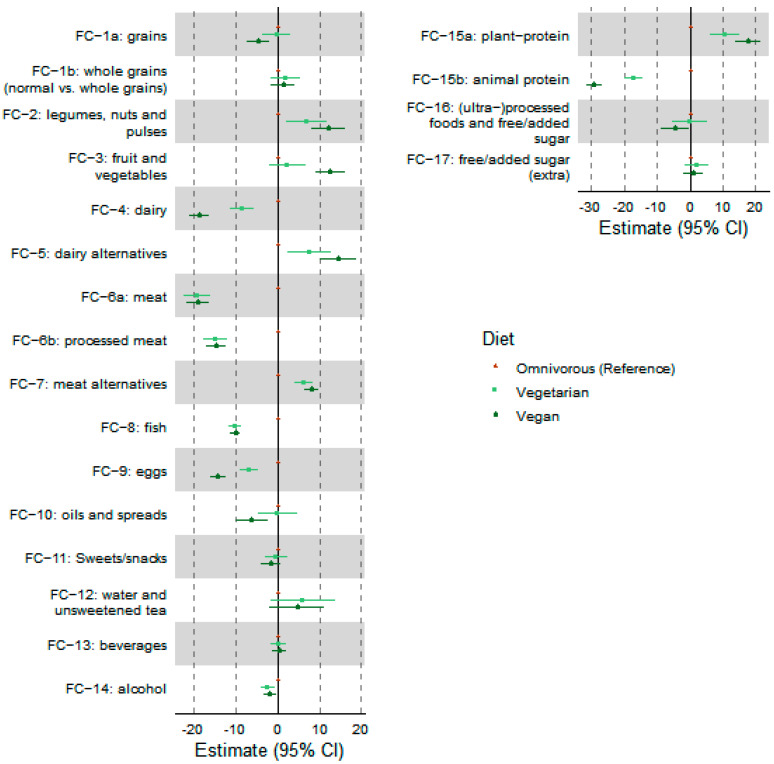
Nowadays, the growing popularity of distance running has been accompanied by the increasing prevalence of vegan and vegetarian diets, especially among endurance athletes. The present study aimed to examine the association between diet type and dietary intake of distance runners competing at distances longer than 10 km. From a total of 317 participants, 211 endurance runners (57% females) were considered the final sample after applying the exclusion criteria. Runners were assigned to three groups based on the self-reported diet types: 95 omnivores, 40 vegetarians, and 76 vegans. Data collection was conducted using an online survey with questions about sociodemographic information, dietary intake, and dietary-associated motives. A comprehensive food frequency questionnaire with 53 food groups (categorized in 14 basic-plus three umbrella-food clusters) was used to assess dietary intake. Vegan runners had a higher intake of "beans and seeds", "fruit and vegetables", and "dairy alternatives", as well as lower intakes of "oils" than other two groups. Vegetarian runners had a lower intake of "dairy products" and "eggs" than omnivores. A greater intake of "alcohol" and a lower intake of "meat alternatives" was observed in omnivorous runners compared to vegans and vegetarians. Despite the existence of a tendency toward the consumption of health-related food clusters by vegan runners, further investigations are needed to verify the predominance of vegans in health-oriented dietary patterns.
如今,随着长跑运动的日益普及,素食和纯素饮食也越来越流行,尤其是在耐力运动员中。本研究旨在探讨饮食类型与 10 公里以上长跑运动员的饮食摄入之间的关系。在对 317 名参与者进行筛选后,共有 211 名耐力运动员(57%为女性)符合条件,被纳入最终样本。根据自我报告的饮食类型,将跑步者分为三组:95 名杂食者、40 名素食者和 76 名严格素食者。通过在线调查收集了参与者的社会人口学信息、饮食摄入和与饮食相关的动机等数据。研究采用了一份包含 53 种食物(分为 14 个基本类和 3 个伞状食物组)的综合食物频率问卷,以评估饮食摄入情况。与其他两组相比,严格素食者的“豆类和种子”、“水果和蔬菜”以及“奶制品替代品”的摄入量较高,而“油”的摄入量较低。素食者的“奶制品”和“蛋类”的摄入量低于杂食者。杂食者的“酒精”摄入量较高,而“肉类替代品”的摄入量较低。尽管严格素食者有食用与健康相关的食物组的趋势,但仍需要进一步研究来验证严格素食者在健康饮食模式中的主导地位。