Wirnitzer Katharina, Seyfart Tom, Leitzmann Claus, Keller Markus, Wirnitzer Gerold, Lechleitner Christoph, Rüst Christoph Alexander, Rosemann Thomas, Knechtle Beat
Pädagogische Hochschule Tirol, Pastorstraße 7, 6010 Innsbruck, Austria.
Medical Department, Ernst-Moritz-Arndt University of Greifswald, Fleischmannstraße 8, 17475 Greifswald, Germany.
Springerplus. 2016 Apr 14;5:458. doi: 10.1186/s40064-016-2126-4. eCollection 2016.
Beneficial and detrimental effects of various vegetarian and vegan diets on the health status are well known. Considering the growing background numbers of vegetarians and vegans, the number of vegetarian and vegan runners is likely to rise, too. Therefore, the Nutrition and Running High Mileage (NURMI) Study was designed as a comparative study to investigate the prevalence of omnivores, vegetarians, and vegans in running events and to detect potential differences in running performance comparing these three subgroups.
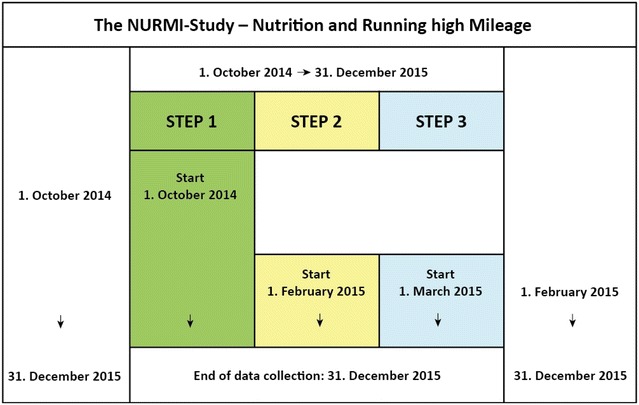
METHODS/DESIGN: The NURMI Study will be conducted in three steps following a cross-sectional design. Step 1 will determine epidemiological aspects of endurance runners (any distance) using a short standardized questionnaire. Step 2 will investigate dietary habits and running history from eligible participants (capable of running a half-marathon at least) using an extended standardized questionnaire. Step 3 will collect data after a running event on finishing time and final ranking as well as a post-race rating of perceived exertion, mood status, nutrient and fluid intake during the race.
Our study will provide a major contribution to overcome the lack of data on the prevalence and running performance of vegetarian and vegan runners in endurance running events. We estimate the prevalence of vegetarians and vegans participating in a running event to be less compared to the respective proportion of vegetarians and vegans to the general population. Furthermore we will validate the subject's self-assessment of their respective diet. This comparative study may identify possible effects of dietary behavior on running performance und may detect possible differences between the respective subgroups: omnivorous, vegetarian and vegan runners. Trial registration Current controlled trials, ISRCTN73074080.
各种素食和纯素饮食对健康状况的有益和有害影响已为人所知。鉴于素食者和纯素者的背景人数不断增加,素食和纯素跑步者的数量可能也会上升。因此,营养与高里程跑步(NURMI)研究被设计为一项比较研究,以调查耐力跑赛事中杂食者、素食者和纯素者的比例,并检测这三个亚组在跑步表现上的潜在差异。
方法/设计:NURMI研究将按照横断面设计分三个步骤进行。第一步将使用简短的标准化问卷确定耐力跑者(任何距离)的流行病学特征。第二步将使用扩展的标准化问卷调查符合条件的参与者(至少能够跑完半程马拉松)的饮食习惯和跑步历史。第三步将在跑步赛事结束后收集关于完赛时间、最终排名以及赛后自觉用力程度、情绪状态、比赛期间营养和液体摄入的评分数据。
我们的研究将为克服耐力跑赛事中素食和纯素跑步者的比例及跑步表现方面数据不足的问题做出重大贡献。我们估计参加跑步赛事的素食者和纯素者的比例低于素食者和纯素者在普通人群中的相应比例。此外,我们将验证受试者对其各自饮食的自我评估。这项比较研究可能会确定饮食行为对跑步表现的可能影响,并可能检测出各个亚组(杂食、素食和纯素跑步者)之间的可能差异。试验注册 当前受控试验,ISRCTN73074080。