Nandety Raja Sekhar, Gill Upinder S, Krom Nick, Dai Xinbin, Dong Yibo, Zhao Patrick X, Mysore Kirankumar S
Noble Research Institute, LLC, Ardmore, OK 73401, USA.
USDA-ARS, Cereal Crops Research Unit, Edward T. Schafer Agricultural Research Center, Fargo, ND 58102, USA.
Plants (Basel). 2022 Jul 28;11(15):1962. doi: 10.3390/plants11151962.
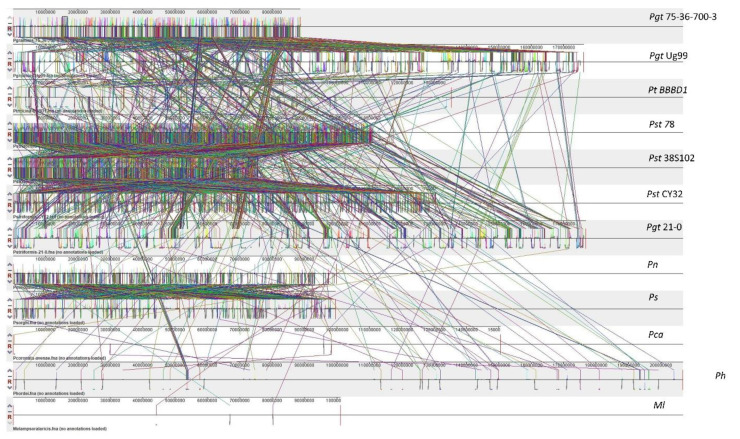
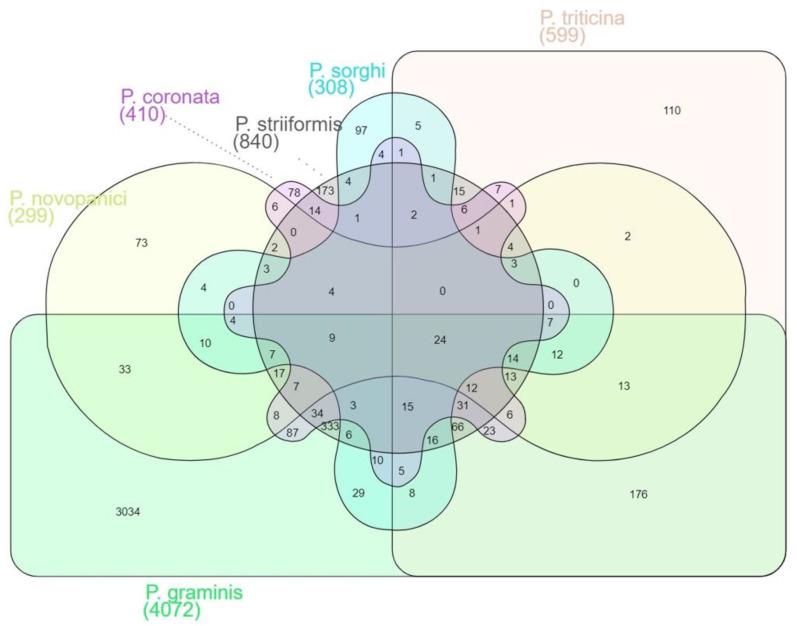
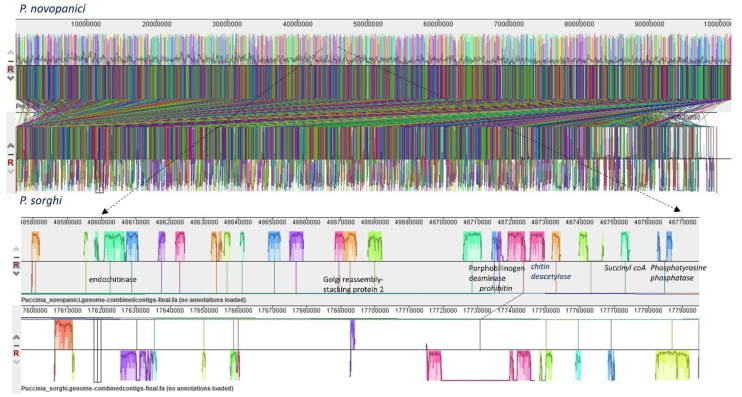
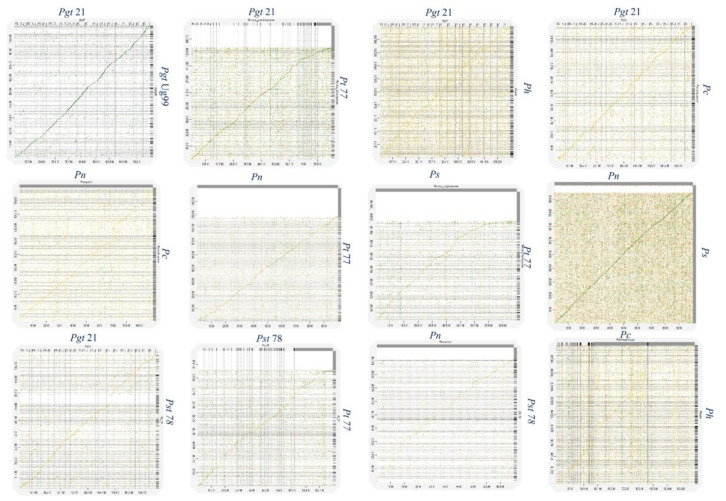
Switchgrass rust caused by () has the ability to significantly affect the biomass yield of switchgrass, an important biofuel crop in the United States. A comparative genome analysis of with rust pathogen genomes infecting monocot cereal crops wheat, barley, oats, maize and sorghum revealed the presence of larger structural variations contributing to their genome sizes. A comparative alignment of the rust pathogen genomes resulted in the identification of collinear and syntenic relationships between and ; 21-0 ( 21) and Ug99 ( Ug99) and between 21 and (). Repeat element analysis indicated a strong presence of retro elements among different genomes, contributing to the genome size variation between ~1 and 3%. A comparative look at the enriched protein families of spp. revealed a predominant role of restriction of telomere capping proteins (RTC), disulfide isomerases, polysaccharide deacetylases, glycoside hydrolases, superoxide dismutases and multi-copper oxidases (MCOs). All the proteomes of spp. share in common a repertoire of 75 secretory and 24 effector proteins, including glycoside hydrolases cellobiohydrolases, peptidyl-propyl isomerases, polysaccharide deacetylases and protein disulfide-isomerases, that remain central to their pathogenicity. Comparison of the predicted effector proteins from spp. genomes to the validated proteins from the Pathogen-Host Interactions database (PHI-base) resulted in the identification of validated effector proteins PgtSR1 (PGTG_09586) from and Mlp124478 from across all the rust pathogen genomes.
由()引起的柳枝稷锈病能够显著影响柳枝稷的生物量产量,柳枝稷是美国一种重要的生物燃料作物。对感染单子叶谷类作物小麦、大麦、燕麦、玉米和高粱的锈病病原体基因组与()进行比较基因组分析,发现存在较大的结构变异,这导致了它们基因组大小的差异。锈病病原体基因组的比较比对结果显示,()与;21 - 0(21)和Ug99(Ug99)以及21与()之间存在共线和同线性关系。重复元件分析表明,在不同的()基因组中强烈存在反转录元件,这导致基因组大小差异在1%至3%之间。对()属丰富蛋白质家族的比较研究表明,端粒封端蛋白(RTC)、二硫键异构酶、多糖脱乙酰酶、糖苷水解酶、超氧化物歧化酶和多铜氧化酶(MCOs)发挥着主要作用。所有()属的蛋白质组共有75种分泌蛋白和24种效应蛋白,包括糖苷水解酶、纤维二糖水解酶、肽基 - 脯氨酰异构酶、多糖脱乙酰酶和蛋白质二硫键异构酶,这些蛋白对于它们的致病性至关重要。将()属基因组预测的效应蛋白与病原体 - 宿主相互作用数据库(PHI - base)中经过验证的蛋白进行比较,结果在所有锈病病原体基因组中鉴定出了来自()的经过验证的效应蛋白PgtSR1(PGTG_09586)和来自()的Mlp124478。